Most older Americans say they’d take a vaccine to prevent dementia
A vaccine to reduce the risk of dementia? Older Americans are all for it.
- Nearly three-quarters of Americans 50 and older say they would probably or definitely take a vaccine that substantially reduced their risk of dementia.
- No dementia-prevention vaccine is currently approved, but several candidates are being studied — while intriguing evidence suggests existing shingles vaccines may already reduce dementia risk.
- The new survey found notably greater hesitation among women and Black adults, suggesting acceptance may depend heavily on how future vaccines are explained and offered.
If scientists eventually develop a vaccine capable of preventing dementia, they may not have much trouble finding people willing to take it.
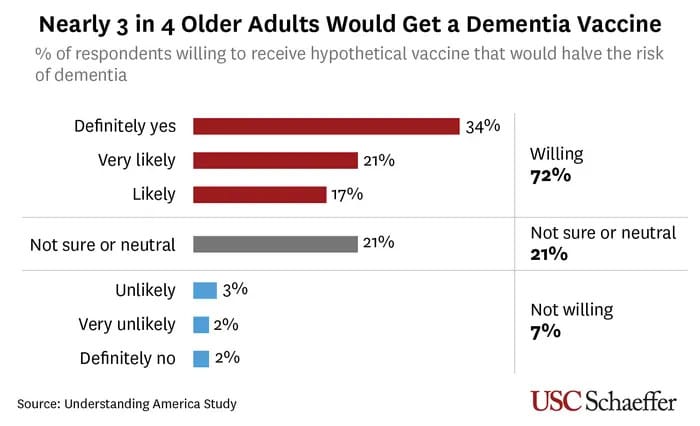
A new nationally representative survey found that 72% of Americans age 50 and older said they would be likely to receive a low-cost, multidose vaccine that reduced their dementia risk by half if they were at high risk of developing the condition.
Only 7% said they probably or definitely would not take it. Another 21% were unsure, according to.a research report in JAMA Network Open.
The findings, published Sept. 21, are significant because researchers are increasingly looking beyond drugs that treat Alzheimer's disease after symptoms appear and toward ways of delaying or preventing dementia before it develops.
There is an important catch: the vaccine described to survey participants does not yet exist.
Researchers presented participants with a hypothetical vaccine that would cut dementia risk by 50%, cost relatively little and require multiple doses. The scenario was modeled on experimental vaccine approaches now being investigated.
Still, the results suggest demand could be considerable if such a treatment eventually proves safe and effective.
“Older adults are highly interested in receiving a preventive dementia vaccine, while relatively few are opposed,” said lead author J. Felipe Montano-Campos, a postdoctoral researcher at the USC Schaeffer Center for Health Policy & Economics, according to EurekAlert!.
Interest grows with age
The USC researchers surveyed 1,529 adults age 50 and older through the Understanding America Study, a probability-based internet panel designed to represent the U.S. population.
Interest generally increased as people grew older.
Among respondents in their 50s, 31.1% said they would “definitely” take the vaccine. That increased to 35.1% among respondents 70 and older. After adjusting for demographic and economic differences, people 70 and older were significantly more receptive than those ages 50 to 59.
People who had a relative or someone close to them with dementia were also more willing to be vaccinated, as were respondents with higher incomes and college degrees.
Those results may not be surprising. Dementia becomes increasingly common with age, and many older adults have firsthand experience caring for a spouse, parent or friend who developed Alzheimer's disease or another form of dementia.
 James R. Hood
Women were more hesitant
One of the more intriguing findings involved sex differences.
Women were less willing than men to receive the hypothetical vaccine. About 23% of women were hesitant compared with 18.5% of men, while 29.1% of women said they would definitely get the vaccine compared with 38.5% of men.
That is noteworthy because some of the strongest existing evidence linking vaccination with reduced dementia risk suggests women may receive an especially large benefit.
A major 2025 study published in Nature took advantage of an unusual shingles-vaccine rollout in Wales that effectively created a natural experiment. Researchers found that receiving the older Zostavax shingles vaccine was associated with about a 20% reduction in new dementia diagnoses over seven years, with a stronger apparent protective effect among women.
Separately, research involving the newer Shingrix vaccine has also found an association with reduced dementia risk, again with a stronger effect among women in at least one large analysis, Nature reported.
Those studies do not establish that Shingrix should be regarded as a dementia vaccine, and dementia prevention is not an approved indication for it. But they have strengthened scientific interest in the possibility that vaccination, immune stimulation or prevention of certain infections may influence dementia risk.
Racial differences also emerged
The USC study also found differences among racial and ethnic groups.
About 26% of Black respondents were hesitant, the highest level among the groups studied. Only 19.4% said they would definitely receive the vaccine, compared with 35.8% of White respondents.
Hispanic respondents did not differ significantly from White respondents after researchers adjusted for other factors.
The authors said the findings suggest that if dementia vaccines eventually become available, public-health officials may need to pay particular attention to communication, trust and access.
That could be especially important because the survey indicates that outright rejection is relatively uncommon. The much larger group consists of people who are simply undecided.
Researchers described that uncertainty, rather than opposition, as potentially the biggest obstacle to adoption.
Why vaccines might affect dementia
Dementia itself is not an infectious disease, and there is no known contagious “dementia virus.”
But researchers are exploring several ways in which vaccination might influence the development of Alzheimer's disease and other dementias.
One possibility is that preventing infections — particularly reactivation of the varicella-zoster virus that causes shingles — reduces inflammation or neurological damage that may contribute to dementia.
Another possibility is that certain vaccines stimulate the immune system in ways that have beneficial effects beyond protection against the disease they were designed to prevent.
A 2025 study involving more than 436,000 people, for example, found that both shingles and RSV vaccines using the same AS01 immune-system stimulant were associated with a lower short-term risk of dementia, raising the possibility that the vaccine's immune response itself could play a role, a report in Nature said.
Meanwhile, other researchers are attempting to develop vaccines that attack Alzheimer's disease more directly — including vaccines intended to trigger immune responses against abnormal proteins involved in the disease.
Those approaches remain experimental.
What consumers should know
For now, consumers should not read the USC study as evidence that a dementia vaccine is about to arrive at the neighborhood pharmacy.
The researchers were measuring attitudes toward a hypothetical future vaccine, not testing whether one works.
They also cautioned that what people say they would do in a survey does not necessarily predict what they would do when confronted with a real vaccine, with real side effects, costs and uncertainties.
But the study points to an interesting shift in the dementia battle.
For decades, Alzheimer's research has largely focused on trying to slow the disease after memory loss and other symptoms have already appeared. Increasingly, researchers are asking whether intervention years earlier — through lifestyle changes, medications, control of cardiovascular risks or possibly vaccination — might keep dementia from developing in the first place.
And if an effective vaccine emerges, this survey suggests a large portion of the population most at risk may be ready to consider it.