


A massive legal fight over U.S. tariffs could soon unleash one of the largest government refund programs in modern history — potentially returning more than $170 billion to companies that imported goods into the United States.
But a growing question is emerging: Should consumers get any of that money back?
Costco has become the focal point of that debate after its chief executive suggested the company would pass tariff refunds along to customers — not through checks, but through lower prices.
The issue touches on a deeper economic question about tariffs that economists have debated for years: Who really pays them?
A Supreme Court ruling triggered the refunds
The controversy stems from a recent Supreme Court decision striking down certain tariffs imposed under the International Emergency Economic Powers Act (IEEPA).
Those tariffs, imposed during a trade crackdown, applied to a wide range of imported goods, from electronics and furniture to apparel and household products. Because the court ruled the tariffs were unlawful, the federal government must now refund the money collected from importers.
Analysts estimate the refunds could total $166 billion to $182 billion, making it one of the largest reimbursement efforts ever handled by U.S. Customs and Border Protection.
The agency is currently building a system to process the claims, and importers may soon begin filing requests for repayment. Thousands of companies are expected to seek refunds.
Why consumers are paying attention
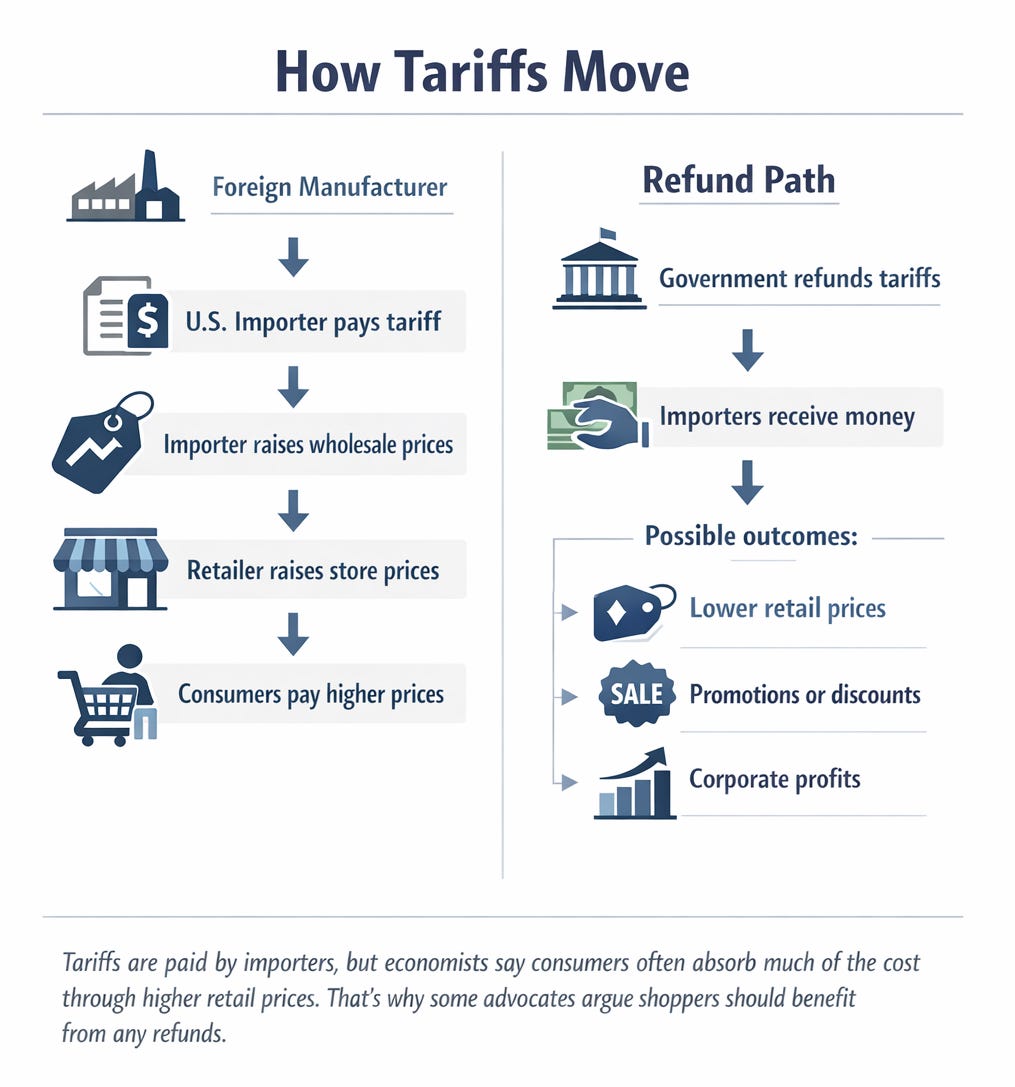
Tariffs are technically paid by importers when goods enter the United States. But economists widely agree that companies often pass much of the cost along to consumers through higher prices.
That means the tariffs likely raised the cost of many everyday goods over the past year — even though shoppers rarely saw the charges directly.
Now that refunds are coming, some consumers argue they deserve a share.
A Costco shopper recently filed a class-action lawsuit arguing that if the retailer receives tariff refunds, it should pass the money back to customers who ultimately paid the higher prices.
The lawsuit reflects a broader frustration about hidden costs in the economy. Tariffs often function like a stealth tax, raising prices without appearing as a line item on a receipt.
Costco’s response: lower prices instead of checks
Costco CEO Ron Vachris recently addressed the issue during a call with analysts, saying that if the company receives tariff refunds, it would likely return the benefit to customers.
But that probably won’t mean refund checks. Instead, Costco indicated the money would likely be passed along through lower prices or other customer benefits.
That approach reflects how retailers typically deal with cost reductions — spreading the savings across products rather than tracking individual purchases.
Still, the comment has fueled debate about whether companies should do more.
Why direct refunds to consumers are unlikely
Economists say calculating individual consumer refunds would be extremely difficult.
Tariffs affect prices in complex ways:
Some companies pass the full cost to consumers.
Others absorb part of the cost to stay competitive.
Retailers may spread the price increase across multiple products.
By the time a product reaches a store shelf, it may have passed through several companies — importers, wholesalers, and retailers — each adjusting prices differently.
That makes it nearly impossible to determine exactly how much of a tariff was reflected in the price of a specific item.
Because of that complexity, experts say consumers are unlikely to receive direct payments. Instead, any benefit would likely appear gradually through lower prices, promotions, or expanded discounts.
A potential windfall for companies
For many businesses, the refunds could represent a major financial boost.
Companies across the economy paid tariffs over the past year, including shipping firms, retailers, manufacturers, and technology companies.
Some of the largest importers — including logistics companies and major retailers — are expected to file claims. For corporations that paid millions or even billions in tariffs, the refunds could significantly improve earnings.
Investors are already watching closely to see how companies use the money. Some may reduce prices to remain competitive. Others may keep the funds to offset past losses or invest in their businesses.
The irony: tariffs may still raise prices
The refund debate also highlights a strange twist in U.S. trade policy.
While courts are forcing the government to return money from old tariffs, policymakers are already pursuing new tariffs under different legal authorities.
That means consumers could simultaneously see:
refunds flowing to importers
and new tariffs pushing prices higher again.
Economists say that cycle underscores how tariffs affect the broader economy.
Although they are often framed as penalties on foreign countries, tariffs are typically paid by U.S. companies and ultimately shared by American consumers.
A hidden cost of everyday goods
For shoppers, tariffs can be difficult to notice because the price increases are often small and spread across many products.
But over time, those increases can add up.
Consumer advocates say the refund fight reveals something many households rarely see: how government trade policies quietly affect the cost of everyday life.
Whether any of the money eventually reaches shoppers directly remains uncertain. But the debate has already highlighted a key question in modern trade policy.
If consumers helped pay the tariffs through higher prices, should they also share in the refunds?
As billions of dollars begin flowing back through the economy, that question is likely to grow louder.
Why consumers probably won’t get tariff refunds
To be clear: even if companies receive billions of dollars in tariff refunds, most economists say consumers are unlikely to receive direct payments.
The main reason: it’s almost impossible to determine how much each shopper actually paid because of the tariffs.
Prices change constantly for many reasons, including:
supply chain costs
shipping expenses
exchange rates
retailer pricing strategies
A single product may also pass through several companies before reaching the store shelf, each adjusting prices differently.
That makes it extremely difficult to calculate how much of a tariff was ultimately reflected in the price a specific consumer paid.
Instead of refund checks, companies that receive tariff refunds are more likely to pass the benefit along indirectly through:
lower prices
temporary discounts
promotions
expanded membership perks
Retailers such as Costco have already suggested that price reductions would be the most practical way to return the money to customers.
Everyday products often affected by tariffs
Tariffs frequently target imported products that Americans buy every day. When tariffs are imposed, price increases can show up across a wide range of consumer goods.
Among the categories most often affected:
Electronics
Televisions, laptops, smartphones, gaming systems, and computer components are commonly imported and have frequently been subject to tariffs.
Home appliances
Dishwashers, refrigerators, microwaves, and washing machines have been part of several trade disputes.
Furniture and home goods
Imported furniture, lighting, mattresses, and décor items are often subject to tariffs.
Clothing and footwear
Apparel and shoes have long faced tariffs, which can significantly affect retail prices.
Tools and hardware
Power tools, hand tools, and building materials are often imported and can become more expensive when tariffs rise.
Because these products pass through multiple companies before reaching store shelves, tariff costs are often spread throughout the retail system rather than appearing as a separate charge.