


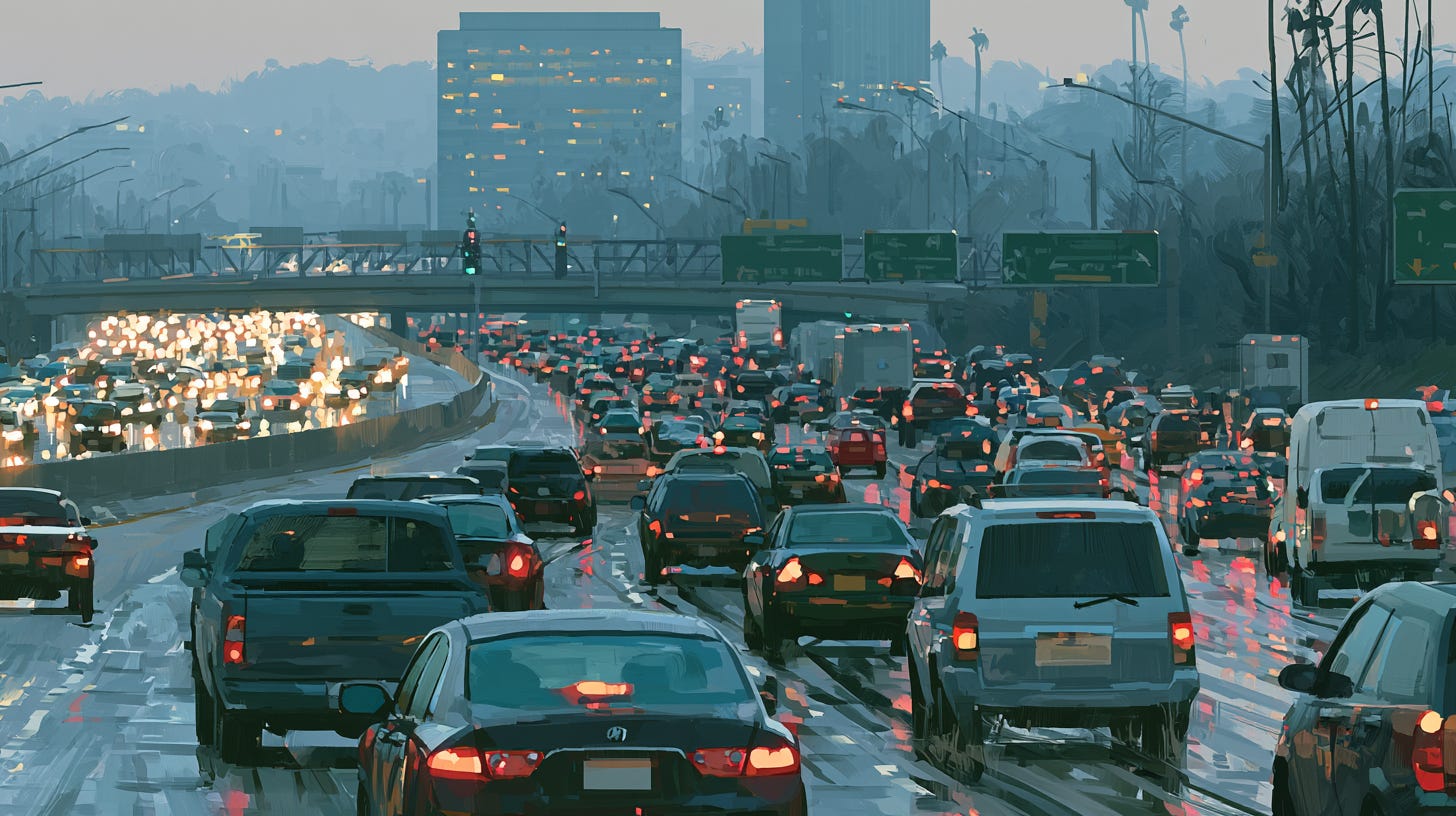
AAA expects a record 45.1 million Americans to travel between Thursday and Monday, breaking a holiday-weekend mark that had stood since 2005, NBC News reported. More than 38 million of them will drive — the most Memorial Day motorists AAA has ever counted.
About 3 million more will fly across nearly 54,000 scheduled flights, up about 2 percent from a year ago. The Transportation Security Administration projects it will screen more than 18 million passengers and crew members between Tuesday and Wednesday alone, The New York Times reported in its holiday travel forecast.
What the drivers are paying for is the part that has changed. The national average for regular gasoline opened the week at $4.56 a gallon, according to AAA figures cited by the Times — a year ago, the same gallon cost about $3.18. California drivers are paying $6.11 a gallon, Washington $5.71 and Hawaii $5.62, GasBuddy data in the Times piece show. Only Texas, at $3.92, is anywhere near pre-war territory.
Stultifying traffic predicted
The traffic forecast is brutal. INRIX expects Friday between 3 p.m. and 6 p.m. and Monday afternoon to bring more than double normal volumes on key corridors. The 70-mile drive from Boston to Hyannis, the Times noted, is forecast to run close to three hours instead of the usual 1 hour and 15 minutes.
The airlines, for their part, are bracing for a summer of their own: American Airlines expects a record 75 million passengers between May 21 and Sept. 8, United is planning for three million more customers than last summer, and Delta said it will fly its largest trans-Atlantic schedule ever, adding service to Malta and Sardinia.
Memorial Day began as “Decoration Day” after the Civil War to honor Union war dead, then gradually evolved into a national day of remembrance for all Americans who died in military service.pbs+2
What the holiday honors
Memorial Day grew out of local springtime customs in the late 1860s, when communities across the North and South decorated soldiers’ graves with flowers, flags, and wreaths.
One early and often-cited observance took place in Charleston, South Carolina, on May 1, 1865, when formerly enslaved people organized a ceremony and reburial to honor Union soldiers who had died in a prison camp there.
“Decoration Day” and 1868 national proclamation
On May 5, 1868, Gen. John A. Logan, leader of the Union veterans’ group Grand Army of the Republic, issued General Order No. 11 calling for a nationwide “Decoration Day” to decorate the graves of Civil War dead.
He set May 30, 1868, for the first large national observance, likely because flowers would be in bloom across the country.
By the late 1800s, most Northern states were observing Decoration Day annually, and by 1890 every Northern state had made it an official state holiday, while many Southern states held separate memorial days for Confederate dead.
From Civil War dead to all war dead
Originally, Decoration Day honored only those who died in the Civil War.facebook
After World War I, the observance broadened to commemorate Americans who died in all wars, including later conflicts such as World War II, Korea, Vietnam, and more recent wars.
Over time, “Decoration Day” gradually came to be known as “Memorial Day,” a name that appears with increasing frequency in the early 20th century and was widely used after World War II.
For about a century the date remained May 30, but in 1968 Congress passed the Uniform Monday Holiday Act, moving Memorial Day to the last Monday in May to create a three-day weekend; the change took effect in 1971.