


The big artificial intelligence companies are always looking for promises they can make about how AI will solve thorny problems, improve the economy and make life better for everybody.
Sometimes they may strain a little too hard coming up with possibilities. Take medical care and insurance. Americans are already more than skeptical about the decisions made by insurance companies but they’re not convinced AI would be any better and fear it might be worse.
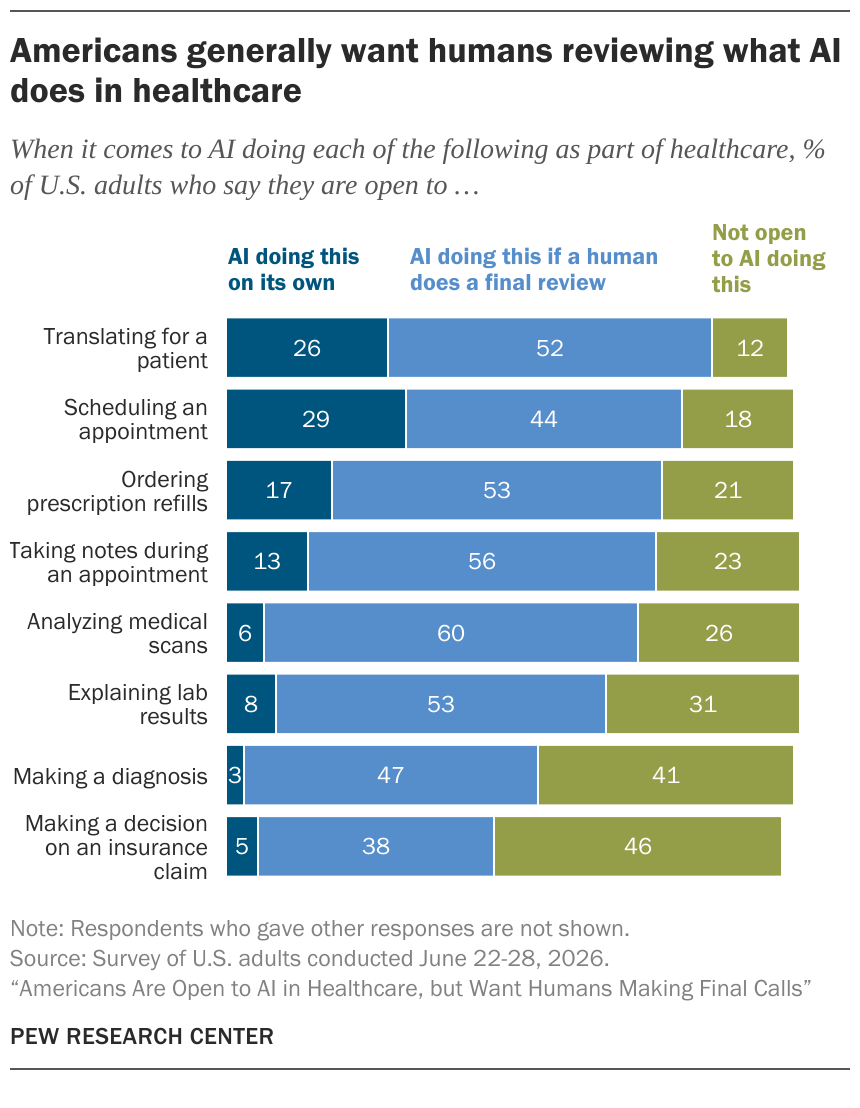
Rote tasks like translating and keeping records are one thing, but a recent Pew Research Center report finds that 60% of the 3,488 US adults Pew surveyed said they were uncomfortable with AI helping their doctor make a diagnosis or treatment plans.
That’s not very good. Even worse is the reaction to AI making insurance claim decisions without human review — only five percent think that’s a good idea.
Humans want humans making decisions
“They generally don’t want AI operating solo,” Eileen Yam, the director of science and society research at Pew Research Center and lead author of the report, said in a Bloomberg interview. “They want a human in the loop doing final reviews.”
Doctors are another matter. Consumers display greater trust in their physicians and say they trust them to use AI in their patients’ best interest. Given a choice, they would rather have doctors making decisions about patient care, rather than insurance companies, governments, tech firms, hospital administrators or AI.
More than half worry about privacy
More than half of respondents also said that they see AI posing a risk to their personal health information. There are already numerous cases of internet sites and online pharmacies, among others, selling patient information to marketing interests.
If tech companies really want to persuade consumers that AI actually contributes to improving their healthcare rather than just making money from it.
“For ordinary Americans navigating a world where AI is increasingly part of healthcare, we see in our data that their views on AI in healthcare are not a binary ‘thumbs up’ versus ‘thumbs down,’” Yam said. “Americans just want to be informed when AI is being used in their care.”