


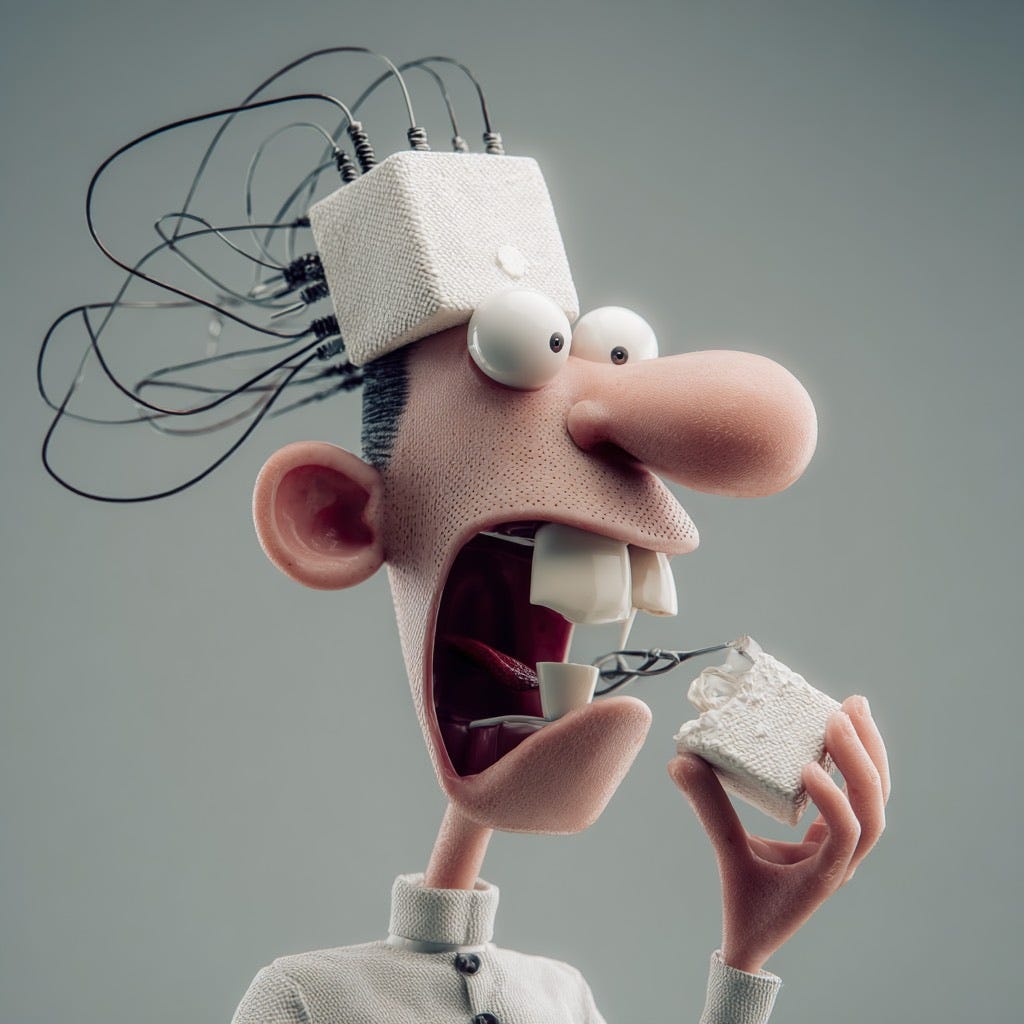
Many years ago, the Outraged Consumer found himself in one of those D.C. think tanks that lend a hand to corporate interests trying to move some MBA’s brainstorm from hallucination to reality. We were working with one of the big packaged goods companies which had developed a number of substances that might, if properly presented, be passed off as food.
The problem big food companies wrestle with, of course, is the trouble and expense of producing, packaging and transporting vast quantities of real stuff. Sometimes the stuff rots, sometimes it gets dried out and sometimes it gets infected with various dread diseases. This cuts into profits and annoys the corporate higher-ups, who have more important things – you know, quarterly earnings – to worry about.
To help grease the skids, we were developing a prototype academic journal – working title Future Foods – that would give food scientists a place to present their harebrained schemes to an audience of fellow fake food scientists and technocrats. We had early proposals for fake fruit (to be used in cereal and yogurt), fake eggs (made from left-over chicken parts) and, perhaps most promising, fake meat.
The problem with meat is that it comes from animals, which tend to be large, messy creatures that spend most of their time eating and trying to impregnate others of their species. They are loud and smelly and often get sick, molt or attack their counterparts. Very messy. Also, those dread health nuts and medical researchers are always going on about the wellness risks entailed in eating the remains of these poor creatures.
Sort of simple, really
The obvious answer is to make something that sort of looks, tastes and feels like meat. You start with some grease, add a bit of vegetable protein, then some gummy stuff to toughen it up a bit and the usual blends of tasty flavonoids. While seemingly a fairly simple undertaking, things did not always go smoothly in the early attempts. Finicky human taste-testers retched and groaned at the early samples.
Trying to get things sliding along, one company had come up with a rather slimy substance that was basically fake fat. It could be added to potato chips, frozen French fries and other comestibles to take the place of real fat, which tastes great but gums up consumers’ arteries. The new stuff was given a name, which out of respect for the dead (and fear of corporate attorneys) we will not mention here, and it was heavily promoted as a new health food. The introductory roll-out was mostly potato chips, muffins and other snacks.
The results were promising. The stuff didn’t taste too bad and felt sufficiently slippery and contributed next to no cholesterol to consumers’ circulatory systems. In fact, the only known side effects were nausea, vomiting and diarrhea. No one thought this was a problem, since those little annoyances are common enough that no one thinks much about them, the corporate geniuses argued.
Potato chip diarrhea
Wrong. When the first news reports about potato chip diarrhea leaked, the entire affair hit the fan and most of those associated with it were soon working on their resumes. Our little group? We were no longer developing Future Foods Journal and no longer had a big fat food client.
However, this was in the 1980s or so and, as luck would have it, an irritable D.C. judge had just ordered the break-up of AT&T for antitrust violations, throwing open to madcap development the gargantuan market for high-tech communication devices.
The Outraged Consumer will recount this era more fully in a later edition. For now, let’s just say that one thing leads to another and the wide-open telecom environment soon grew to encompass the personal computer and, what else, the internet.
Computing power and data transmission exploded and soon the types of geniuses who had previously been sold on fake meat were drooling over the notion of wiring people’s brains to boost their IQs and, not coincidentally, shoot commercial messages directly into their subconscious.
This will just take a minute
The first step in this grand procession is to get everyone in place, comfortably seated and waiting for the insertion of the chip that will get things moving along as desired. Just as fake foods were going to liberate (or, sometimes, evacuate) our intestinal tracts, so artificial intelligence will liberate our brains and maybe even our minds, freeing us to think in ways we had never imagined, and eventually not to think at all, as – just like a self-driving Muskmobile -- our minds will receive the knowledge we have long sought from soothsayers, oracles and other founts of wisdom, all from the comfort of our cubicles or cells.
In time, it will be possible to resurrect the Future Foods movement, when wired and wi-fi’d brains are freed to see the advantages of eating food made from plastic and to ignore or discount the importance of any minor alimentary disturbances.
There are those who seek to hold back the future, as in the case of Texas Governor Greg Abbott who recently signed a bill outlawing artificial meat, basically branding it as devil’s food sent to Earth to irritate Texas cattlemen, who I believe now prefer to be called protein producers, though I may be mistaken in this presumption. There is, perhaps, some crossover between Texas’ retrograde rules on abortions and the like and the notion that tampering with the fate of cattle, hogs and so forth is somehow anathema before God.
It is anticipated that these retrograde notions will pass away once artificial intelligence is widely wired into the citizenry, allowing full singularity to finally reunite fake food with artificial intelligence, at which time both can become known as simply “newtrition” and “noledge,” laying to rest the pejorative old terms that have for so long hampered the adoption of true fakery in our lives.