



National Consumer Law Center and more than two dozen consumer and public-interest organizations are accusing Bank of America of quietly reviving a controversial legal tactic that critics say strips customers of their right to take the bank to court.
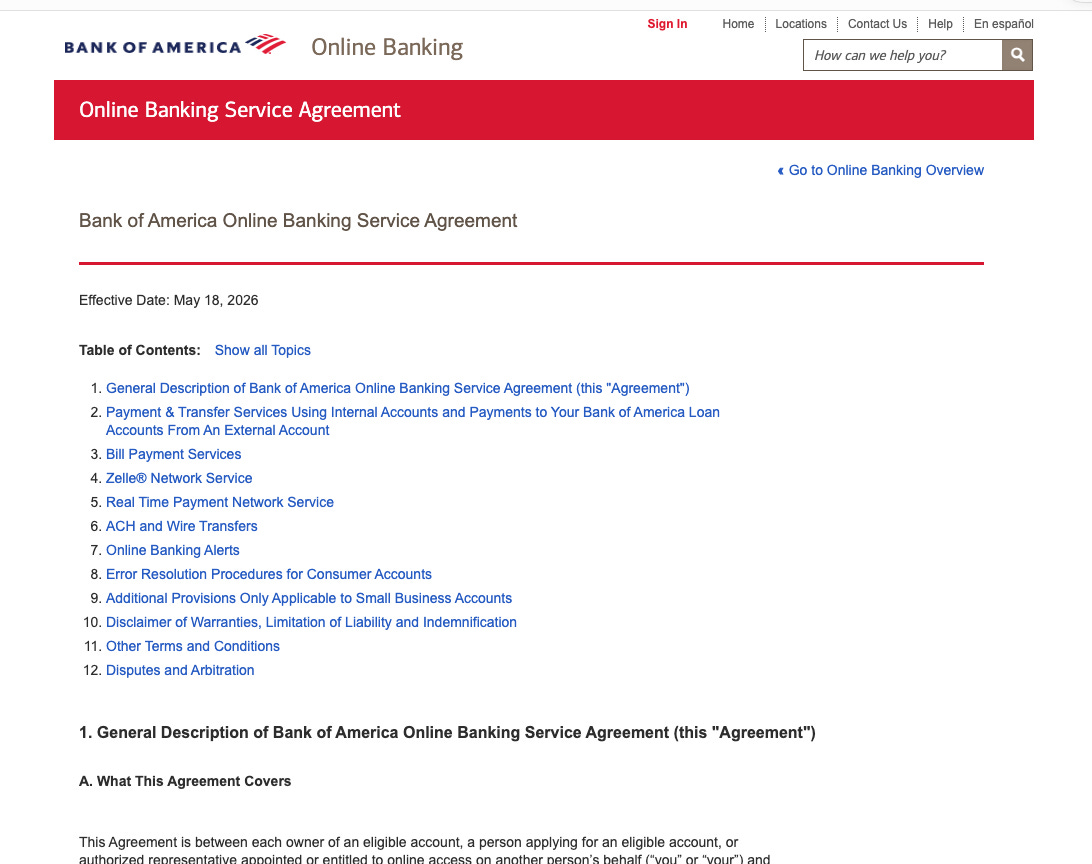
In a sharply worded statement released this week, the groups condemned the banking giant’s decision to add a forced arbitration clause to its Online Banking Service Agreement, requiring many customer disputes to be resolved in private arbitration rather than through lawsuits in public court.
Consumer advocates argue the provision could make it far harder for customers to challenge improper fees, account freezes, billing disputes or other alleged misconduct — especially in cases involving relatively small amounts of money.
“Forced arbitration blocks customers’ access to the court system and eliminates their right to a jury trial,” the National Consumer Law Center said in its release.
The change also bars most class-action lawsuits, preventing consumers from joining together in large cases involving systemic practices that may affect millions of people, according to the advocacy groups.
A return to an old fight
The controversy revives a long-running national debate over mandatory arbitration clauses buried in consumer contracts.
Bank of America had largely abandoned forced arbitration in consumer agreements in 2009 amid mounting criticism and litigation involving the banking industry. At the time, major banks faced accusations that they had coordinated the use of arbitration clauses to shield themselves from consumer lawsuits.
Now, nearly 17 years later, advocates say the bank is reversing course.
Under the new policy, customers reportedly have just 60 days after receiving notice to opt out of arbitration. Consumer groups warn many customers may never notice the change because it is embedded in lengthy digital account agreements and online disclosures.
The groups are urging customers to immediately reject the clause through an online opt-out process or by phone.
Why arbitration matters to consumers
Arbitration is a private dispute-resolution system in which claims are decided by an arbitrator rather than a judge or jury. Businesses frequently argue arbitration is faster and less expensive than traditional litigation.
But critics say the process overwhelmingly favors corporations.
Consumer advocates point to what they call the “repeat player” problem: large companies regularly appear before arbitration firms, while consumers usually participate only once. They also argue arbitration proceedings are often confidential, reducing public scrutiny of corporate practices.
For consumers with small-dollar disputes — such as overdraft fees or questionable charges — class actions may be the only economically realistic way to seek relief, critics say.
“Customers rarely pursue individual arbitration over small claims,” said one advocacy analysis cited by the coalition.
The issue has become especially contentious in recent years as arbitration clauses spread across banking, credit cards, cell phone contracts, employment agreements and online services.
Political and regulatory backdrop
The dispute also comes during a period of heightened concern about consumer financial protections.
The advocacy coalition argued that consumers are facing increasing economic pressure from inflation, debt burdens and higher banking costs while federal regulators have scaled back some aggressive enforcement efforts seen in earlier years.
The groups are backing the proposed FAIR Act — legislation sponsored by Sen. Richard Blumenthal and Rep. Hank Johnson — which would sharply restrict the use of forced arbitration clauses in consumer, employment and civil-rights disputes. (NCLC)
Business groups, however, have long defended arbitration as an efficient alternative to lengthy court battles and say class-action litigation often benefits lawyers more than consumers.
The U.S. Supreme Court has repeatedly upheld mandatory arbitration clauses over the past two decades, helping fuel their widespread use in consumer contracts.
What Bank of America customers can do
Consumer advocates say customers who want to preserve their right to sue in court should carefully review notices from the bank and act quickly if they wish to opt out.
The coalition also encouraged consumers unhappy with the new policy to consider switching to banks or credit unions that do not require mandatory arbitration.
Data Box: Forced arbitration by the numbers
Millions of U.S. consumers are covered by arbitration clauses in banking and credit-card agreements
Bank of America customers reportedly have 60 days to opt out of the new clause
The bank had not broadly used forced arbitration in consumer contracts for roughly 17 years
Arbitration clauses commonly prohibit class-action lawsuits
Critics say many consumers never realize they agreed to arbitration until after a dispute arises
Consumer Watch: Why this matters
If a bank customer is hit with a disputed fee, account closure or alleged improper practice, the new agreement could prevent them from filing a lawsuit in court or joining a larger consumer case.
Instead, disputes would generally be handled privately through arbitration — a process critics say is less transparent and less favorable to consumers than public court proceedings.