


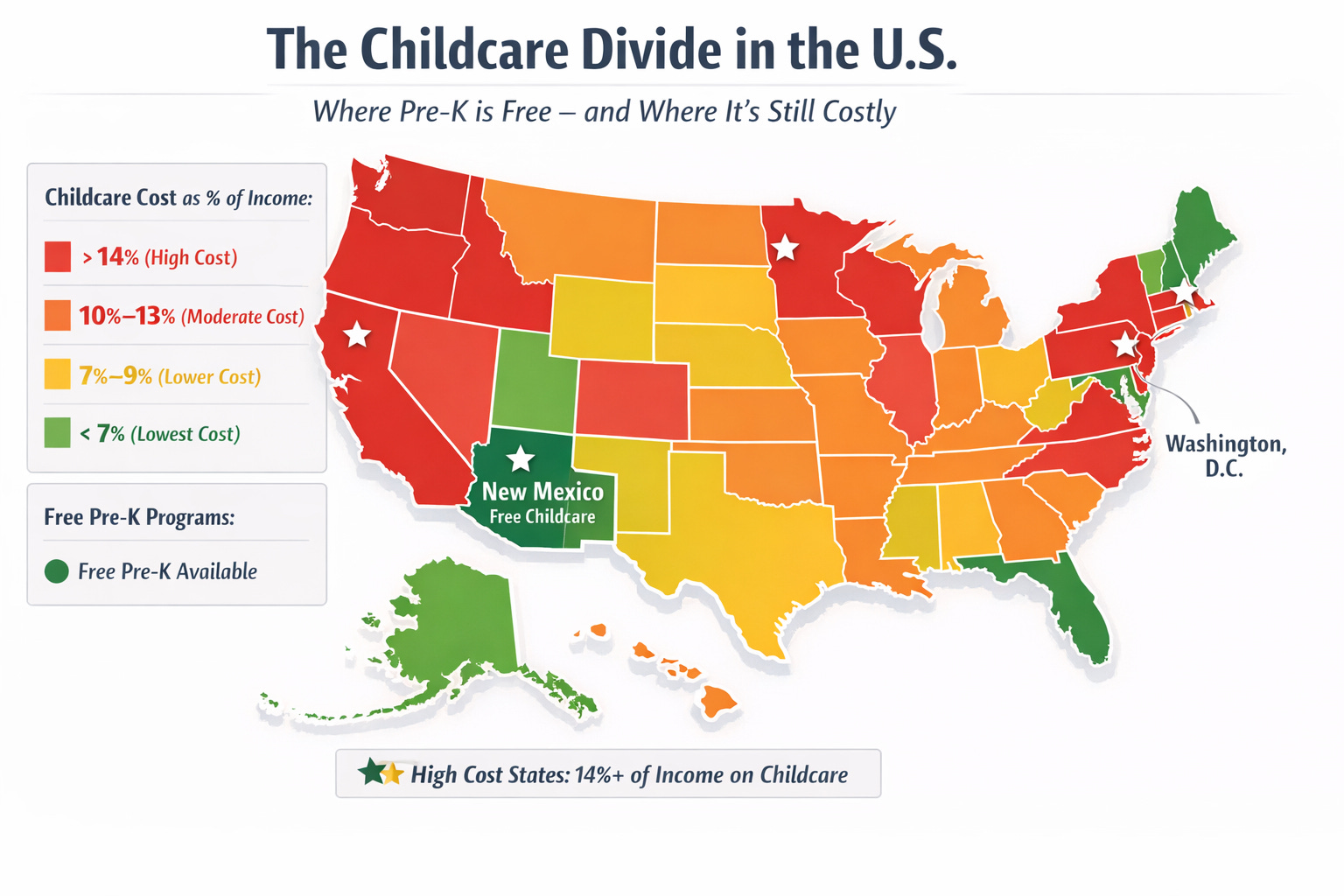
A fact that’s little noticed is that child care costs in the U.S. vary wildly from one area to another. Taxpayers living in Vermont are paying 16-17% of family income while those in, say, South Dakota are paying around 7%.
This disparity is part of what makes the issue so politically difficult. While everyone pays lip service to supporting children and families, the need is greater in the more urban, more expensive areas that tend to be Democratic, less urgent and more often condemned in rural Republican areas.
Vice President JD Vance has called child care programs “a subsidy for the affluent and a class war against normal people” and has said that “grandma and grandpa should help a little more.”
While free or nearly-free child care for all all ages is extremely rare in the United States, pre-Kindergarten care is seen as especially critical, since children at that age need constant hands-on care as well as emotional and intellectual development, childcare experts say.
What’s most striking about the cost of pre-K child care in the U.S. is how uneven it is. A family in Vermont or California may spent twice the share of income as a family in South Dakota. That’s why free pre-K is spreading fastest in high-cost states and cities.
As a result, the U.S. is quietly splitting into two systems:
High-cost states → expanding free pre-K
Lower-cost states → still mostly private pay
Where are the Democrats?
U.S. Senator Elizabeth Warren (D-Mass.) and New York City Mayor Zohran Mamdani are trying to deal with that. They’re kicking off a campaign calling for the Democratic party to commit to making universal child care a central part of its platform.
In an op-ed in USA Today, the pair argued that investments in child care would have enormous economic benefits, with an estimated return of $13 for every dollar spent on early childhood care.
“[I]t will be felt when our economy is energized by parents who can stay in their jobs, by businesses that can attract and retain top talent who might otherwise be priced out of this city, and by an increase in economic activity to the tune of tens of billions of dollars,” Warren and Mamdani wrote.
Cities tend to be ahead of the states, partly because the need is greater there and because they can target money more effectively. Boston, Chicago and San Antonio, for example, have large universal pre-K systems, according to EarlyEdgeCalifornia.
The biggest recent developments include New Mexico, which became the first state to offer free child care broadly (not just pre-K) in 2025. San Francisco is moving toward free child care for many middle-class families (up to ~$230k income). This is notable because it targets middle-income families, not just low-income.
Reality check - no free lunch
It’s worth noting that even in states and cities with “free” child care, seats are often limited, programs are only a few hours and “wraparound” care is still expensive.
In their op-ed, Warren and Mamdani highlighted that the push for universal child care is already underway in New Mexico and Quebec, Canada, with the latter program resulting in a 13 percent increase in women’s participation in the workforce.
“The case for universal child care is overwhelming. It’s the kind of investment Wall Street would tout,” they wrote.
They also called for paying child care workers a living wage.
“By committing to build child care infrastructure, we also have an opportunity to invest in child care workers and to ensure that they are paid commensurate with their training and experience…We invest in firefighters and road maintenance crews by paying a living wage; we should make the same investments in people who care for our babies,” Warren and Mamdani wrote.
“We should not have to dust off history books to find examples of the Democratic Party leading with courage and ambition. With universal child care, we can transform our economy, transform the lives of parents and children, and transform how Americans see government. We’re in the fight to get it done,” they concluded.