

Time has been running backward in the world of consumer protection the last few years but New York City Mayor Zohran Mamdani is trying to restart at least one basic protection — a “Click to Cancel” rule that would make it easier for consumers to escape from subscription renewal traps and other shady practices.
“Subscription traps are just another way that big corporations extract hard-earned money from working people. In our city, we’re drawing a clear line: if you can sign up with a click, you must be able to cancel with one, said Mamdani.
“If it’s easy to sign up for something, it should be just as easy to cancel,” said Department of Consumer and Worker Protection (DCWP) Commissioner Samuel A.A. Levine. “This proposed rule sends a warning to gyms, apps and other businesses citywide that our agency will not tolerate tricks and traps that rip off New Yorkers.”
The proposed rule would give DCWP citywide enforcement authority to ensure consumers can easily cancel subscriptions. Businesses that violate the rule would be liable for restitution to harmed consumers and civil penalties, with fines starting at $525. California, New York State and other states have similar rules.
The NYC rule would require clear disclosures and affirm consumers’ rights when purchasing, enrolling in or canceling subscriptions for services or goods. It applies to any subscription that qualifies as an automatic renewal or continuous service offer.
Too often, bad actors force consumers through confusing, time-consuming hurdles to cancel unwanted services — from “free trials” that quietly convert into costly charges to cancellation processes buried in endless steps or unclear instructions. This rule targets those practices directly, requiring straightforward, transparent cancellation mechanisms, Levine said.
New Yorkers can submit comments for 30 days after the rule was published on April 8. After the comment period, DCWP will review feedback before finalizing the rule.
Congress renewing the fight
There’s also an attempt in Congress to resurrect federal protections against subscription abuses. A California congressman has introduced a measure that would revive the overwhelmingly popular Federal Trade Commission rule that was struck down by the courts before it had a chance to go into effect.
As we reported last July, the measure was modest enough. It basically provided that it should be as easy for consumers to cancel a subscription as it was to sign up. But even such a simple and straightforward measure sent corporate hearts aflutter and armies of lobbyists, lawyers and influence peddlers declared war.
As expected, lawsuits were filed, claiming not that the rule wasn’t needed, wouldn’t work or was otherwise defective. No, as is usual in such skirmishes, the arguments were strictly procedural -- claiming that the Biden-era FTC hadn’t crossed all the t’s, etc.
It didn’t take long for a three-judge panel from the U.S. Court of Appeals for the Eighth Circuit agreed to find in mid-July that the “Commission’s rule-making process was procedurally insufficient and Petitioners demonstrated prejudicial error.”
In response to the nationwide chorus of groans from consumers getting unwanted monthly jelly shipments, exciting email newsletters and anti-virus programs for computers long since put out of their misery, Rep. Brad Sherman (D-Calif.) introduced the Click-to-Cancel Act of 2025.
“This legislation would ensure that auto-renew subscription services are transparent, easy to cancel, and required to gain explicit consent from the consumer before they are charged for services,” Sherman said.
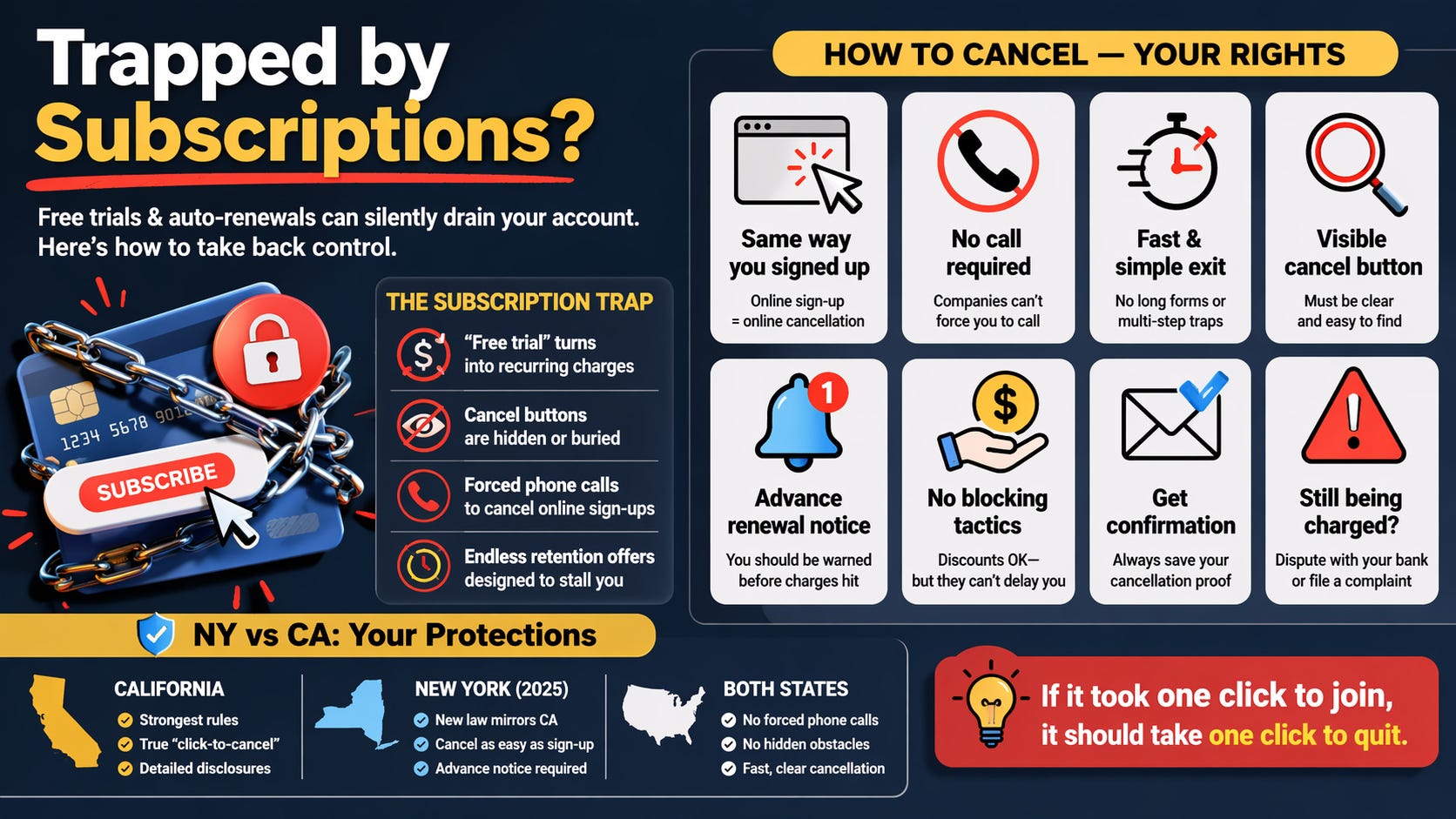
Click-to-cancel: consumer checklist (NY & CA)
Use this anytime you’re trying to cancel a subscription, membership, or free trial.
1. Match how you signed up
If you signed up online → you should be able to cancel online
If by phone → cancel by phone
👉 Laws in both states require cancellation to be as easy as enrollment
2. Look for a clear “cancel” button
Should be easy to find in your account settings
In California, companies must provide a true “click-to-cancel” option for online subscriptions
3. Cancellation must be immediate
No long forms, hidden pages, or delays
Companies cannot obstruct or delay cancellation requests
4. You shouldn’t be forced into a call
If you signed up online, they can’t require you to call
They must offer an easy method like online, email, or phone Watch for renewal notices
5. Watch for renewal notices
You should get advance warning before charges hit
Notices must include how to cancel
6. Ignore pressure tactics
Companies can offer discounts to keep you—but
They can’t block or slow your cancellation
7. Confirm it’s canceled
Look for:
Confirmation email
No future billing date
If charges continue, you may have grounds for a dispute
8. Escalate if needed
File a complaint with:
New York Attorney General
California Attorney General
These laws are actively enforced at the state level
Bottom line
California = stricter, more explicit (“click-to-cancel” button required)
New York = catching up fast with similar protections
In both states, the key rule is simple:
👉 If it took one click to join, it should take one click to quit.