


There’s been a lot of talk by political partisans lately about the declining birth rate in the U.S. and exhortations to young women to get married, stay home and have children — commonly called the “tradwife” appeal. That’s easy to say but it’s very expensive — in both time and money — to take on the responsibilities of parenthood.
In fact, four in five parents say it costs too much to have a baby, according to the University of Michigan Health C.S. Mott Children’s Hospital National Poll on Children’s Health.
Parents of children ages three and younger are especially stretched, with two in five describing their family’s financial situation as “struggling” or “just getting by.”
Some of the biggest costs are tied to keeping children safe and healthy, including car seats, enough diapers, nutritious food and quality childcare.
“Parents understand how important the first years of life are for a child’s health and development, but knowing what a child needs and being able to afford it are two different things,” said Mott Poll Co-Director Sarah Clark, M.P.H.
“These findings point to a difficult balancing act for families during a critical period of child development, when parents feel they’re choosing between meeting their child’s basic needs and covering the rest of their household expenses.”
Parents say they need relief - like paid leave
The poll surveyed a national sample of parents with children ages 0 to 18 in July about the financial demands of raising young children.
Nearly all parents surveyed agree that early development is important to long-term health. Yet families often have to stretch their budgets, work extra hours, cut spending and rely on secondhand items to manage the costs.
Many parents support programs designed to ease these financial pressures.
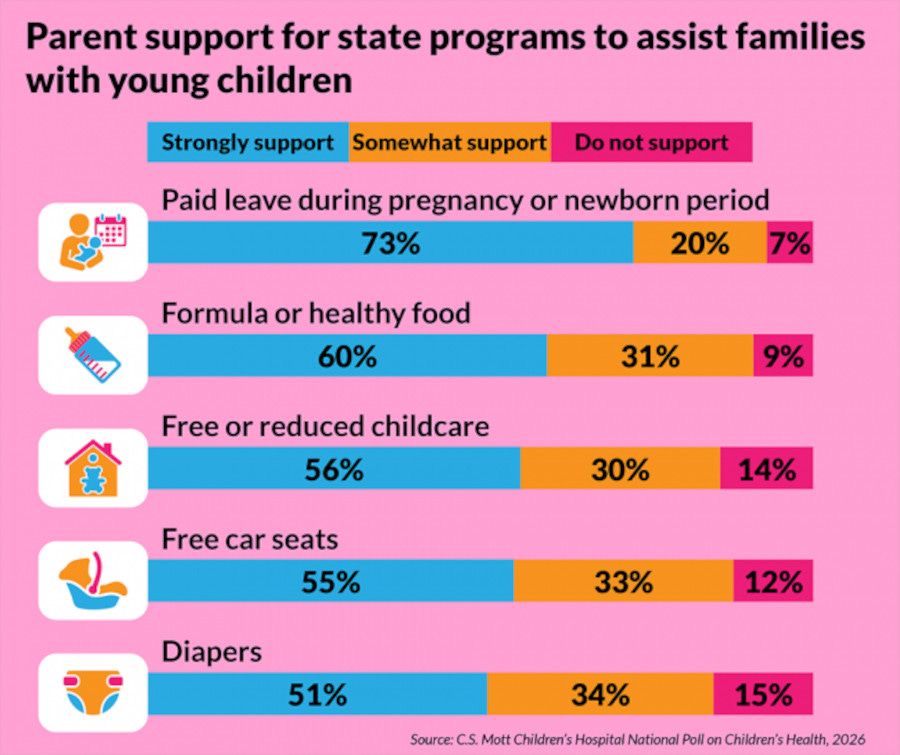
Paid leave during pregnancy or the newborn period received the greatest support, with nearly three in four parents saying they would strongly support such a program in their state.
“The United States is the only industrialized nation without a national paid parental leave program—politicians decided that; so while there are women who must return to work within two weeks of giving birth, while they are still bleeding from their births, motherhood will remain political,” said Diana Spalding, a certified nurse-midwife writing recently in Motherly,
The Michigan study found that six in 10 strongly of those surveyed support programs that provide formula or healthy food, while more than half strongly support free or reduced-cost childcare, free car seats and diapers.
Parents of children ages three and younger were more likely than those with older children to strongly support these programs. They were also more likely to say assistance should be available to all families, not just those who demonstrate financial need.
“Families’ needs can look very different from one household to the next, and it’s difficult for parents when assistance is spread across many programs or organizations,” Clark said in a news release. “Programs that provide direct financial support – such as paid leave – give parents the flexibility to focus on their newborn and make decisions about what their family needs most.”
One program that provides direct support to first-time mothers is Boston’s Family Health Project. It gives $400 a month to new moms. The money goes straight to a debit card, helping moms afford the essentials with an occasional treat thrown in.
Families are finding ways to make ends meet
For parents already struggling financially, these expenses can be a persistent source of stress. More than a third of those who describe their finances as struggling or just getting by say they worry about money constantly.
Compared with financially comfortable parents, these families are more likely to cut back on extras, work additional hours or save money in advance to cover the costs of raising a young child. Parents across financial circumstances also report relying on secondhand baby clothes and equipment.
“Parents are using different strategies to deal with the costs of having a baby, but these are not simply optional purchases or extras in a family budget,” Clark said. “Diapers, safe car seats, nutritious food and quality childcare all play a role in a child’s health, safety and development.”