


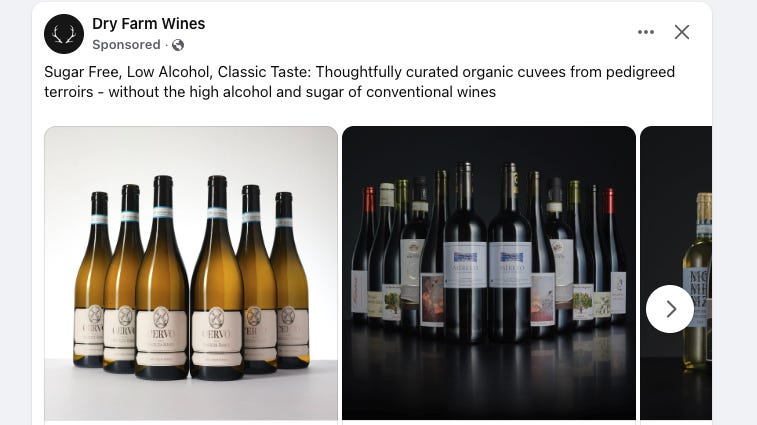
The Outraged Consumer was nosing around the Facebook the other day when he caught the aroma of an advertising claim that seemed too good to be true — a wine claiming to be “sugar free.”
These wines are quite the rage in Napa Valley and other areas frequented by oenophiles and their hangers-on. By the way, Dry Farm Wines is a brand but just plain old “dry farming” describes a method of growing grapes without using irrigation.
We looked into it a bit and it turns out that the “sugar free” claim is technically true but requires some important unpacking. Here’s what’s actually going on.
The regulatory loophole
Under FDA rules, if a food or drink contains less than 0.5 grams of sugar per serving, the manufacturer can round down to zero and legally claim it is “sugar-free.” Dry Farm Wines exploits this threshold, though they apply a stricter internal standard: the company tests its wines and allows a maximum of 0.15 grams of sugar per glass.
So their wines do contain some sugar — just not enough to legally require disclosure, according to Amy Burkhart MD, RD, a doctor who writes The Celiac MD, a website devoted to information about gut health.
How they achieve very low sugar
The answer lies in fermentation. During fermentation, yeasts convert sugar into alcohol, gradually turning grape juice into wine. With the right fermentation process, the wines can be essentially sugar-free.
Dry Farm Wines (the brand) claims to specifically seek out wines that have fermented fully — meaning nearly all the grape sugar has been converted to alcohol. Each wine is lab-tested to ensure it contains less than 1g/L of sugar, less than 12.5% alcohol, and less than 75 ppm sulfites, according to The Chalkboard Mag, a website dealing with nutrition and healthful living.
But there’s a catch that undermines the health halo: it doesn’t matter if wine is sugar-free when measured, because the body converts the alcohol in wine to sugar after you consume it. So while the residual sugar in the bottle is negligible, the metabolic effect of alcohol itself isn’t avoided.
What’s legitimately different
The FDA allows any wine with fewer than 2.5g/L of sugar to be labeled “sugar-free,” and the only way to find truly low-sugar wine is to lab test. Dry Farm Wines says it does actually lab test every bottle, which is more than most wine companies do. And conventional American wines often contain substantially more residual sugar — sometimes several grams per glass — due to incomplete fermentation or deliberate sweetening, Chalkboard says.
Dry-farmed wines are also said to be lower in alcohol content and contains fewer additives than the full-bore varieties.
Bottom line
The claim is legally defensible but scientifically misleading in the way that matters most to consumers. The wines are genuinely lower in residual sugar than many commercial alternatives, and the lab-testing process is real. But “sugar free” implies a health benefit that the alcohol content itself undermines — and that’s a marketing sleight of hand worth scrutinizing.
We haven’t tried any dry-farmed wines and we’re neither endorsing nor dissing them. It’s better not to drink at all but you already knew that. Cheers.