

The week’s headline consumer prize — a national average gasoline price under $4 a gallon for the first time since March — arrived alongside a stark warning from the Federal Reserve that further relief may have to be paid for with an interest rate hike before the end of the year.
The U.S. and Iran signed their deal to reopen the Strait of Hormuz, sending oil prices lower for a second straight day, but two new reports made clear that airfares, food bills and shipping-dependent costs will linger long after the war is officially over.
Meanwhile, the U.S. consumer is still spending. May retail sales rose 0.9 percent, pending home sales beat expectations, and a Fed projection that had pointed to a 2026 rate cut now points to a hike instead.
Gas drops below $4 a gallon
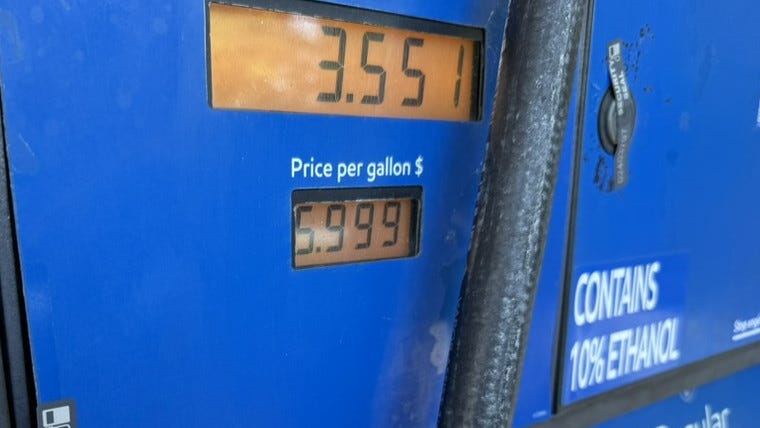
National regular unleaded gasoline averaged $3.999 a gallon on Thursday, the first time since March, Bloomberg reported citing the American Automobile Association — more than 50 cents below the $4.5150 average a month ago.
Brent crude dropped about 3 percent to roughly $77 a barrel on Thursday, near the lowest level since the war began. U.S. West Texas Intermediate fell more than 3 percent to about $73, the Times reported. The International Energy Agency added to the bearish tone, warning of a potential oil supply surplus in 2027 as Middle East production normalizes — global supply will average 102.4 million barrels a day in 2026 before rebounding to 110.3 million in 2027, CNBC reported.
Optimism is tempered. Dan Pickering, chief investment officer at Pickering Energy Partners, told CNBC it could take six to 10 weeks for the strait to return to normal. The agreement requires reopening with no Iranian tolls for at least 60 days, a CNBC analysis of the memorandum’s terms noted. David Fyfe, chief economist at Argus Media, cautioned in a CNBC interview that the supply recovery remains uncertain.
Diesel pump prices remain elevated, averaging $5.16 a gallon Thursday and still up nearly 40 percent since the war began, the New York Times reported. Gasoline remains 35 percent above pre-war levels despite the drop.
Airfares are unlikely to fall — and may stay high through the summer
The Hormuz deal will not buy travelers cheaper plane tickets, the New York Times reported. Jet fuel prices nearly doubled during the war, prompting carriers to cut capacity and raise fares.
Even if fuel falls, airlines may not pass it on. John Grant, chief analyst at the aviation data firm OAG, told the Times: “The operational costs are now set for the next three to four months for most airlines, leaving little flexibility. It’s not a straightforward cause-and-effect scenario. A 10 percent drop in oil prices doesn’t equate to a 10 percent reduction in ticket prices.”
There is a structural reason airlines drag their feet. About 20 percent of the world’s maritime jet fuel exports flow through the Strait of Hormuz, according to Amaar Khan, European head of jet fuel pricing at Argus Media, quoted in the Times. The reopening of the strait should ease backlog at Persian Gulf ports, but carriers will not see lower fuel costs at the pump for months.
Carriers, moreover, have discovered that travelers are willing to pay more — and many have no commercial incentive to cut prices ahead of the busiest travel weeks of the summer.
May airfares had already jumped 2.7 percent month-over-month, according to the Bureau of Labor Statistics’ Consumer Price Index, CBS News reported last week. For consumers planning Independence Day and Labor Day travel, that means budgeting for fares that may stay above pre-war averages into the fall — particularly on transatlantic and Middle East-routed itineraries.
Higher food prices will outlast the Iran war
A Bloomberg feature published Thursday detailed how the Iran war’s disruptions are still working through global food supply chains, even with the strait now formally set to reopen, Bloomberg reported.
The shutdown disrupted prices for fuel, energy, fertilizers and other agricultural and industrial products, and the disruptions are not unwinding overnight. Liliana Danila, chief economist at the U.K. Food and Drink Federation, told Bloomberg: “While the Strait of Hormuz is now reopening, it will take another six months, at least, for supply chains to normalize and, in some cases, longer for energy infrastructure to be repaired.”
European Central Bank Governing Council member Martin Kocher made a similar point in Vienna on Thursday, Bloomberg reported. “We have been seeing an energy price shock again with the war in the Middle East. Hopefully the sign of this interim agreement today leads to the path of declining prices, but prices will stay higher for some time.”
The data points back him up. Wholesale U.S. inflation exceeded 6 percent in May; consumer inflation topped 4 percent, NBC News reported. Tomatoes were up 32 percent year over year, lettuce nearly 25 percent and coffee 17.5 percent, per the May CPI report. Roughly 30 percent of the world’s fertilizer moved through Hormuz before the war, and fuel accounts for 15 to 30 percent of total food cost, the Associated Press has reported.
Ground beef set a fresh record of $7.064 a pound in May, and the screwworm outbreak compounds the supply problem for the smallest U.S. cattle herd in 75 years.
U.S. consumer keeps spending despite higher prices
Despite the gloom, U.S. shoppers are still showing up. Retail sales rose 0.9 percent in May, well above the consensus estimate, the Associated Press reported — even as elevated gas prices ate into household budgets, Bloomberg noted. The Wall Street Journal reported that retailer sales growth accelerated in May, broadening beyond the gas-station and auto-dealer categories that had carried the index in April. Pending home sales also beat expectations in May, the Wall Street Journal reported, pointing to underlying demand even with the 30-year mortgage stuck above 6.5 percent.
The juxtaposition with the Fed’s hawkish dot plot is striking. A strong consumer is exactly what the central bank cites when justifying higher rates, and Warsh emphasized in his statement that “economic activity is progressing at a robust rate,” the New York Times reported. If consumers keep spending and inflation stays sticky, the case for a hike strengthens.