


Everyone had a good time over the weekend at the No Kings demonstrations but, while they made good television, the protests haven’t done much to end the government showdown and the creeping cataclysm it represents for needy and disabled consumers, not to mention the federal workers and contractors suddenly left without pay.
Looming changes to Medicare and Medicaid and other vital programs are bad enough but nothing is more essential than food, and state officials across the nation are issuing urgent warnings that tens of millions of Americans could abruptly lose food assistance by month’s end if the ongoing federal government shutdown prevents the authorization of new funding for the Supplemental Nutrition Assistance Program (SNAP).
“Shut our government down and America loses. 2 MILLION Pennsylvanians depend on SNAP to feed their families,” said Sen. John Fetterman (R-Pa) in a social media posting. “For me, it’s hungry Americans over party. Paying our military over party. Paying Capitol Police and federal workers over party. I choose country over party.”
SNAP, which traces its origins to 1939 when it was first established during the Great Depression, serves as the country’s primary bulwark against hunger among low-income families. The program helps supplement grocery budgets and ensures adequate nutrition for vulnerable households.
While many Americans still remember the paper “food stamps” of decades past, the program has since modernized, now distributing benefits through Electronic Benefits Transfer (EBT) cards that function like standard debit cards at grocery stores and approved retailers.
This means more seniors, veterans, people with disabilities and children will go to bed hungry. … Our farmers … will see billions in lost revenue. - Sen. Amy Klobuchar (D-MN)
Widespread state warnings
In recent days, a growing chorus of state agencies have raised the alarm. New Jersey, Texas, Illinois, Oklahoma, California, Pennsylvania, New York, Missouri, and Minnesota have all issued public warnings about potential disruptions to November benefits.
The timeline varies by state: some have indicated that November payments could be delayed or reduced if the shutdown extends beyond October 27, while others — including Pennsylvania, Oklahoma, and Illinois — have already confirmed that November benefits will not be distributed at all if funding isn’t restored.
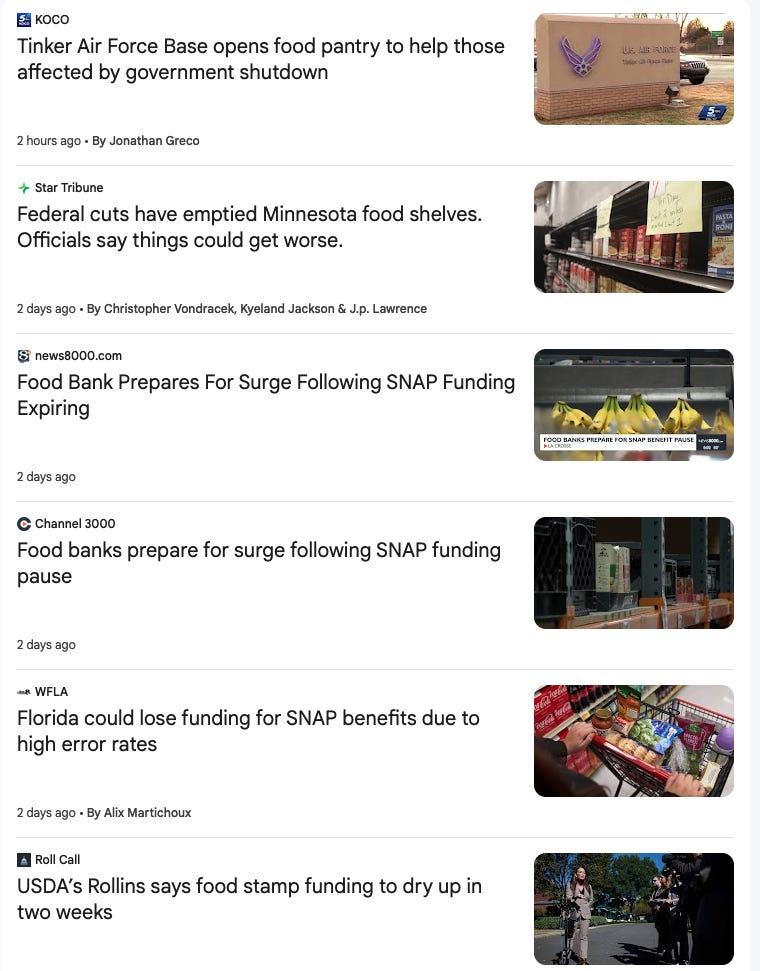
“You’re talking about millions and millions of vulnerable families — of hungry families — that are not going to have access to these programs because of this shutdown,” Agriculture Secretary Brooke Rollins told the Washington Post last week, her voice reflecting the gravity of the situation facing federal officials tasked with managing the crisis.
Historic cuts to the safety net
The current crisis comes on the heels of significant policy changes to SNAP’s funding structure. The program has traditionally been funded entirely by the federal government, with states handling administrative duties. However, under the controversial “One Big Beautiful Bill” passed by the Republican-controlled Congress in July, states will be required to begin shouldering a portion of SNAP’s operational costs starting in 2028.
The legislation represents the most dramatic reduction in U.S. social safety net spending in decades, triggering fierce opposition from Democratic lawmakers and anti-poverty advocacy organizations.
The nonpartisan Congressional Budget Office estimated that the bill would reduce federal SNAP spending by about $286 million while reducing the number of participants and reducing average benefits — fewer people getting less money. It said the changes would cut resources for low-income families and drive up rates of food insecurity nationwide, with particularly harsh consequences for children, elderly Americans, and people with disabilities.
“Hunger and poverty aren’t going to stop because you cut a program. … The price of food keeps going up … people relying on these benefits will not have any recourse.” - CBPP
A Lifeline for Millions
The stakes could hardly be higher. Current federal data from August shows that more than 42 million Americans depend on SNAP benefits each month — approximately 12.3 percent of the entire U.S. population. For many of these households, SNAP represents the thin line between adequate nutrition and hunger.
Yet even in normal times, SNAP benefits rarely cover a family’s complete food expenses. According to the USDA’s Food and Nutrition Service, the average benefit in fiscal year 2023 amounted to $332 per household, or roughly $177 per individual per month. Broken down further, that translates to less than $6 per day in food assistance per recipient — a modest sum that typically must be stretched to cover breakfast, lunch, and dinner.
The inadequacy of these amounts becomes even more apparent when considering rising food costs. Many SNAP recipients must make difficult choices about which groceries to purchase, often sacrificing fresh produce and protein in favor of less expensive, shelf-stable items.
“A cut to SNAP at this time, when food costs are continuing to rise, the timing is horrifying.” - Food Research & Action Center
Warning signs already visible
Community organizations on the front lines of hunger relief report they were already experiencing increased demand even before the current shutdown crisis. At a food pantry in Chicago earlier this year, volunteers noted a steady uptick in families seeking assistance as various federal nutrition programs tightened eligibility requirements and reduced benefit levels in response to the July legislation.
“SNAP is the largest and most effective hunger prevention program in the country,” said Barbara C. Guinn, commissioner of New York’s Office of Temporary and Disability Assistance, in a statement that captured the alarm felt by state officials nationwide. “To permit monthly benefits to halt would be unprecedented and have an immediate and devastating impact.”
State human services departments are now scrambling to prepare for potential fallout, developing emergency response plans and coordinating with food banks and charitable organizations. However, experts caution that the charitable food system, already stretched thin, cannot possibly absorb the sudden loss of benefits for 42 million people. Food banks typically supplement SNAP rather than replacing it, and they lack the resources to serve as a primary food source for such a massive population.
As the October 27 deadline approaches, families who rely on SNAP face an anxious wait, uncertain whether the political standoff in Washington will be resolved in time to prevent what would be an unprecedented disruption to the nation’s nutritional safety net.
It's true that "the protests haven’t done much to end the government showdown..." For those of us in ruby red states, though, it's heartening to see that there are so many of us who would rather cut off our arms than vote red.