


California consumers will soon be able to cash in gift cards with a balance of less than $15, up from the current $10. That’s the result of California Senate Bill 22 (SB 22), which takes effect April 1.
Most states don’t have any requirement that stores return unused balances — the technical term is “stranded value” — so if you’re a person who puts off using gift cards, California may be the place for you.
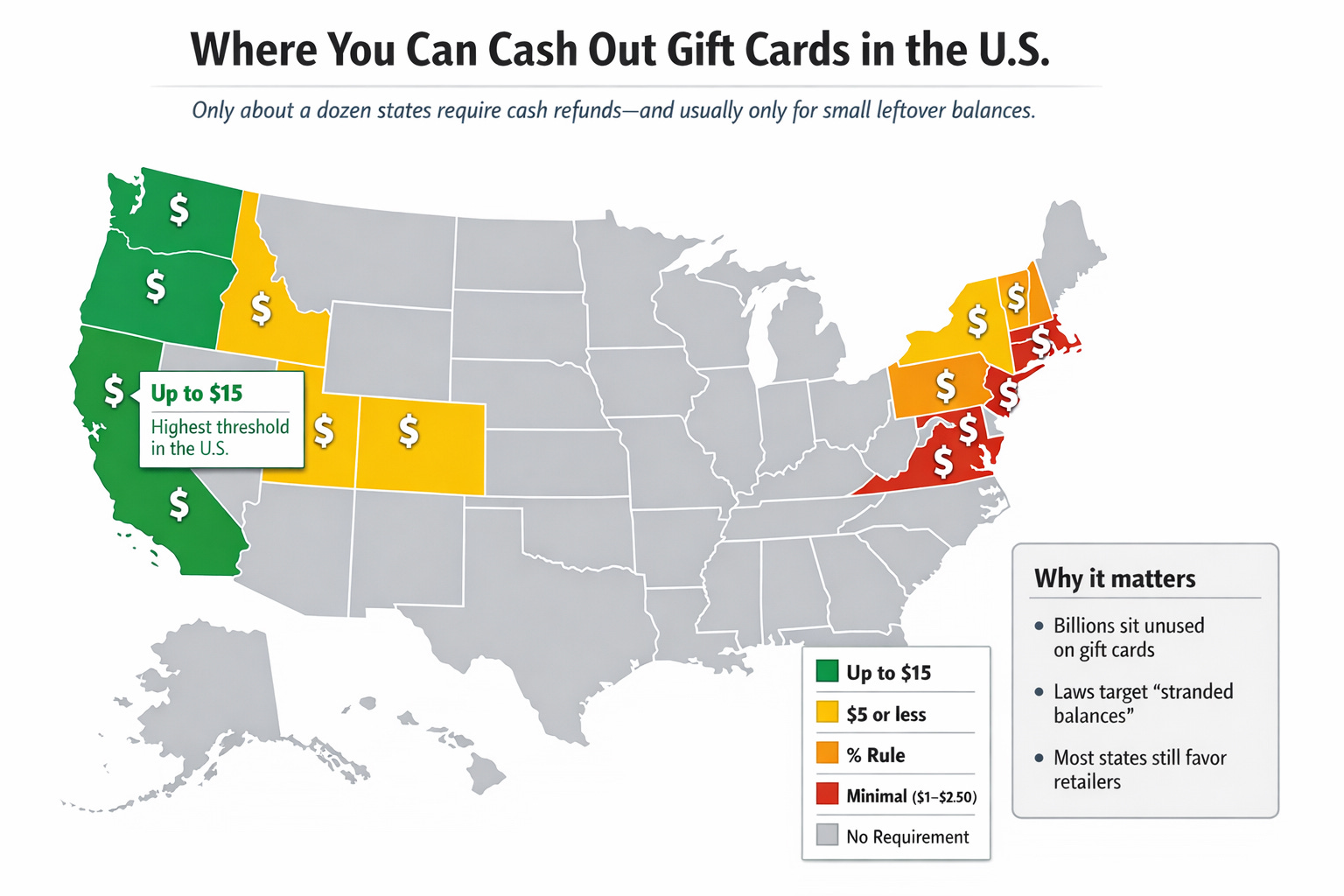
States that do have a way to rescue stranded value include:
Colorado, Maine, Montana, New Jersey, Oregon, Washington
Typically $5 or less
Massachusetts
Cash-out once 10% of original value remains
Rhode Island & Vermont
Very small threshold (under $1)
Connecticut, Maryland and Florida have limited refund rules that have numerous exceptions that make iti hard to summarize them. Some states have expiration date requirements but they vary widely.
If you’re in a state with no requirement that unused balances be cashed out, your options are limited. You can use up what’s left by making a purchase and making up any additional amount in cash. There are also websites that will give you a portion of what’s stranded on your card.
Billions at stake
This may sound like such a minor issue that it’s not worth thinking about, and maybe it is. But like many such quiet consumer issues, it scales up quickly, amounting to tens of billions of consumers’ dollars nationwide that end up sitting in retailers’ accounts.
A bonanza for lawyers
While consumers haven’t engorged their bank accounts with $2 and $4 cash-outs, the $10 California limit has been in effect for nearly 20 years and has sparked nearly 200 lawsuits against merchants.
While some of these lawsuits have hit businesses that were non-compliant or unaware of the cash-redemption requirement in California’s gift card law, retailers say it’s more commonly just lack of experience by sales associates. Most consumers don’t bother cashing in such small amounts so sales people often aren’t familiar with the law.
“Oftentimes, these cases arise when an investigator for a plaintiffs’ attorney hits a bunch of stores at once (usually in a mall) armed with gift cards under the threshold amount, asks for cash back, and if the sales associate even responds simply with “I’m not sure we can do that,”—bingo—class action,” said an advisory from Ballard Spahr, a law firm that’s active in retail litigation.
Retailers should therefore be sure to train sales associates about the law and to frequently remind them about it, the firm said.
“It is also imperative that the stores train personnel on how to actually give the cash back, since oftentimes that is a barrier to compliance, even if a sales associate is attempting to comply,” the advisory noted.
What’s new
The central change under SB 22 is the increase in the cash-redemption threshold from $10 to $15. The bill also makes two related adjustments: It brings electronic gift cards within the scope of the statute, and it carves out an exception for gift certificates donated to nonprofits.
Donated gift certificates. SB 22 creates an exception for certain gift certificates donated to nonprofit or charitable organizations.