

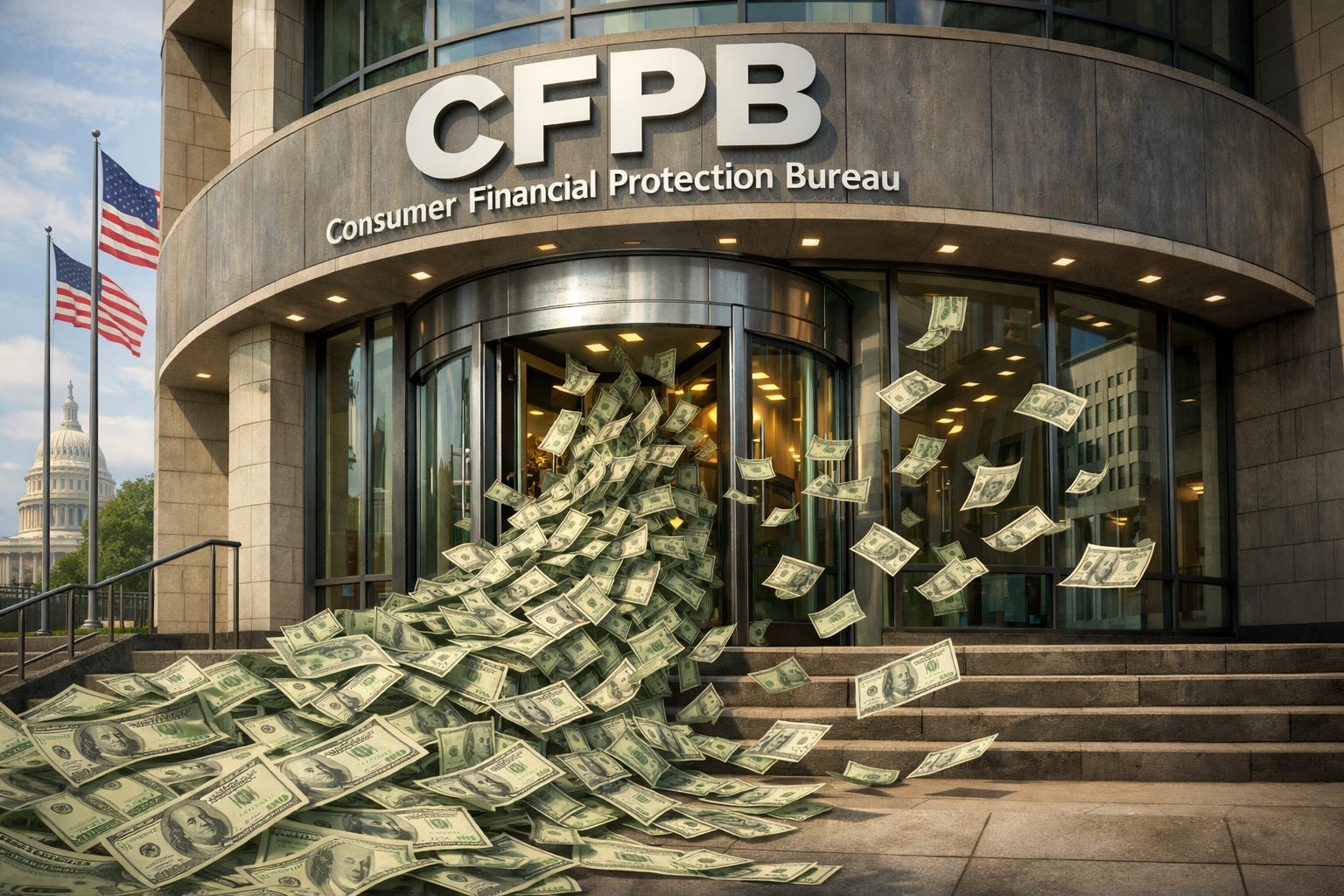
A federal judge has ordered the Consumer Financial Protection Bureau (CFPB) to resume requesting money from the Federal Reserve, rejecting a move by Trump appointees that critics said would have effectively shut the agency down.
The ruling centers on a relatively technical — but consequential — question: Can the CFPB choose to stop funding itself?
The judge’s answer: no.
Under federal law, the CFPB does not rely on congressional appropriations. Instead, it draws funding directly from the Federal Reserve, up to a capped amount, in a structure designed to insulate the agency from political pressure.
That structure, the court said, is not optional.
The legal theory — and why the court rejected it
CFPB leadership had argued that the agency could not legally request funds because the Federal Reserve has recently reported operating losses rather than profits.
Under that reasoning, the bureau halted funding requests.
The court rejected the argument outright, finding that:
The law does not require Federal Reserve profits for CFPB funding
The agency has a statutory obligation to request funds if needed
Refusing to do so was arbitrary and contrary to law
The judge emphasized that Congress intentionally designed the CFPB’s funding mechanism to be stable and independent — and that allowing leadership to simply stop the flow of money would undermine that design.
Why it matters for consumers
While the dispute may sound technical, the stakes are anything but.
The CFPB plays a central role in policing:
Credit card fees and practices
Mortgage servicing and lending
Student loan servicing
Debt collection
Consumer complaints across the financial system
Had the funding halt continued, the agency could have been forced to scale back or suspend enforcement, supervision and consumer response functions.
Consumer groups warned that outcome would leave households more exposed to:
Hidden fees
Predatory lending
Servicing errors
Aggressive debt collection
Affordability Watch: oversight at a time of rising debt stress
The ruling lands as many households are already under financial strain.
Recent data from the Federal Reserve Bank of New York shows:
Credit card balances remain near record highs
Delinquency rates are rising across several categories
Auto loan and credit card stress is particularly elevated among lower-income borrowers
In that environment, the CFPB’s oversight role becomes more consequential.
A prolonged funding disruption could have coincided with:
More consumers falling behind on payments
Increased disputes with lenders and servicers
Greater risk of errors or abusive practices going unchecked
In short, the case isn’t just about agency structure — it’s about whether consumer protections remain active during a period of mounting financial pressure.
Part of a broader legal battle
The decision is one of several recent court rulings addressing challenges to the CFPB’s structure and authority.
Courts have generally upheld:
The agency’s funding mechanism
Its independence from the congressional appropriations process
At the same time, political and legal battles over the bureau’s scope and power continue, suggesting the issue is far from settled.
What happens next
The ruling requires the CFPB to resume the normal process of requesting funds from the Federal Reserve.
That does not necessarily end the dispute.
Possible next steps could include:
Appeals by the parties involved
Additional litigation over the agency’s authority
Continued political efforts to reshape or limit the bureau
For now, however, the decision ensures the CFPB can continue operating — and that its funding stream remains intact.
The bottom line
A federal judge has made clear that the CFPB cannot effectively shut itself down by refusing funding.
At a moment when many Americans are struggling with rising debt and financial pressure, the ruling preserves the agency’s ability to act as a watchdog over the consumer financial system.
Voices: CFPB funding fight draws sharp reactions
“An agency cannot nullify its own statutory duties.”
— Federal judge (paraphrased from ruling)
The court made clear that CFPB leadership cannot sidestep the law by refusing to request funding, calling the move inconsistent with Congress’s design.
“This was an attempt to dismantle the bureau from within.”
— Consumer advocates
Public interest groups argued that halting funding requests amounted to a backdoor shutdown of the nation’s primary consumer financial watchdog.
“The funding structure is unconstitutional and unaccountable.”
— CFPB critics / industry voices
Opponents of the bureau say its Federal Reserve funding model insulates it too much from congressional oversight and democratic control.
“Consumers would pay the price for a shutdown.”
— Consumer Federation / advocacy groups
Advocates warned that without CFPB oversight, borrowers could face more abusive practices, especially in credit cards, auto loans and mortgages.
“This preserves stability in consumer protection.”
— Supporters of the ruling
Backers say the decision ensures continuity at a time when rising delinquencies and household debt make oversight more important.
“The legal fight is far from over.”
— Legal analysts
Experts expect continued litigation and possible appeals, as broader challenges to the CFPB’s structure continue to move through the courts.