



Gmail has sort of become the Xerox of email. Before scanning became commonplace, everyone used a copier and called it a Xerox, whether it was or not. This is the tip-off that a product has become so dominant that it deserves a second or third look from the antitrust department — especially if its name is commonly used as a verb.
And, sure enough, someone said to me the other day that they would Gmail me with a follow-up to our rather desultory conversation. If I didn’t already have an alternative email service, that would have sent me looking for one.
In fact, I’ve been on the lookout for a Gmail substitute ever since I found out that Google was mining gmails for personal data that it used for ad targeting. It says it no longer does that but there’s the lingering suspicion that it may pick up a scrap every now and then.
There’s also the little matter of AI, which is poking around in every corner of our lives these days. While I don’t really mind if my dental history becomes public knowledge, I’m not especially thrilled about it.
Fortunately, there are several excellent options, including a new one from Mozilla that hasn’t yet launched publicly. Mozilla, you may recall, is the non-profit that produces the Firefox browser and a batch of other privacy-focused products. Privacy, in fact, has become its mantra and it’s not surprising that the primary selling point for its new mail service — called Thundermail — is that it’s private and won’t catapult your private affairs into cyberspace.
The Thundermail name comes from Thunderbird, which historically has been Mozilla’s name for its email desktop and mobile apps, which you can use to handle traffic from just about any email service. It has been around forever, seemingly longer than the internet itself, and is highly regarded if a little dated in its approach.
Thundermail, on the other hand, will be a full-fledged online service, like Gmail. You won’t need an app to use it. It promises complete confidentiality and no ads. (We hope it gets a shorter name before it launches. Tmail, maybe?)
However, unlike Gmail, iCloud, Outlook and Proton, it won’t have a free version and is expected to cost around $6 a month. That may be enough to put off many prospects but nothing is free, especially on the internet. A good rule of thumb is that if it’s free, you’re paying for it by giving up some (or most!) of your personal data to marketers.
Don’t forget Proton
Thundermail sounds OK but a better option for the privacy-focused may be Proton, a Swiss service which does offer a free option. Better yet, Proton is fully encrypted and thus highly secure.
Proton’s current pricing menu offers a free account that provides service for one user, one GB of storage and one email address. There are other options they’re hoping you’ll graduate to, including Unlimited, which is currently $6.49.
Both Proton and Thundermail have a full portfolio of other services, including data storage, VPN, a password manager and so forth.
Here at Outrage Central, we use Proton for just about everything and have been unable to find anything to get outraged about, although it can be a little slow to load sometimes, presumably because many of its servers are in Switzerland.
The company was started in 2014 by scientists from CERN, which operates particle physics laboratories. Since it is headquartered in Switzerland, it is outside the European Union, not to mention the United States, and is governed by Swiss laws, which provide very strong protection for individual users’ data.
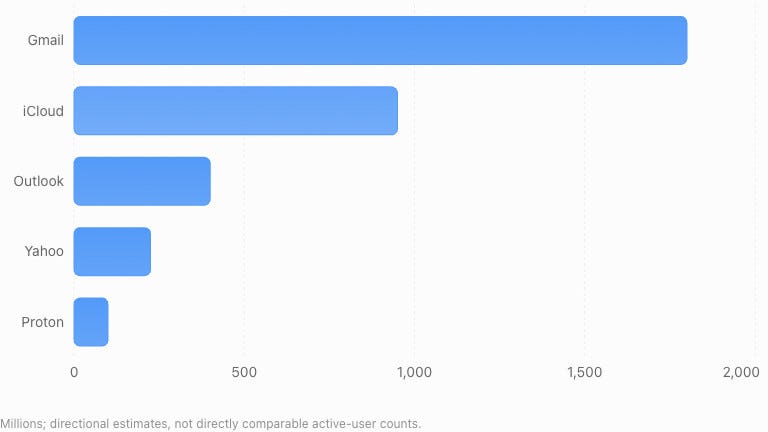
Proton reached 100 million subscribers in 2023 and has not released any updates since then, so it may be much larger than that by now. That’s small compared to Gmail but it’s been growing quickly and is becoming a major player in the data and email field.
Email is something most of us never think about, although we probably should. It may not be a popular subject at your next cocktail (or whatever) party but it’s worth a second thought now and then.