


Millions of employees working for some of America’s largest corporations earn so little that they rely on taxpayer-funded health care and food assistance programs to make ends meet, even as executive pay and shareholder payouts continue to soar, according to a new report.
The study, published by the Institute for Policy Studies (IPS), examines 20 companies in the S&P 500 that report some of the lowest median wages among firms with primarily U.S.-based workforces. Collectively, these corporations employ about 6.7 million workers across the country.
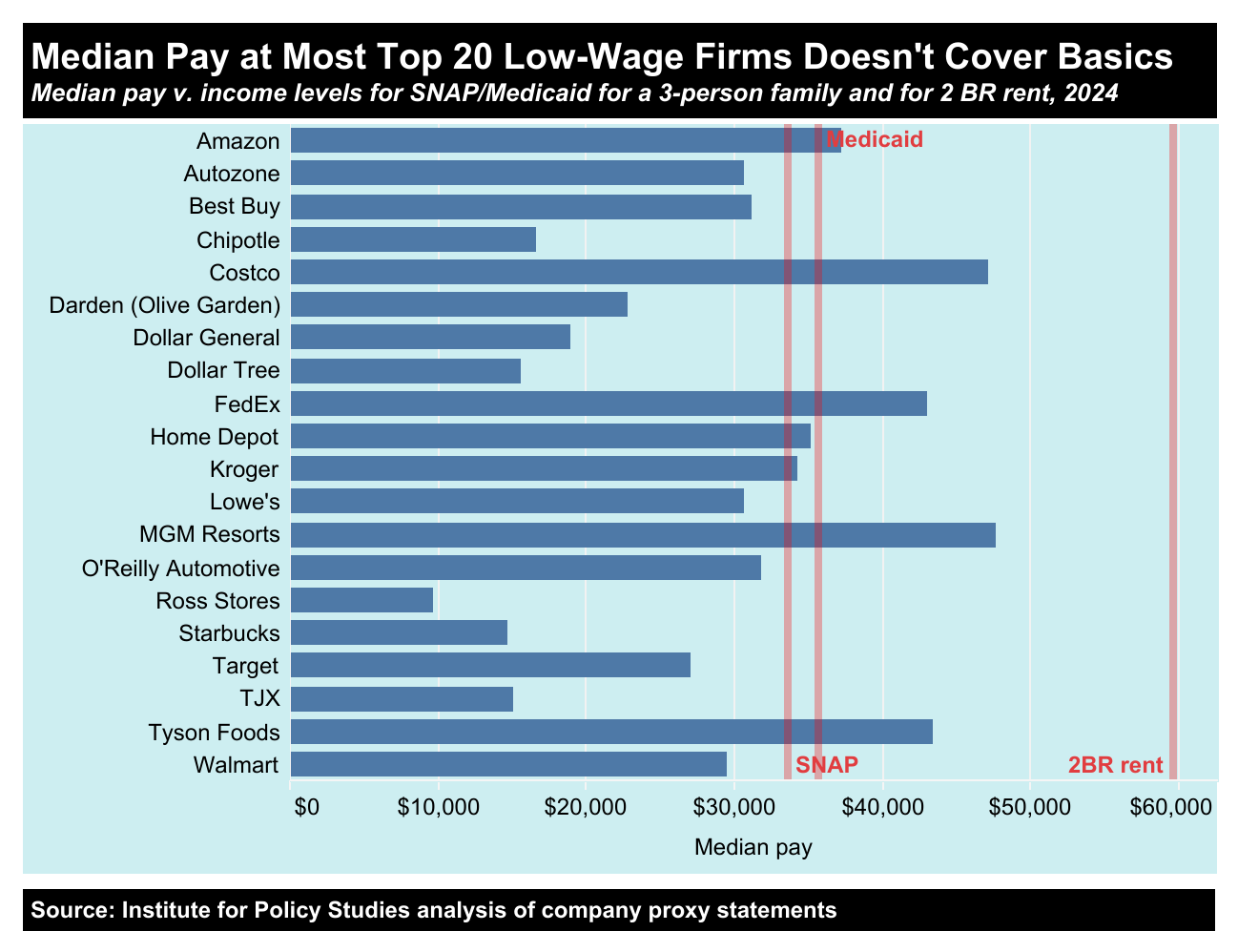
Researchers found that three-quarters of the companies pay median wages below the income threshold that would qualify a family of three for Medicaid in most states, while 13 of the companies report median wages below the eligibility cutoff for the Supplemental Nutrition Assistance Program (SNAP).
The findings underscore a long-running debate about whether large corporations are effectively shifting part of the cost of paying workers onto taxpayers.
“When corporations can get away with shifting their employees’ basic living costs onto taxpayers, this is a form of corporate welfare,” said Sarah Anderson, director of the Global Economy Project at the Institute for Policy Studies and author of the report. “With the federal government slashing spending on anti-poverty programs, it’s even more important that major corporations in the world’s richest country pay their employees a living wage.”
Workers leaning on safety net programs
Public assistance data from several states illustrates how widespread the problem may be.
In Nevada, one of the few states that tracks Medicaid enrollment by employer, nearly half of Amazon workers (48.4%) and almost one-third of Walmart employees (29.3%) were enrolled in Medicaid in 2024.
Other states provide similar insights regarding food assistance. In Colorado, Massachusetts, Illinois, and Michigan, the report found that 10,920 Walmart employees and 9,633 Amazon employees were enrolled in SNAP in 2024.
Eligibility for these programs depends on total household income and family size, meaning that many workers may qualify even if they are working full-time.
The report also warns that millions of Americans could soon lose access to those programs. Budget reductions in the federal spending package dubbed “One Big Beautiful Bill” are projected to cause 7.5 million people to lose Medicaid coverage and about 4 million to lose some or all SNAP benefits.
If those cuts take effect, researchers say low-wage workers could face even greater financial strain.
Wages falling behind inflation
Despite rising corporate profits in many sectors, the report found that workers’ pay has largely stagnated in recent years.
Across the “Low-Wage 20” companies analyzed in the study, inflation-adjusted median pay fell 4.6% between 2019 and 2024, dropping from $30,474 to $29,087.
That amount falls far short of what many households need to cover basic expenses. According to the report, the typical worker would need about $59,600 per year to afford the average rent for a two-bedroom apartment in the United States without spending more than 30% of income on housing.
The gap between wages and living costs has become a defining economic challenge for many American workers, particularly in the retail, service, and warehouse sectors.
The “Low-Wage 20”
Major U.S. corporations with the lowest median pay
The Institute for Policy Studies identified 20 companies in the S&P 500 with primarily U.S.-based workforces and some of the lowest reported median worker pay among large corporations.
Together, these companies employ about 6.7 million U.S. workers across retail, restaurants, logistics, hospitality, and service industries—sectors that rely heavily on large frontline workforces.
Retail & Home Improvement
Walmart
Target
Dollar General
Dollar Tree
Five Below
Ross Stores
TJX Companies
Burlington Stores
Lowe’s
Home Depot
Restaurants & Food Service
Starbucks
Yum! Brands
Chipotle Mexican Grill
Darden Restaurants
Travel, Hotels & Entertainment
Marriott International
Hilton Worldwide
Las Vegas Sands
Logistics, Delivery & Transportation
Amazon
FedEx
Uber Technologies
What These Companies Have in Common
According to the IPS analysis:
Median pay at most of these companies falls below Medicaid eligibility levels for a family of three in many states.
Many workers qualify for SNAP food assistance based on household income.
Several companies have CEO-to-worker pay ratios approaching or exceeding 1,000-to-1.
Researchers say the concentration of low wages in these sectors highlights a broader economic pattern: many of the largest employers in the country operate in industries where frontline workers outnumber management and professional staff by a wide margin, pulling median pay down.
Stock buybacks and executive pay
While worker pay has stagnated, the companies examined in the report spent billions returning money to shareholders.
In 2024 alone, the corporations collectively spent $32.5 billion on stock buybacks, a common corporate strategy used to boost share prices and increase shareholder returns.
Home improvement retailers dominated the buyback totals. Lowe’s spent $46.6 billion on stock repurchases over the study period, while Home Depot spent $37.9 billion.
Researchers argue that redirecting even a portion of those funds toward wages could dramatically improve workers’ financial stability.
“If the companies had used that money to boost wages,” the report said, “the pay of roughly one million workers could have risen from about $29,000 to nearly $60,000.”
Executive compensation has also continued to rise.
Across the 20 corporations studied, average CEO compensation reached $18.9 million in 2024, producing an average CEO-to-worker pay ratio of 899-to-1.
In some cases, the gap is even wider.
At Starbucks, CEO Brian Niccol earned $95.8 million in total compensation in 2024, while the company’s median employee pay was $14,674—a staggering 6,666-to-1 pay ratio, according to the report.
Meanwhile, the wealth of 16 billionaires is tied to the companies examined in the study, including Amazon founder Jeff Bezos, eight members of the Walton family linked to Walmart, and former Starbucks CEO Howard Schultz.
Benefits that many workers can’t use
Some of the companies included in the report offer benefit programs designed to help employees save or build financial security. But researchers say many workers earn too little to fully take advantage of them.
Starbucks, for example, provides a 401(k) retirement plan with matching contributions. Yet 45% of eligible Starbucks employees had account balances of zero in 2024, the report found.
For workers living paycheck to paycheck, contributing to retirement accounts may simply not be possible.
“When basic expenses consume most of a worker’s income, saving for the future becomes a luxury,” Anderson said.
Corporate Responses
Several companies named in the report defended their compensation practices and employment policies in a Guardian report.
An Amazon spokesperson said the company’s wages are competitive within the retail and logistics sectors and argued that critics often misunderstand how public assistance eligibility works.
“Pointing fingers at Amazon over SNAP and/or Medicaid is a red herring when eligibility is based on total household income and size—not individual wages,” the spokesperson said in an emailed statement. “What really needs to happen is a significant increase in the federal minimum wage—that would be a big boost for American families.”
A Walmart spokesperson said the company offers career advancement opportunities and training programs designed to help employees move into higher-paying positions.
“We offer a ladder of opportunity so people can build a career at Walmart,” the spokesperson said. “We hire people who may initially be on public assistance, train them, and give them the chance to build a better life.”
A Starbucks spokesperson emphasized the company’s benefits package, including health care coverage, stock grants, and tuition programs, and said employee retention rates exceed those typical in the retail industry.
Home Depot and Lowe’s did not respond to requests for comment.
A growing policy debate
The report arrives amid a broader policy debate over wages, corporate profits, and the role of government safety-net programs.
Critics argue that when workers at highly profitable corporations depend on Medicaid or food assistance, taxpayers effectively subsidize corporate payroll costs.
Supporters of the current system counter that public benefits are designed to help low-income households regardless of where they work and that companies already face rising labor costs.
The debate may intensify as federal budget cuts threaten to reduce the availability of programs many low-income workers rely on.
“If safety-net programs shrink while wages remain stagnant,” Anderson warned, “millions of working families could find themselves pushed even closer to the financial edge.”
Corporate Welfare Watch
When low pay meets public subsidies
A new analysis from the Institute for Policy Studies highlights how low wages at some of America’s largest corporations intersect with taxpayer-funded assistance programs.
The result: millions of workers rely on public benefits to cover basic needs while corporate profits and executive compensation continue to rise.
Key numbers
6.7 million
Workers employed by the 20 major corporations identified as having some of the lowest median wages in the S&P 500.
$29,087
Median worker pay across those companies in 2024, after adjusting for inflation.
$59,600
Estimated annual income needed for a worker to afford the average rent for a two-bedroom apartment in the U.S.
$32.5 billion
Total spent by the companies on stock buybacks in 2024.
$18.9 million
Average CEO pay across the 20 corporations.
899-to-1
Average CEO-to-worker pay ratio among those companies.
Workers using public assistance
State data shows many employees at major corporations rely on safety-net programs:
Medicaid (Nevada, 2024)
• 48.4% of Amazon employees enrolled
• 29.3% of Walmart employees enrolled
SNAP (4 states reporting)
• 10,920 Walmart workers receiving benefits
• 9,633 Amazon workers receiving benefits
Eligibility depends on household income, meaning many workers qualify despite working full time.
The policy tension
Advocates argue that when profitable companies pay wages low enough to qualify workers for public assistance, taxpayers effectively subsidize corporate labor costs.
Businesses counter that public benefits are designed to support low-income households regardless of employer and that broader policies—such as raising the federal minimum wage—would be more effective.
Why it matters now
Federal budget proposals could soon reduce access to safety-net programs.
Projected impact of recent federal spending cuts:
• 7.5 million people could lose Medicaid coverage
• 4 million people could lose some or all SNAP benefits
If those cuts take effect, low-wage workers may have fewer resources to make up the gap between wages and basic living costs.