


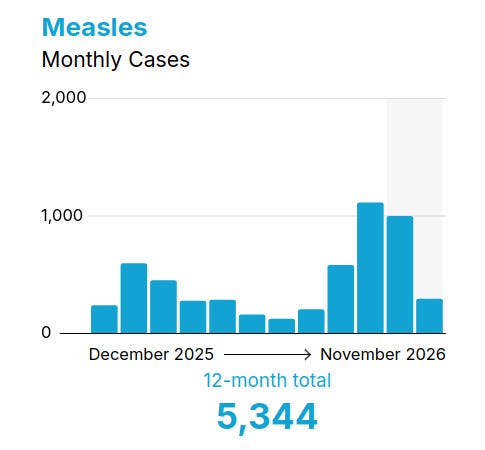
Not long ago, measles was nearly extinct in the United States. In 2024, the were only 285 cases reported. So far this year, there have been 5,412, according to the U.S. Centers for Disease Control and Prevention.
Why? Fewer Americans have been getting vaccinated against measles and other communicable diseases. And now, President Trump, who maintains that vaccines are dangerous and contribute to disease, is finalizing a rule that would pay doctors to treat patients injured by vaccinations.
It’s part of a campaign by Health and Human Services (HHS) Secretary Robert F. Kennedy Jr. to de-emphasize vaccines and medical research while making it easier for attorneys to sue doctors, hospitals and drug manufacturers for harm supposedly caused by vaccines and other medications.
If it has achieved nothing else, the anti-vaccine campaign has reduced tracking of communicable diseases. An audit of U.S. Centers for Disease Control and Prevention (CDC) public databases found that nearly half of routinely updated federal health surveillance systems had stopped or delayed updates in 2025, raising concerns that gaps in data, particularly on vaccinations and respiratory diseases, could undermine clinical guidance, public health policy, and public trust.
Kennedy is behind the establishment of a “vaccine injury research center” at the National Institutes of Health. He has a longtime interest in vaccines, particularly in filing lawsuits seeking damages from supposed injuries caused by vaccinations.
Kennedy has previously disclosed that he made $2.5 million in referral fees that he got for testifying as an expert witness in trials. At his confirmation hearing, Sen. Elizabeth Warren (D-MA) pointed to his history of anti-vaccine testimony.
“Kennedy can kill off access to vaccines and make millions of dollars while he does it,” Warren said at the hearing, according to the Guardian. “Kids might die. But Robert Kennedy can keep cashing in.”
Kennedy, she said, had also been active in litigation against Merck for its HPV vaccine, including lawsuits that were settled for more than $50 million in June 2026.
“A lot of what he is doing is geared toward setting up a more profitable litigation atmosphere,” said Dorit Reiss, professor of law at UC Law San Francisco, the Guardian reported.
Scientists, doctors ignored
Although there is little debate among medical professionals about the safety of vaccines for measles and other once-common diseases, Florida and many other state and local governments are considering dropping their measles, mumps and rubella (MMR) vaccine mandate for school attendance.
A new University of Maryland study predicts that such a policy change could spark the largest measles epidemic in the United States in nearly 50 years. The study was published in the Proceedings of the National Academy of Sciences on September 28, 2026.
“Measles is one of the most contagious human pathogens, and we’ve seen a striking 650% increase in cases just between 2024 and 2025,” said paper co-author Abba Gumel, a Distinguished University Professor of Mathematics at UMD. “This is an extremely important case study with ramifications well beyond the southeastern United States.”
As vaccine hesitancy and exemptions grow, 3,471 measles cases have been confirmed nationally so far this year — reaching 45 states plus Washington, D.C., and New York City, Gumel noted.
The research paper’s first author, Alice Oveson, compared the situation to wildfire risk.
“It’s like having a very dry forest with a lot of kindling,” she said. “Having a large unvaccinated population including children is the perfect set-up to spark a very big and potentially deadly outbreak.”
Dangerous and expensive
Measles is not only dangerous. Major outbreaks are very expensive and can quickly burn through available public health funds. A cost analysis of the 2025 measles outbreak in New Mexico found that the outbreak carried an estimated societal cost of $5.4 million, or more than $53,000 per case.
Vaccination-related activities accounted for the largest share of the public health response, underscoring both the high cost of containing outbreaks and the value of maintaining strong vaccination coverage to prevent them. The findings are published in Annals of Internal Medicine.
Anti-vaccine activists often say measles isn’t a dangerous disease and goes away in a few days. That’s true in some cases but complications, such as ear infections, pneumonia and diarrhea, can occur, according to experts at the University of Chicago School of Medicine.
“A serious complication of measles is acute encephalitis, or inflammation of the brain, which can result in permanent brain damage in one of every 1,000 cases. In the U.S., death from neurologic or respiratory complications of measles occurs in one to three of every 1,000 cases,” according to a briefing paper on the university’s website.
In addition, there is a late-onset complication called subacute sclerosing panencephalitis (SSPE). This rare, degenerative and fatal central nervous system disease can occur seven to 11 years after a primary measles infection, with the highest rates seen in children infected before 2 years of age, UChicago Medicine warned.
If you are not vaccinated or immune, there is a 9 in 10 chance you’ll get sick if you’re exposed — even from sharing the same air, briefly or hours later, with someone who has measles, it added.
Is money driving Kennedy’s actions?
There are various theories behind Kennedy’s opposition to vaccinations for measles and other diseases, with some critics saying that Kennedy — a lawyer, not a doctor — has made millions of dollars by suing drug companies and testifying as an expert witness at trials.
At Kennedy’s confirmation hearing in 2025, Sen. Warren tried to pin Kennedy down on whether he would stop such activities if he became HHS secretary, as shown in this transcript from that hearing and cited cases in which he had testified on behalf of plaintiffs in cases involving alleged vaccine injuries:
Senator Warren: Now, you just said that you want the American people to know that you cannot be bought, your decisions won’t depend on how much money you could make in the future, you won’t go work for a drug company after you leave HHS. But you and I both know there’s another way to make money.
So, Mr. Kennedy, will you also agree that you also won’t take any compensation from any lawsuits against drug companies while you are Secretary and for four years afterwards?
Mr. Kennedy: Well, I will certainly commit to that while I’m Secretary. But I do want to clarify something because you make me sound like a shill. I put together that case. I did the science day presentation to the judge on that case to get it into court, the docket hearing –
Senator Warren: Mr. Kennedy, it’s just a really simple question. You’ve taken in $2.5 million, I want to know if you will commit right now that not only will you not go to work for drug companies, you won’t go to work suing the drug companies and taking your rake out of that while you are Secretary and for four years after.
Mr. Kennedy: I will commit to not taking any fees from drug companies while I’m Secretary. I –
Senator Warren: No, I’m asking about fees from suing drug companies. Will you agree not to do that?
Mr. Kennedy: You are asking me to not sue drug companies, and I’m not going to agree to that –
Senator Warren: No. You can sue drug companies as much as you want.
Mr. Kennedy: I am not going to agree to not sue drug companies or anybody.
—-
Warren, who is perhaps Kennedy’s harshest critic, later said, “Kennedy can kill off access to vaccines and make millions of dollars while he does it.
“Kids might die, but Robert Kennedy can keep cashing in,” Warren said.