


Nearly 40% of non-organic California produce carries residues of PFAS — synthetic chemicals that persist indefinitely in the environment and human body — according to new research by the Environmental Working Group. The findings raise fresh concerns about dietary exposure to the compounds, commonly known as “forever chemicals,” which have already contaminated drinking water for millions of Americans.
The analysis, which examined 2023 residue data collected by the California Department of Pesticide Regulation, found traces of PFAS pesticides on 348 of 930 samples spanning 78 types of fruits and vegetables. California’s outsize agricultural role — it grows more than half of U.S.-consumed produce — means the contamination extends well beyond state lines.
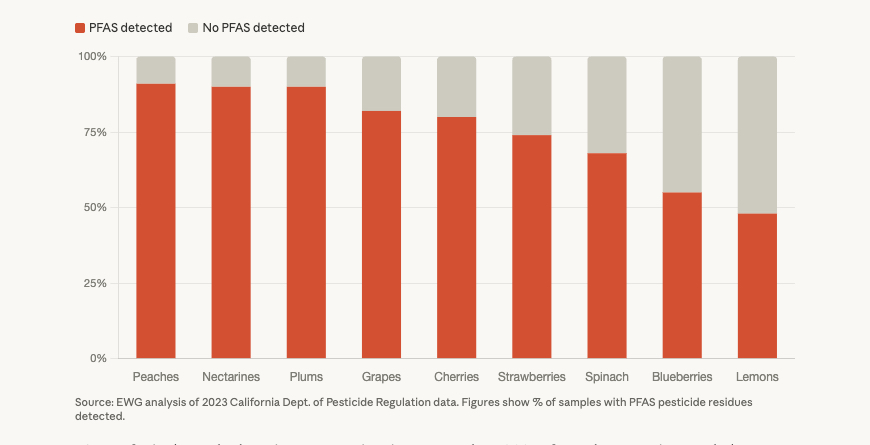
Stone fruits bore the heaviest contamination. More than 90% of peach, nectarine, and plum samples tested positive for fludioxonil, a fungicide that the European Food Safety Authority classifies as an endocrine-disrupting chemical. Grapes and cherries followed, with contamination rates above 80% and frequently carrying four or more distinct PFAS pesticides per sample. Strawberries showed the broadest chemical variety — 10 individual PFAS pesticides were detected on the crop — consistent with their status as one of the most pesticide-intensive crops in American agriculture.
The findings emerge from a broader pattern of agricultural PFAS use that EWG has been documenting. A companion report found California farmers apply roughly 2.5 million pounds of PFAS pesticides annually across all 58 counties, with 785 distinct products used in 2023 alone.
Not just frying pans
“Many consumers associate PFAS exposure with industrial sources or consumer products like Teflon-lined pots and pans,” said Bernadette Del Chiaro, EWG’s senior vice president for California.
“At a time when Americans are demanding a healthier food system, we’re finding that core staples of a healthy diet are contaminated with chemicals linked to serious health harms.
“This report reveals a glaring hole in pesticide oversight – one that demands immediate regulatory action from both California and the federal government,” added Del Chiaro.
PFAS compounds resist breakdown
Unlike many conventional pesticides, PFAS compounds resist chemical breakdown due to the strength of their carbon-fluorine bonds — the same property that makes them useful to industry also renders them nearly indestructible in soil, water, and the body. It’s why they’ve come to be known as “forever chemicals.”
“PFAS pesticides and their breakdown products persist in our environment long after the harvest,” said Varun Subramaniam, EWG science analyst.
“While California’s produce is a cornerstone of the American diet, the fact that very high percentages of it carry residues of these ‘forever chemicals’ locks us into a cycle of long-term contamination of our soil, water, wildlife and human bodies,” he added.
Federal regulatory gaps compound the concern. A recent EPA analysis found that 36 PFAS pesticides — including 25 registered in California — lack current developmental and reproductive toxicity testing. Immunotoxicity studies, EWG notes, are routinely waived during the pesticide approval process despite mounting evidence linking PFAS chemicals to immune suppression.
Seventeen different PFAS pesticides were detected across the sampled produce. Not all California crops were affected: sweet potatoes, cauliflower, mushrooms, tomatoes, watermelon, avocados, and sweet corn showed no detectable PFAS residues in the analysis.
Weigh the benefits vs. risks
EWG stopped short of advising consumers to avoid California-grown produce, noting the established health benefits of fruit and vegetable consumption. The group recommends purchasing certified organic produce where possible — organic certification prohibits the use of PFAS pesticides — and washing all produce before eating.
The group is calling on the EPA and the California Department of Pesticide Regulation to conduct more rigorous toxicity reviews of PFAS pesticides and to reconsider their approved use.
Consumers can consult EWG's Shopper's Guide to Pesticides in Produce and EWG's Guide to Washing Produce for additional guidance.
Note: Strawberry contamination rate is approximated from the report’s description of extensive multi-pesticide detection; the 91–90% figures for peaches, nectarines and plums, and 80%+ rates for grapes and cherries, are drawn directly from EWG’s data.