


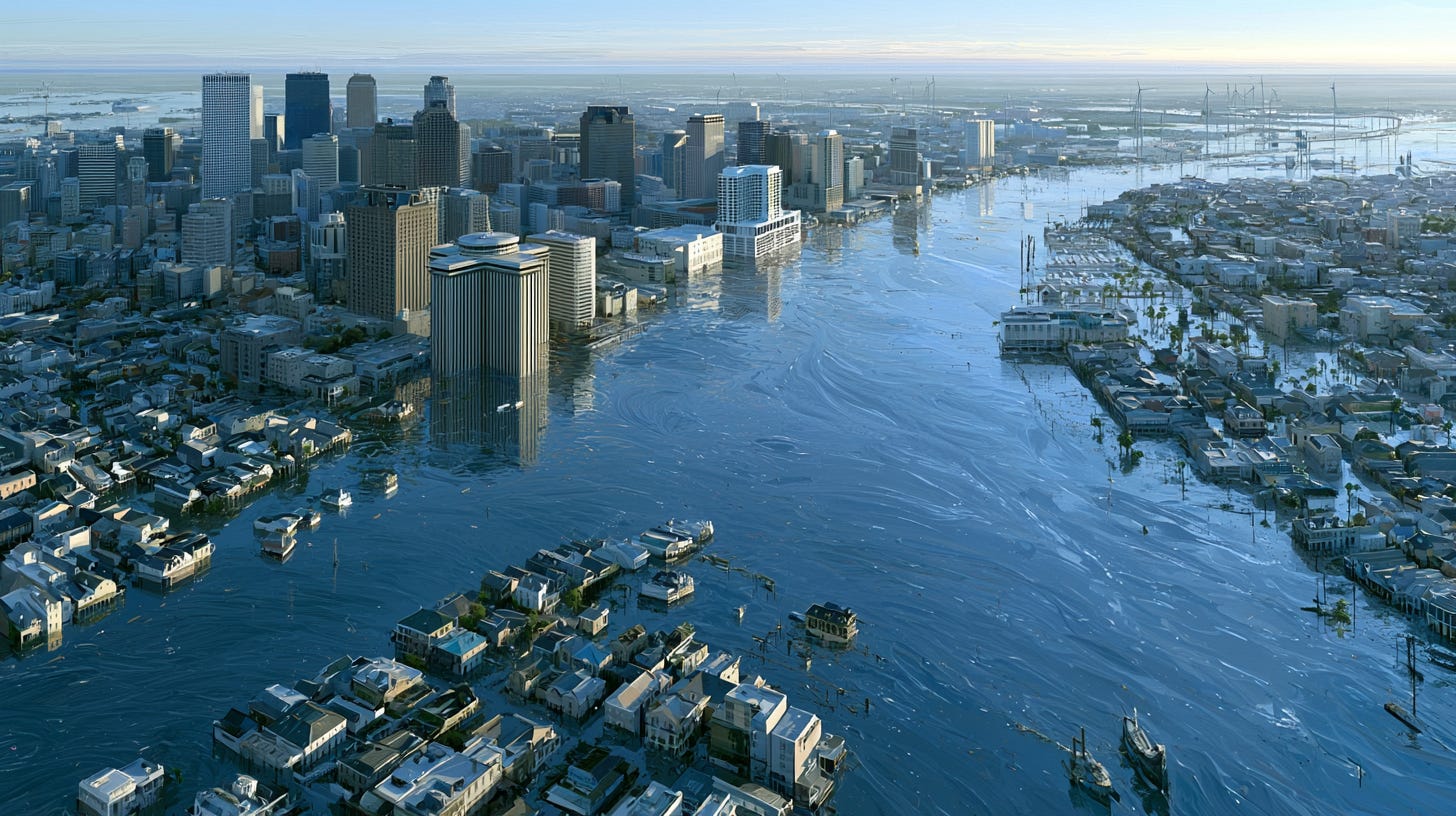
Researchers say billions spent on levees and flood protection may only buy time.
A paper, published in the journal Nature Sustainability, argues that coastal Louisiana has already passed a “point of no return” because of climate-driven sea-level rise combined with rapid land subsidence and erosion.
Researchers warned that southern Louisiana could experience 3 to 7 meters of sea-level rise over time, while losing up to three-quarters of its remaining coastal wetlands. The result, the authors said, could push the Gulf shoreline as much as 62 miles inland and eventually leave New Orleans surrounded by open water.
“In paleo-climate terms, New Orleans is gone; the question is how long it has,” said co-author Jesse Keenan, a climate adaptation expert at Tulane University.
Keenan said the timeline is uncertain but likely measured in decades rather than centuries.
“Even if you stopped climate change today, New Orleans’s days are still numbered,” he said.
Flood risks already severe
The study comes as New Orleans already faces some of the highest flood exposure in the United States.
A separate recent study found that 99% of the city’s population is at major risk of severe flooding — the highest exposure rate among U.S. cities.
Researchers say the risks are compounded by several overlapping problems:
Rising global sea levels
Stronger hurricanes fueled by warmer oceans
Rapid coastal erosion
Land subsidence causing the ground itself to sink
Decades of oil-and-gas canal dredging and wetland destruction
Since the 1930s, Louisiana has lost roughly 2,000 square miles of coastal land — about the size of Delaware — according to the article. Another 3,000 square miles could disappear over the next 50 years.
The rate of land loss is so severe that an area roughly the size of a football field disappears every 100 minutes.
Katrina protections may not be enough
After Hurricane Katrina devastated New Orleans in 2005, billions of dollars were spent building levees, pumps and floodgates around the city.
But researchers behind the new paper say those defenses may ultimately be overwhelmed by worsening climate conditions and rising waters.
The study also criticized Louisiana’s recent decision to cancel the Mid-Barataria Sediment Diversion project, a massive coastal restoration effort designed to rebuild wetlands using sediment from the Mississippi River.
Former Louisiana coastal officials and restoration advocates argued the project was one of the state’s best opportunities to slow land loss.
Louisiana Gov. Jeff Landry canceled the $3 billion project last year, citing costs and concerns from the fishing industry.
The study argues that abandoning the diversion project “effectively means giving up on extensive portions of coastal Louisiana, including the New Orleans area.”
Insurance and affordability pressures expected to grow
The findings also highlight mounting affordability concerns for Gulf Coast residents.
Climate experts say worsening flood risks are already pushing insurance costs higher across Louisiana, with some homeowners struggling to maintain coverage or sell homes in vulnerable areas.
Researchers warned that market pressures may ultimately force relocation even if governments do not formally require it.
“The market will speak as people won’t be able to get insurance,” Keenan said.
The issue mirrors broader national concerns over climate-related insurance instability in states including Florida, California and Louisiana, where rising disaster risks are straining insurers and driving up premiums.
‘Managed retreat’ increasingly discussed
While the idea of relocating a major U.S. city remains politically explosive, researchers say “managed retreat” may become unavoidable.
Experts suggested Louisiana could begin investing in infrastructure and housing farther inland, potentially north of Lake Pontchartrain.
Some climate migration has already begun, researchers said, but without coordinated planning it could become chaotic and deepen economic inequality.
“I know it’s a politically and emotionally charged issue,” said Wanyun Shao, a geographer at University of Alabama. “But managed retreat, no matter how unappealing it may be, is the ultimate solution at some point.”
Data Box: Louisiana’s climate risk by the numbers
2,000 square miles of Louisiana coastal land lost since the 1930s
3,000 additional square miles projected to disappear over the next 50 years
99% of New Orleans residents at major flood risk, according to a recent study
$3 billion cost of canceled Mid-Barataria restoration project
360,000 approximate population of New Orleans
Football field-sized area of land lost every 100 minutes
Data Box: Louisiana’s climate risk by the numbers
2,000 square miles of Louisiana coastal land lost since the 1930s
3,000 additional square miles projected to disappear over the next 50 years
99% of New Orleans residents at major flood risk, according to a recent study
$3 billion cost of canceled Mid-Barataria restoration project
360,000 approximate population of New Orleans
Football field-sized area of land lost every 100 minutes
What this means for consumers
For residents, the long-term implications extend far beyond climate science:
Rising homeowners and flood insurance premiums
Falling property values in high-risk zones
Growing difficulty obtaining mortgages or rebuilding after storms
Infrastructure strain on roads, utilities and evacuation systems
Potential future relocation costs for families and businesses
Experts say the debate over New Orleans may become a national test case for how the U.S. handles climate migration, insurance collapse and the future of vulnerable coastal communities.