



Prediction markets — platforms where people bet on future events (elections, economic data, even weather) — are the latest battleground pitting the federal government against state regulators and big-money interests against each other.
The tussle heated up this week as the Commodity Futures Trading Commission (CFTC) filed lawsuits against Arizona, Connecticut, and Illinois, accusing the states of intruding on its “exclusive jurisdiction” over futures, options, and swaps traded on federally regulated exchanges.
The lawsuits mark a shift in the legal fight from operator-led challenges into a full federal-state confrontation.
The lawsuits follow cease-and-desist letters issued by the three states to operators such as Kalshi. Arizona went even further, bringing criminal charges against Kalshi.
At their core, the CFTC’s lawsuits argue that state regulators are attempting to control markets that fall under federal jurisdiction. They rely on the Commodity Exchange Act (CEA), which gives the CFTC primary authority over derivatives markets.
“This is not the first time states have tried to impose inconsistent and contrary obligations on market participants, but Congress specifically rejected such a fragmented patchwork of state regulations because it resulted in poorer consumer protection and increased risk of fraud and manipulation,” said CFTC Chairman Michael S. Selig.
But many consumer advocates take issue with that.
“Clearly the CFTC is making a land grab for state authorities in order to protect the companies they should be holding accountable,” said Corey Frayer, Director of Investor Protection at the Consumer Federation of America. “It tells you everything you need to know that this CFTC has now brought legal action against more state regulators than it has against prediction market operators.”
At the center of the dispute is Kalshi, a New York–based company that allows users to “trade” on the outcomes of real-world events. Customers can buy and sell contracts tied to questions such as whether a political candidate will win an election, whether war will break out or whether a particular economic indicator will hit a target.
To its users, it can look like trading. To Arizona and other opponents of the practice, it looks like gambling.
The CFTC first officially recognized event contracts in 1992 when it allowed the Iowa Electronic Markets, a futures market at the University of Iowa in which traders can buy and sell contracts pegged to events such as presidential elections and corporate earnings.
Gambling in disguise?
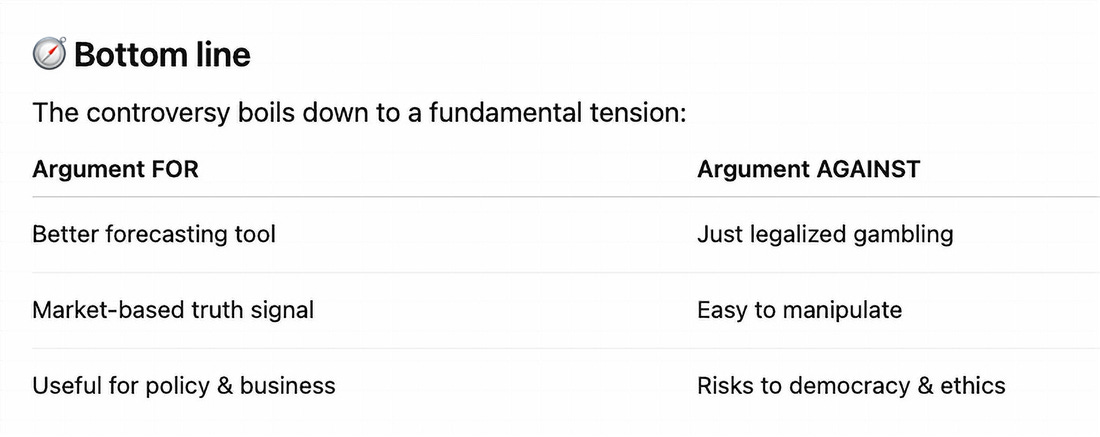
Supporters say prediction markets are valuable forecasting tools — claiming they aggregate crowd wisdom and often outperform polls or experts. Critics argue they are unregulated gambling, especially when tied to politics or public policy.
Prediction markets tied to elections raise alarms about:
Manipulation risk: Wealthy actors could place large bets to influence perceived odds.
Public perception: Markets might shape voter behavior (“bandwagon effect”).
Foreign interference: Harder to control who participates, especially on crypto platforms.
In other words, opponents say a few billionaires could try to “throw” an election by placing large bets on the candidate they support and thus affecting public opinion about who is leading and likely to win the election.
Prediction markets spark arguments about gambling law, financial derivatives and free speech. They also raise serious ethical concerns when markets allow betting on tragedy, such as wars, pandemics and natural disasters.
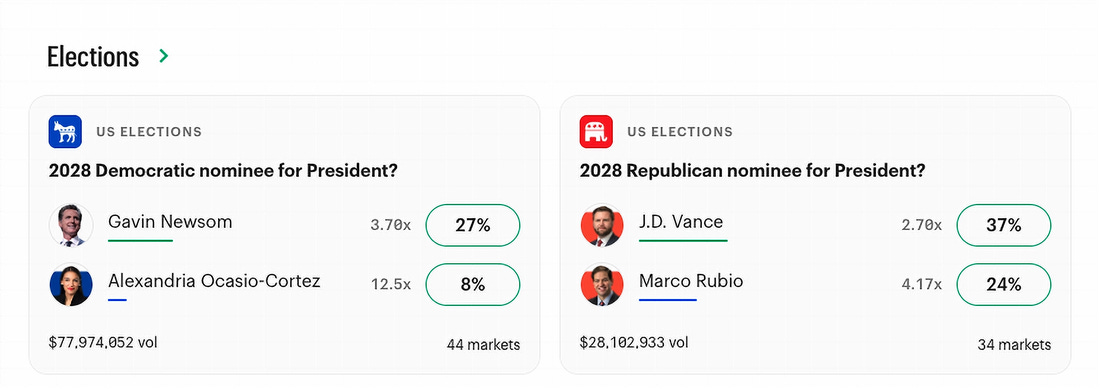
Kalshi’s two top-money markets today are the 2028 elections, with nearly $78 million being placed on the likely Democratic race and $28 million on the GOP match-up.
On target, supporters say
There may be moral and ethical issues but supporters say prediction markets work well, meaning they’re surprisingly accurate, especially in elections and economic predictors, assuming a large enough market size, participant diversity and consistent rules. Opponents say that doesn’t really matter and that the prediction markets are little more than legalized gambling.
But whether prediction markets work or not and whether they raise serious ethical concerns aren’t likely to be the deciding factor in the legal clash between the states and the CFTC.
The courts will presumably base their decision strictly on legal issues — i.e., whether the CFTC does indeed have exclusive authority over the markets. It’s also possible Congress will amend existing law or enact new legislation protecting CFTC’s turf.
Factions forming in Congress
It’s early in this battle and sides are still forming but there’s a lot of pressure coming from lobbyists and influential backers of the prediction markets as well as from consumer advocates who are lining up against any expansion of the markets, or even their continued existence.
The factions are forming along these lines:
Restrict or ban
Progressive Democrats (consumer protection focus)
Some populist Republicans (anti-gambling / anti-tech angle)
Election-security hawks in both parties
Regulate but allow
Financial-services–friendly Democrats
Market-oriented Republicans
Some technocrats and policy wonks
Pro-innovation
Financial services–friendly Democrats
Market-oriented Republicans
Some technocrats and policy wonks
Who lands where?
The coalitions don’t necessarily line up the way you might expect.
Kalshi and similar firms, as well as some economists, favor consistent regulation that recognizes prediction markets as legitimate derivate markets. (Contrary to what you might think, many industries welcome “fair” regulation, meaning rules that protect the incumbents from new entrants).
Crypto and decentralized platforms, like Polymarket, oppose regulation.
The gambling industry is quietly opposed, fearing competition, but reluctant to take a public role (which doesn’t mean they won’t heavily lobby the issue).
Consumer groups like the Consumer Federation of America are leaning toward restrictions.
The states are largely hostile, wanting to protect state gambling authority and tax revenue.
It’s a developing battle and one that could go either way. With big-money interests on both sides, it’s a little too early to place any bets on the outcome.