


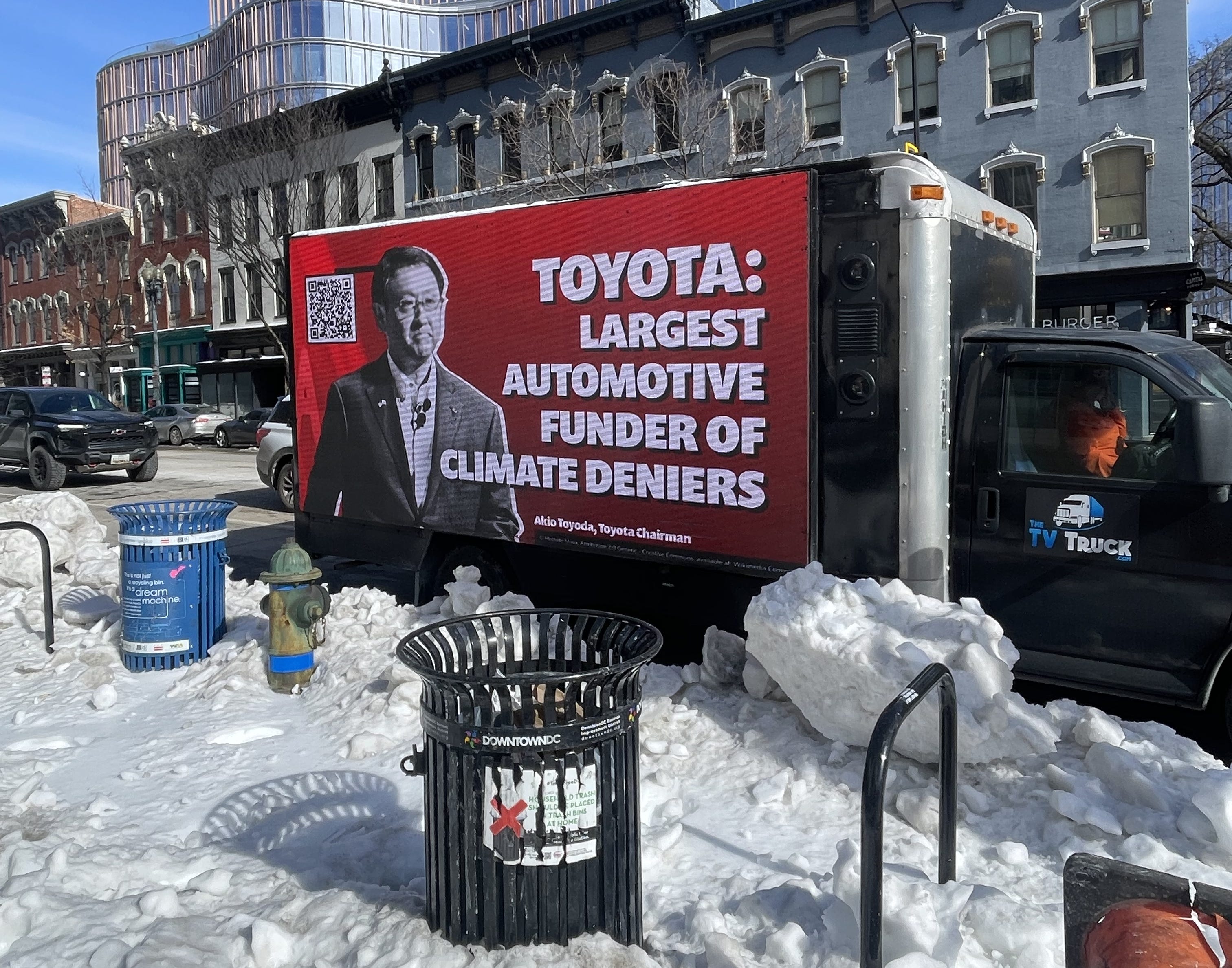
Toyota is notable among auto manufacturers for its reluctance to embrace electric vehicles, and also for its chairman’s open embrace of the Trump administration’s energy policies.
Public Citizen took to the streets over the weekend, using a billboard truck outside the Washington Auto Show to call on Toyota to “stop polluting our air and our politics.” Inside the Washington Convention Center, it was business as usual as Toyota displayed its fleet of mostly gas-powered cars and trucks.
Displaying headlines from the past few years, the truck played a looping video of Toyota Chairman Akio Toyoda’s decision to don a Trump-Vance t-shirt and a “Make American Great Again” hat at a November NASCAR event in Japan. The billboard truck planned to circle the Washington Convention Center and also visit the White House, the Capitol, and Toyota North America’s lobbying headquarters.
“Toyota is the largest automotive funder of congressional climate deniers and is working to dismantle the laws that protect the air we breathe,” said Adam Zuckerman, senior clean vehicles campaigner with Public Citizen’s Climate Program, in a news release. “Public Citizen will continue to expose Toyota as long as it continues to poison our air and our democracy.”
A low-voltage effort?
Toyota, the world’s largest automaker, has said it plans to invest $70 billion in electrified vehicles. Half of that will be for all-electric battery models. While it’s a substantial investment in EVs, it’s smaller than some competitors’ plans, and not as much as some would like given Toyota’s global footprint.
The company says its position is defined by a broader electrification strategy rather than an exclusive, all-in shift to battery electric vehicles. Toyota said its stance blends “cautious and pragmatic” EV adoption with continued emphasis on hybrids and alternative technologies.
The billboard truck was scheduled to be on display along its route through Sunday, Feb. 1, reaching thousands of car aficionados who attend the auto show. The action follows last year’s auto show, where Public Citizen activists disrupted Toyota’s award presentation, calling on Toyota to stop funding the campaigns of climate deniers.
At a recent shareholder’s meeting, Toyota insisted that “our enemy is carbon” and not just one specific technology. He highlighted Toyota’s approach of reducing emissions now using all available means rather than betting on a single technology.
Toyoda routinely points to his company’s pioneering efforts in building and marketing the Prius, the first mass-market hybrid. In an interview that circulated widely in 2025, Toyoda said that Toyota’s 27 million hybrid vehicles on the road have reduced emissions roughly equivalent to 9 million BEVs, implying hybrids have offered more total CO₂ benefit so far — a point that sparked debate.
Groups like Greenpeace criticized Toyoda’s electrification strategy — especially his emphasis on hybrids over BEVs — as not fully aligned with climate science recommendations.
“As chairman, Akio Toyoda is a key player for the future of our climate. However, he has repeatedly promoted decarbonization strategies that do not stand up to science, including the idea that hybrid vehicles are more effective at reducing emissions than battery electric vehicles,” said Mariko Shiohata, Climate Change and Energy Campaigner at Greenpeace Japan last year.
“As the world’s leading automotive company, Toyota should take a leadership role in the development of decarbonization technologies, by setting targets for total emission reductions by 2030, 2035, and 2040,” Shiohata said.
Does it really do that?
While Toyota insists it is working on a variety of solutions to pollution-based climate issues, a 2025 report from The Guardian revealed that Toyota’s U.S. division launched an internal “Toyota Policy Drivers” platform that gamifies and incentivizes employees to contact lawmakers on policy issues — including lobbying against stricter environmental and emissions regulations that would accelerate electrification.
According to critics, the program encourages employees to send pre-written messages to legislators about issues such as loosening light-duty emissions targets and opposing California’s planned 2035 ban on gasoline-only vehicles (which would increase EV adoption).
Public Citizen and other advocacy groups have reported that Toyota’s political action committee (PAC) has contributed to a significant number of U.S. lawmakers who are climate-skeptical or opposed to strong climate action, and say that this aligns with lobbying against tougher EV or emissions policies. Toyota was cited as one of the largest industry funders of such lawmakers in the 2020–24 election cycles.
—
Image supplied by Public Citizen