

Sure, everyone who’s paying attention knows by now that microplastics are everywhere — in the air, in water, in our food and, yes, in us. But, we’re told, it’s OK because it’s plastic and plastic is chemically inert. So it’s used in food packaging, water bottles, children’s toys and just about everywhere else.
But new research finds that’s not the case. Researchers at Columbia University and the University of California, Berkeley found that when a large piece of plastic fragments into micro- and nanoparticles, its surface area increases dramatically relative to its volume. Vastly more of the material is now exposed to its surroundings.
That’s important because all that new surface area is not necessarily safe.
“As plastic fragments into smaller and smaller particles, its surface area increases enormously. Then microplastics change the water that surrounds them, generating high-energy, reactive radicals (reactive oxygen species, ROS) that very likely contribute to biological damage that we see in animals and potentially in humans as a result of microplastic exposure,” said Wei Min, a Columbia professor of Chemistry and Biomedical Engineering.
The work challenges the common view of microplastics as largely passive fragments of inert material, and contributes to a growing understanding of why the large-scale presence of microplastics is a cause for concern. The research was published Oct. 14, 2026 in the journal Nature.
Blood and water
And why is this important for human health? Very simply, it’s because human blood is largely made up of water. That means microplastics that enter the bloodstream or cells could remain chemically active in this water-rich biological environment.
Min’s group at Columbia University also led a 2024 study that developed a laser based microscope technology and found that on average, a liter of bottled water contained some 240,000 detectable plastic fragments — 10 to 100 times more fragments than had previously been estimated. That study led to a growing recognition that micro and nanoplastics exist throughout the food system.
The group’s 2024 research on nanoplastics garnered widespread media attention, and combating microplastic has become a public health priority. This year, the U.S federal government launched a $144 million program to combat toxic microplastics in the human body. The U.S. Environmental Protection Agency also recently added microplastics to a federal list of contaminants that may pose a concern for drinking water, the first time microplastics have appeared on the list.
Subsequent research has found links between micro and nanoplastic exposure and heart attack, stroke, dementia, and brain tumor. But, given its supposed inertness, the mechanism by which microplastics could contribute to these illnesses had been unclear.
This new study specifies a previously overlooked mechanism that might help bridge this gap.
“Our research found that when microplastics interact with water, as they do when they’re in bottled water, or when they’re absorbed into our bloodstream, they spontaneously generate what we call reactive oxygen species (ROS),” said Naixin Qian, a postdoctoral researcher in Wei Min’s lab who helped lead the research. “ROS are textbook examples of the kinds of molecules that can damage animal and human tissue.”
“Water is a key active player here, rather than just a spectator. It’s integral to making these microplastics reactive. Water molecules become chemically active when they come into contact with plastic, which is hydrophobic. Contact between the water and plastic creates an environment that facilitates electron transfer, and the formation of reactive radicals. When plastics fragment into smaller particles, their increasing surface-to-volume ratio creates more of these chemically active areas,” Min said.
Produce aisle a big microplastics producer
Earlier this year, a report released by U.S. PIRG Education Fund and Environment America Research & Policy Center puts some hard numbers on common sources of microplastics in the food chain.
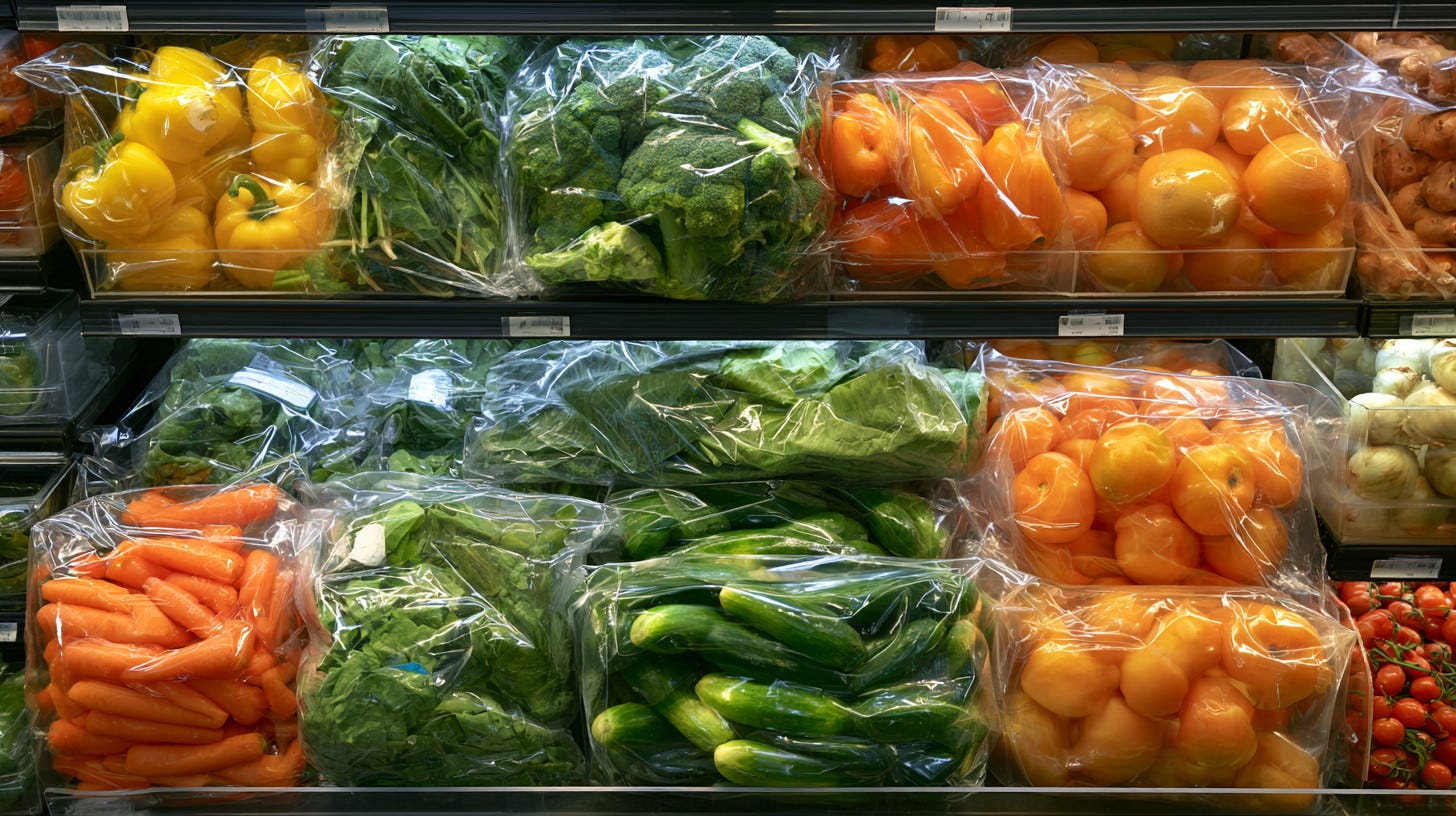
The study surveyed packaging for ten types of herbs, fruits and vegetables at 40 grocery stores across five U.S. cities and found that 81% of the produce examined was sold with plastic packaging — including clamshell containers, mesh bags, plastic film, trays and twist-ties.
Of more than 1,000 product lines surveyed, only 12% were fully plastic-free, while an additional 6% were sold loose but still carried a plastic sticker. Some 88% of stores provided plastic film produce bags in the produce section.
“Plastic waste is spreading throughout our environment at alarming rates,” said Jonathan Kaplan, policy analyst with U.S. PIRG Education Fund and co-author of the report. “The produce aisle turns out to be a great place to take action on plastic pollution.”
No help from Trump
The Trump White House is not on board with the effort.
A Trump administration executive order in January 2025 halted or reversed portions of the EPA’s national strategy to prevent plastic pollution, and an attempt to forge a globally binding plastics treaty at UN negotiations in Geneva in August 2025 adjourned without consensus. Congressional legislation that would create a tax on virgin plastic production and fund reduction efforts has not passed.
Against that backdrop, advocates say the produce aisle represents one of the most achievable near-term targets for change. The new report notes that plastic-free packaging options were already available for nine of the ten produce types surveyed — meaning the industry has demonstrated that alternatives exist; it simply hasn’t deployed them at scale.
“Getting rid of unnecessary plastic in the produce aisle really is low-hanging fruit,” said Lisa Frank, executive director of Environment America Research & Policy Center. “Many grocery chains already have plastic-free options available, so we know it’s possible. We’re asking stores to take the next step by eliminating all unnecessary plastic packaging for fresh produce.”