


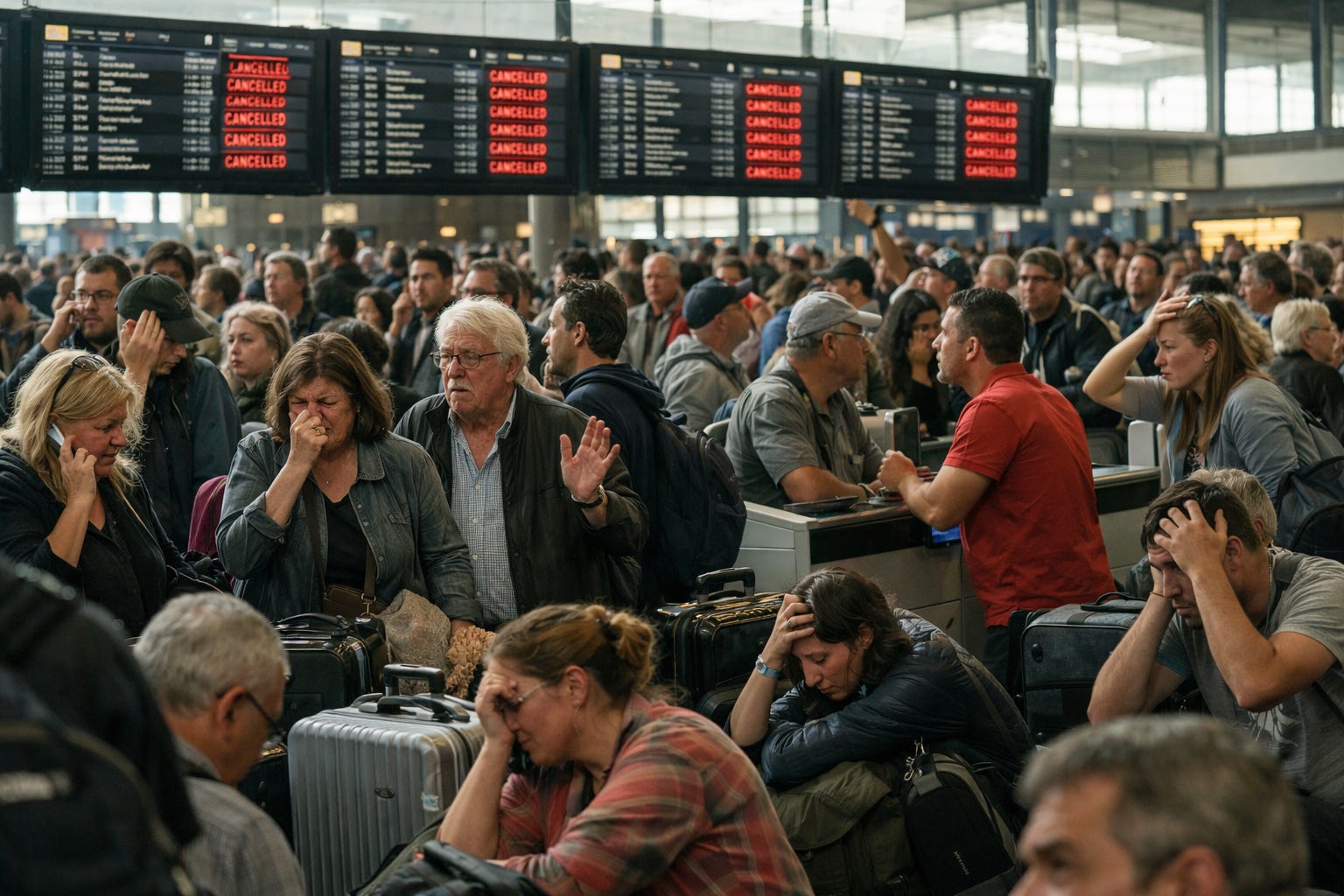
If you’re among the thousands of travelers stranded by the conflict in Iran — watching your hotel bills climb while your rebooked flight keeps getting pushed back — here’s the news that will really ruin your day: the travel insurance you paid for almost certainly won’t cover any of it.
Industry giants Allianz and Zurich are among the insurers who have confirmed that standard travel policies exclude claims tied to armed conflict. It isn’t a technicality buried in the small print by one shady carrier. It is, according to consumer advocates, a blanket exclusion that runs across virtually the entire industry.
“When it comes to war, that is pretty much a blanket exclusion across all travel insurance policies,” said Jodi Bird, a travel specialist with the Australian consumer advocacy group Choice. “We aren’t aware of any travel insurance policies that will cover claims that are directly related to war.”
The scale of the disruption makes that exclusion sting. Fighting has shuttered Gulf airports including Dubai’s main hub — one of the world’s busiest transit points — canceling at least 23,000 flights and forcing passengers either to wait for rebooking by their airline or pay thousands of dollars out of pocket for alternatives. Replacement fares on unaffected carriers have spiked sharply, according to travelers posting on social media. One described buying a new ticket on an alternate routing after their Melbourne-to-Europe flight via Doha was forced to turn back. None of it reimbursable.
Two drones fell near Dubai's main airport today, further complicating the situation for travelers stranded there or hoping to transit through there.
Why the exclusion exists — and why that explanation will not comfort you
Insurers say they have a reason for the carve-out. “These exclusions exist because the scale and unpredictability of armed conflict create risks that are difficult for insurers to price,” the Insurance Council of Australia said in an advisory this week. Without the exclusion, it argued, premiums for everyone would become “unsustainable.”
That is a defensible actuarial argument. It is also, for the traveler currently eating a $400-a-night hotel bill in a city they never intended to stay in, cold comfort.
Consumer advocates have for years argued that the travel insurance market — worth an estimated $31 billion annually — systematically oversells its value.
The standard critique: high commissions for sellers, low payout rates for buyers and exclusions broad enough to void coverage precisely when travelers need it most. Armed conflict is only the starkest example. The pandemic exposed similar gaps, and advocates say policies have actually narrowed since then, with more exclusions and fewer protections than before COVID.
A small silver lining, with asterisks
Some insurers, including Allianz and Zurich’s Australian brand Cover-More, say they will extend existing travel coverage at no additional cost for customers who began their journeys before the conflict started. The catch: covered claims must be unrelated to the conflict itself — medical emergencies, lost baggage, that sort of thing. The costs you’re actually trying to cover — new flights, extra nights, meals while you wait — remain excluded.
A tier of premium “cancel for any reason” policies may reimburse a portion of prepaid, non-refundable trip expenses, but those plans typically cap total trip costs and don’t cover the full hit.
What you can do right now
If you’re stranded, don’t just sit there absorbing costs — and don’t cancel your original flight yourself. Passengers who voluntarily cancel generally forfeit their right to a refund or rebooking from the airline.
Instead:
Contact your airline directly. Carriers have an obligation to rebook you at no charge when they cancel or substantially delay flights. Document every interaction.
Keep every receipt. Even if your insurer won’t cover war-related disruptions, hold onto documentation of all additional expenses — hotels, meals, alternative transport. Some costs may be recoverable through other channels.
Know your passenger rights by route. European Union rules require carriers to provide meals and accommodation during lengthy delays even in “extraordinary circumstances” — a category that includes armed conflict. If any leg of your journey touches EU-regulated airspace, those rules may apply to you. Rights vary significantly outside the EU, but it is worth checking the rules for every jurisdiction your route passes through.
In the U.S., airline passenger rights are relatively narrow and mostly focus on refunds and rebooking, not compensation.Check your credit card benefits. Some premium travel cards carry their own trip interruption or delay coverage. The terms vary widely, but it’s worth a call to your card issuer before you pay out of pocket.
File a complaint if your airline stonewalls you. Most countries have aviation consumer protection bodies. In the U.S. that’s the Department of Transportation; in the U.K., the Civil Aviation Authority. A formal complaint costs nothing and sometimes produces results that a phone call doesn’t.
As for the longer-term lesson: the fine print on travel insurance deserves more scrutiny than most of us give it at the point of purchase. If your policy doesn’t include “cancel for any reason” coverage — and most standard and credit-card-backed policies don’t — you may be paying for a product that offers less protection than you assumed.