


By the time many Americans reach retirement, their financial reality is stark: little savings, rising healthcare costs, and a growing reliance on government programs to make ends meet.
A new analysis from the RAND Corporation suggests a proposal backed by President Donald Trump aims to change that equation—by giving workers a direct financial incentive to save. But the study also makes clear: the plan is not cheap, and its success depends on a fragile assumption about human behavior.
At its core, the proposal offers a straightforward deal: save money for retirement, and the government will match your contribution—up to $1,000 a year. Over time, that could build meaningful savings for millions of Americans who currently lack access to workplace retirement plans.
But RAND’s modeling shows this is more than a savings program. It’s a long-term fiscal gamble—one that trades large upfront federal spending for the uncertain promise of reduced costs decades down the road. It also does not solve the winners/losers issue that is a hallmark of the current system.
A system with gaps
The proposal targets a well-documented problem: the uneven access to retirement savings tools in the U.S.
Millions of workers—particularly those in part-time jobs, gig work, or small businesses—lack access to employer-sponsored retirement plans like 401(k)s. Without automatic payroll deductions or employer matches, many simply don’t save.
The result is a widening divide:
Higher-income workers accumulate retirement assets
Lower-income workers rely heavily on Social Security and safety-net programs
Trump’s proposal attempts to close that gap by offering a portable, government-supported account that workers can carry from job to job.
How the plan would work
The structure is intentionally simple:
Workers contribute their own money
The federal government matches contributions (up to $1,000 annually)
Accounts grow over time through investment returns
Funds are available in retirement
The idea borrows from behavioral economics: people are far more likely to save when there is a clear, immediate reward—in this case, a government match.
The cost: A front-loaded investment
RAND estimates the plan would require significant federal spending:
$285 billion over the first decade
$1.5 trillion over 40 years
That’s because the government would be matching contributions year after year, across millions of participants.
In the short term, the plan adds to the deficit. There’s no avoiding that. But RAND’s analysis argues that focusing only on the cost misses the broader fiscal picture.
The payoff: Fewer people needing help
The central claim of the study is that the program could reduce long-term government spending by helping people rely less on safety-net programs in retirement.
Specifically, RAND projects:
Reduced reliance on Medicaid
Lower use of Supplemental Security Income (SSI)
The mechanism is simple: retirees with savings must spend down their own assets before qualifying for assistance.
Over time, RAND estimates:
$3.3 trillion in reduced federal safety-net spending
That’s more than double the projected cost of the program.
The catch: it’s not pure savings
Those “savings” come with an important nuance.
They don’t arise because retirees are better off in every case—but because:
They rely on their own savings first
They delay or reduce eligibility for public assistance
From a federal budget perspective, that’s a win.
From a consumer perspective, it’s more complicated.
The plan effectively shifts some responsibility:
from government support → to individual savings
Who benefits most
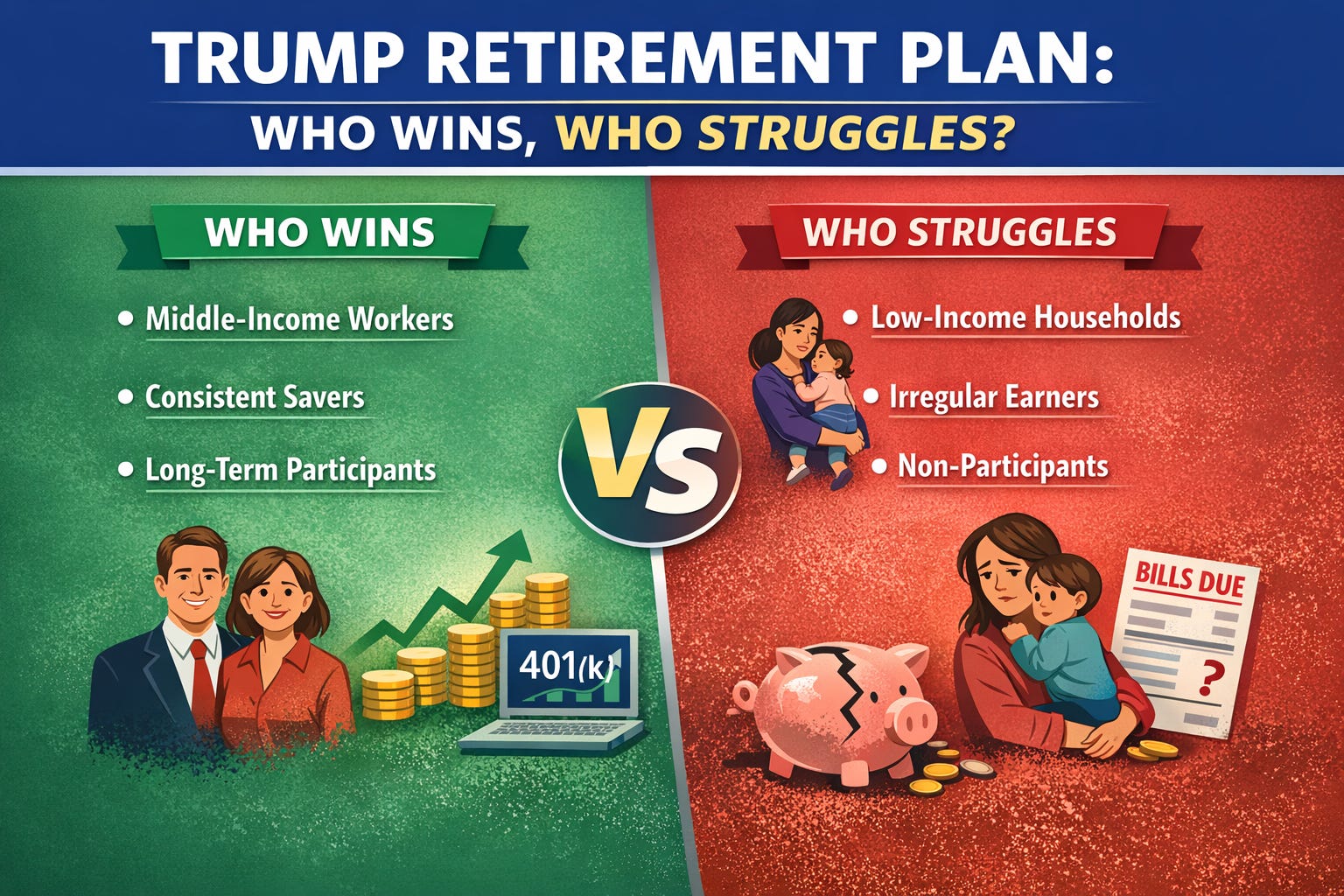
RAND’s findings suggest the biggest gains go to workers who can consistently contribute.
These are typically:
Moderate-income households
Workers with stable earnings
Individuals able to set aside even modest amounts regularly
For them, the government match acts as a powerful multiplier:
Contributions grow
Investment returns compound
Retirement security improves
Who might be left out
The biggest challenge is also the most obvious one: people need money to save money.
For many low-income households:
Budgets are already stretched
Emergencies consume available cash
Long-term saving takes a back seat to immediate needs
If these workers don’t participate:
They don’t receive the government match
Their retirement outlook doesn’t improve
The program’s projected benefits shrink
This creates a paradox:
The people who need the program most may be least able to use it.
The participation problem
Everything hinges on participation rates.
If large numbers of workers:
Enroll
Contribute regularly
Stay invested over time
Then the plan works largely as modeled.
If they don’t:
Costs remain
Savings fall short
The fiscal case weakens
RAND’s projections assume meaningful participation—but real-world behavior is less predictable.
What others say about it
A range of economists, policymakers, and advocates weigh in on whether the proposal is a smart investment—or a risky bet.
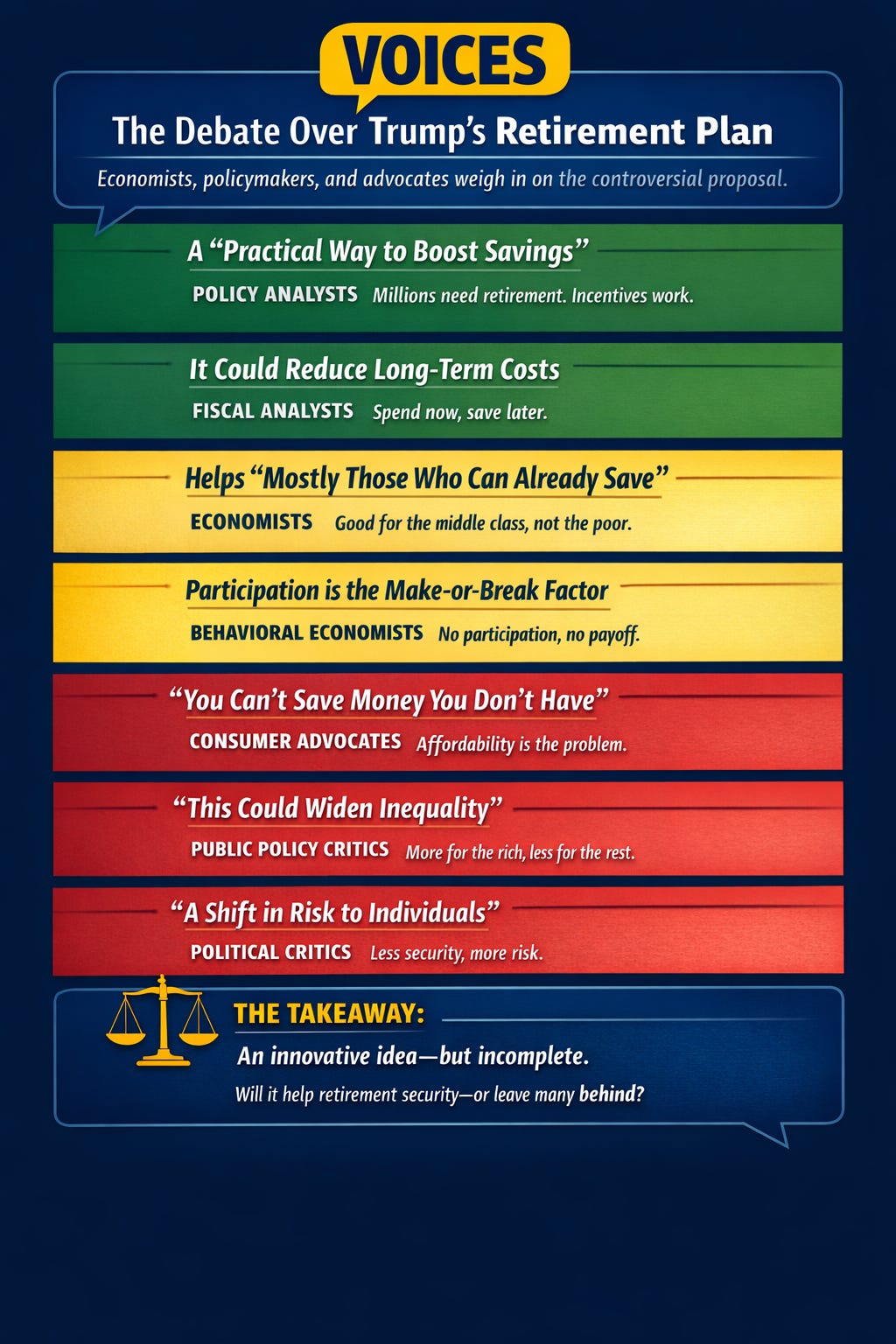
“A practical way to boost savings”
Policy analysts / RAND researchers
Supporters say the plan tackles a real gap: millions of workers lack access to retirement accounts. Matching contributions, they argue, is one of the most effective ways to encourage saving—especially when accounts are portable and easy to use.
Key idea:
Incentives work. Give people a reason to save, and many will.
“It could reduce long-term government costs”
Fiscal policy analysts
Some experts point to RAND’s findings that higher personal savings could reduce reliance on programs like Medicaid and SSI.
Key idea:
Spend now → save later.
“It helps—but mostly those who can already save”
Economists / retirement experts
A common concern is that the biggest gains go to middle-income workers who can afford regular contributions—while lower-income households may struggle to participate.
Key idea:
The match is valuable—but only if you can use it.
“Participation is the make-or-break factor”
Behavioral economists
Experts stress that the plan’s success depends on whether workers actually enroll and contribute consistently—something past programs have struggled to achieve.
Key idea:
No participation, no payoff.
“You can’t save money you don’t have”
Consumer advocates
Critics argue the plan overlooks financial reality for many households already stretched by rent, food, and debt. Without addressing income constraints, they say, participation will lag.
Key idea:
Affordability—not incentives—is the real barrier.
“This could widen inequality”
Public policy critics
Some warn the plan could disproportionately benefit higher earners, who can contribute more and gain more from compounding returns.
Key idea:
Those with more to save get more help.
“A shift in risk—from government to individuals”
Political critics / some Democrats
Others frame the proposal as part of a broader shift away from guaranteed benefits, raising concerns about exposing retirees to market risk and weakening the role of Social Security.
Key idea:
More personal control—but more personal risk.
The takeaway
Across the debate, one theme stands out:
The plan is widely seen as innovative—but incomplete.
It may expand access and encourage saving—but whether it truly strengthens retirement security depends on who participates, and who can’t.
This isn’t as cockamamie an idea as privatizing Social Security, but its inability to help those most in need of a safety net makes it unlikely to pay for itself. I’d like to see a fraction of that amount invested in K-12 financial literacy education.