


There was literally dancing in the streets — some streets anyway — following the Democratic sweep of the recent midterms and many of the celebrants are hoping the Dems will finally do something about healthcare costs. You know, something along the lines of Medicare for All.
But the second the subject is raised, sober-minded folk counter that it would cost trillions to cover healthcare for everyone. The White House, in a paper titled “The Real Cost of Socialism in America” pegged it at $4.7 trillion.
That might be right but many economists and researchers say, in essence, that you should see what we’re paying now.
“We already do spend trillions of dollars on healthcare,” said Cynthia Cox, a senior vice president at KFF, a health information nonprofit that includes KFF Health News. “It’s just that it’s not only spent by the federal government but also by states, individuals, private insurers, and other third-party payers.”
Cox said that higher spending by government would replace most, if not all, of what is now being paid by insurance companies, employers, consumers and others and would also improve public health for everyone, not just those rich enough to afford it.
Many people would end up paying less for a universal health plan’s taxes than consumers now shell out in premiums and other out-of-pocket costs, Cox and other Medicare for All proponents argue.
But whether that sounds right to you is the big question. Previous efforts to implement a single-payer, universal healthcare plan on the state level have failed in California, Massachusetts and Vermont, some of the most liberal states in the country. A similar plan is now in trouble in Oregon.
Those plans not only failed to win approval, they fell flat with voters, most not winning even a quarter of the public’s support. Will it be different this time around?
Tough times bring change
It’s possible. To put it bluntly, today’s middle-class voters live in fear. They see their real wages declining and watch their friends and family lose jobs they thought they would hold for life. And they see them struggle to find affordable health insurance for their families.
Even those with what were once considered “good jobs” today often labor with no pension plan, no employer-paid health insurance and a job market that seems to be disappearing before their eyes.
“I’m working for chump change. It’s not even worth showing up for what they’re paying me but it gets me out of the house,” a middle-aged man stocking soda shelves in a supermarket in Virginia told me not long ago. He said he had an engineering degree and had once held a well-paying industrial job.
Many younger workers deliver sandwiches for DoorDash or drive affluent retirees around for Uber. Their attitudes cannot be recounted in polite conversation.
“Affordability” was, after all, one of the keywords in the recent election and the Dems aren’t likely to find a magic formula that puts everything back the way they remember it, so it’s likely to remain the driving issue in two years.
The Democratic wave also brought some outspoken Medicare for All proponents into office, most most notably Sen.-elect Abdul El-Sayed of Michigan, who campaigned on a universal healthcare platform.
Then there’s Sen. Bernie Sanders, perhaps the best-known advocate for Medicare for All, who is expected to become chairman of the Senate Health, Education, Labor, and Pensions Committee.
Put this all together and it’s likely that single-payer healthcare will be the driver in 2028.
Follow the money
It should be simple to lay out a formula that compares the costs under today’s system with what Medicare for All would cost. It’s not though and that’s because there are few people who actually understand how much today’s fragmented system costs taxpayers, consumers and the healthcare industry, leaving aside the human cost of consumers who forgo healthcare visits and skip prescriptions because they can’t afford them.
“Most people think that what they pay out-of-pocket or out of their paycheck directly is what it costs, and they’re not as familiar with the larger piece,” said John McDonough, a health policy professor at the Harvard T.H. Chan School of Public Health writing in KFF News. “Nobody on Medicare knows what that costs. Nobody on Medicaid knows what it costs. Very few people on the exchanges know. So, with something brand-new, it’s a massive education effort just to get to the starting line.”
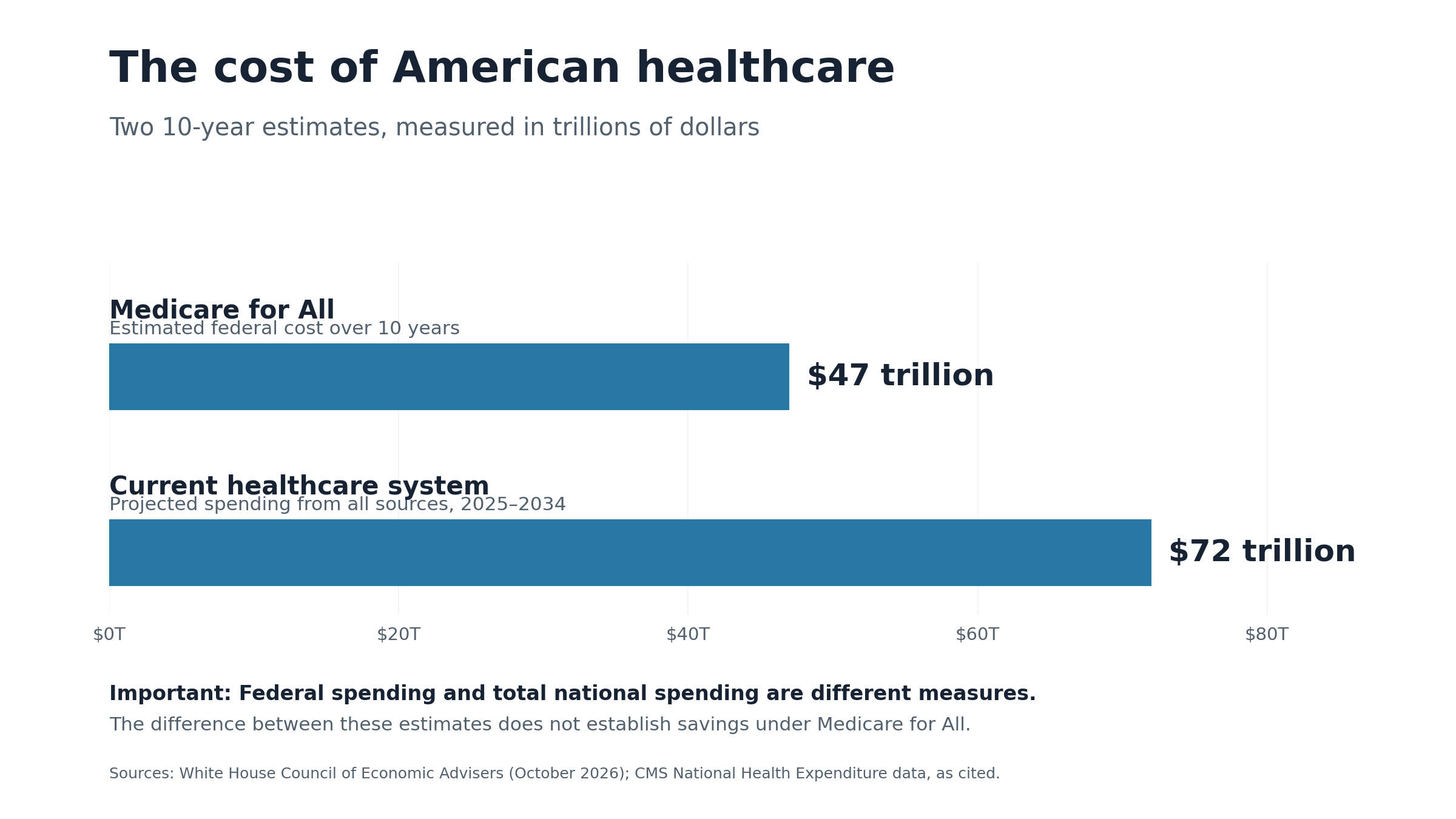
The White House Council of Economic Advisers, for example, estimated in October that a plan to extend Medicare benefits to all Americans would cost the federal government $47 trillion over 10 years. And a recent Wall Street Journal op-ed from Joel Zinberg of the conservative-leaning Paragon Health Institute decried that figure as a massive increase in federal spending.
But the latest government data shows total spending for healthcare from all sources in the U.S. reached about $5.3 trillion in 2024. And that spending is on pace to top $72 trillion combined over the 10-year period from 2025 through 2034. While that estimate includes spending for the military and veterans, the Indian Health Service, and elective services that might not be covered under a universal health plan, the price tag for national healthcare coverage still could look like a bargain.
“People are aware that healthcare is very expensive and that they have trouble getting access to it even if they have decent insurance,” said Stephanie Woolhandler, a public health professor at the City University of New York’s Hunter College. “But if they think $47 trillion is a big number relative to what we’re spending now, they’re mistaken.”
Check with your healthcare provider
It’s easy to talk about all this without considering those who have a lot of skin in the game — healthcare professionals, hospitals and drug companies. They have opinions and the money to back them up.
It’s not hard to say which is which. The healthcare industry is largely opposed to Medicare for All, but there is an important split between the corporations that finance and deliver healthcare and the doctors and nurses who actually provide it.
Historically, insurers, hospitals and drug companies have been the strongest opponents. But among doctors, nurses and other hands-on caregivers, support for some kind of single-payer coverage is growing.
There are more than 335 organizations calling for passage of Medicare for All, including some physicians groups, nurses associations and numerous labor unions and patient advocacy groups.
While the drug companies, insurance companies and hospitals have more money to spend on lobbying and advertising, they might want to consider the experience of SpaceX CEO Elon Musk, who spent millions in the recent Texas elections only to see his candidates go down to crushing defeats.
Public attitudes toward Medicare for All have been changing steadily. A September 2026 KFF poll found that 66% of Americans now favor Medicare for All, the highest level of support KFF has recorded since it began tracking the issue in 2016.
All-out industry opposition to highly popular public programs is often met with harsh voter response, something the healthcare industry might want to review in its strategy sessions.