



For nearly 250 years, the U.S. Postal Service has moved the mail, not always smoothly or quickly but with relatively high reliability and a bargain-basement price. Who else can move an envelope across the country in a few days for 78 cents?
FedEx will do it for about $12 for two- or three-day delivery. Overnight will cost you about $40. UPS charges $20-$25 for two-day, $40-$60 or more for overnight.
The problem, of course, is that the Postal Service can’t make money at those prices, especially when it’s expected to provide universal service to every wide spot in the road and the most congested inner city while trying to deal with rising operating costs and constant political interference.
None of this is new, but a new analysis from the Brookings Institution warns that time is running short as the USPS runs short of money.
A business model under pressure
At the heart of the Postal Service’s financial troubles is a fundamental shift in how Americans communicate. First-class mail, once the agency’s most profitable product, has been in steady decline for decades as consumers and businesses move to digital alternatives.
That decline has eroded a key revenue stream that historically subsidized the Postal Service’s expansive delivery network. Meanwhile, the costs of maintaining that network—vehicles, facilities, labor, and daily delivery to more than 160 million addresses—have remained largely fixed.
Brookings notes that this imbalance is not unique to the United States. Postal systems around the world are grappling with the same challenge: declining mail volumes paired with high fixed costs tied to universal service obligations.
When income goes down and costs stay the same, an organization is in trouble.
In the U.S., the financial strain is particularly acute because the Postal Service operates as a self-funded entity. Unlike most federal agencies, it does not receive regular taxpayer funding and must cover its expenses primarily through the sale of postage and services.
The cost of universal service
One of the central findings of the Brookings report is that many of the Postal Service’s financial challenges stem not from inefficiency, but from its core mission.
The agency is legally required to deliver mail to every address in the country at uniform prices—a mandate known as the “universal service obligation.”
This requirement ensures that rural and remote communities receive the same level of service as densely populated urban areas. But that commitment comes at a cost.
Maintaining post offices and delivery routes in sparsely populated areas generates far less revenue than similar operations in cities. Yet those facilities cannot be easily scaled back or closed without undermining the Postal Service’s mission.
Brookings emphasizes that these losses are not a flaw in the system but a predictable outcome of a public service model designed to prioritize access over profitability.
Losses continue to mount
Recent financial results underscore the depth of the problem. The Postal Service has reported billions in annual losses in recent years, even as revenues have held relatively steady.
Much of that pressure comes from declining mail volumes and rising operational costs, including transportation, labor, and infrastructure upgrades. Even efforts to expand into package delivery—driven by e-commerce growth—have not fully offset the loss of traditional mail revenue.
The Brookings analysis suggests that cost-cutting alone is unlikely to solve the problem. While operational efficiencies can help, they cannot fully address the structural mismatch between revenues and the cost of universal service.
Vital to the U.S. economy
Despite its financial struggles, the report argues that the Postal Service remains an essential part of the nation’s economic infrastructure—particularly in rural communities.
In many parts of the country, the Postal Service provides services that private carriers either do not offer or provide only at higher cost. For small businesses, especially in rural areas, local post offices serve as critical hubs for shipping, receiving supplies, and maintaining a reliable mailing address.
Brookings research finds that proximity to postal services is associated with higher levels of small-business activity in rural areas, suggesting that the network plays a direct role in supporting local economies.
This economic function complicates the debate over reform. Reducing the Postal Service’s footprint might improve its balance sheet, but it could also weaken economic activity in communities that depend on it.
Choices and tradeoffs
The Brookings report highlights a central tension facing policymakers: how to balance financial sustainability with the Postal Service’s public mission.
Several potential approaches have been debated in recent years:
Service reductions, such as cutting delivery days or closing post offices, which could reduce costs but risk limiting access.
Price increases, which could boost revenue but may disproportionately affect small businesses and low-income households.
Expanded services, including new revenue streams like financial services or enhanced package delivery.
Government support, such as direct subsidies or debt relief, to offset the costs of universal service.
Each option carries tradeoffs, and none offers a simple solution.
The report suggests that policymakers must recognize the Postal Service not just as a business, but as a form of public infrastructure—similar to highways or utilities—that provides broad economic benefits beyond its balance sheet.
What’s the future?
As the Postal Service moves forward, the Brookings report calls for a more comprehensive understanding of its role in the economy.
Rather than viewing the agency solely through the lens of financial performance, the report suggests that policymakers should consider its broader contributions—supporting small businesses, enabling commerce, and ensuring nationwide connectivity.
“The same features of the postal network that generate fiscal pressure… also appear to support economic activity,” the analysis concludes.
That dual reality—financial strain paired with public value—lies at the heart of the Postal Service’s dilemma.
A defining moment
The Postal Service’s fiscal crisis is not new, but it is becoming increasingly urgent.
Without significant reforms, the gap between revenues and costs is likely to persist, raising questions about the long-term sustainability of the current model, the Brookings analysis found.
At the same time, the agency’s role as a universal service provider—and a key piece of national infrastructure—remains as important as ever.
The Brookings report makes clear that there are no easy answers. Any path forward will require difficult choices about what Americans expect from their postal system—and how much they are willing to pay for it.
For now, the Postal Service remains a vital but financially fragile institution, navigating the tension between its past as a mail-driven enterprise and its future in a rapidly changing economy.
Closer Look: Why the U.S. Postal Service Keeps Losing Money
The U.S. Postal Service’s financial problems aren’t the result of a single issue—they stem from a combination of structural, economic, and policy-driven pressures that have built up over decades.
1. First-Class Mail Is Declining
First-class mail—letters, bills, and statements—has long been the Postal Service’s most profitable product.
But digital communication has sharply reduced mail volume:
Online bill pay replaces mailed checks
Email replaces letters
Digital records replace paper statements
Because first-class mail once subsidized the entire system, its decline has left a major revenue gap.
2. High Fixed Costs
The Postal Service must deliver to more than 160 million addresses, six days a week.
That creates enormous fixed costs:
Delivery routes (even in remote areas)
Post office operations
Vehicle fleets and fuel
A large workforce
Even when mail volume drops, these costs don’t fall proportionally.
3. Universal Service Mandate
By law, USPS must:
Deliver to every address
Charge uniform prices nationwide
That means:
Rural delivery is often unprofitable
Urban areas subsidize less dense regions
This mission prioritizes access over profitability—and inherently creates financial strain.
4. Packages Help—But Not Enough
E-commerce has boosted package delivery, a growing revenue source.
However:
Package delivery is more competitive (UPS, FedEx, Amazon)
Margins are thinner than traditional mail
Growth hasn’t fully offset mail losses
5. Limited Flexibility
Unlike private companies, USPS:
Cannot easily close post offices
Faces regulatory limits on pricing
Must meet service standards set by law
This makes rapid cost-cutting or restructuring difficult.
6. Self-Funded Structure
USPS is expected to operate like a business:
It relies primarily on postage and service revenue
It does not receive regular taxpayer funding
But it also functions like public infrastructure—creating a built-in tension.
What Could Fix the U.S. Postal Service?
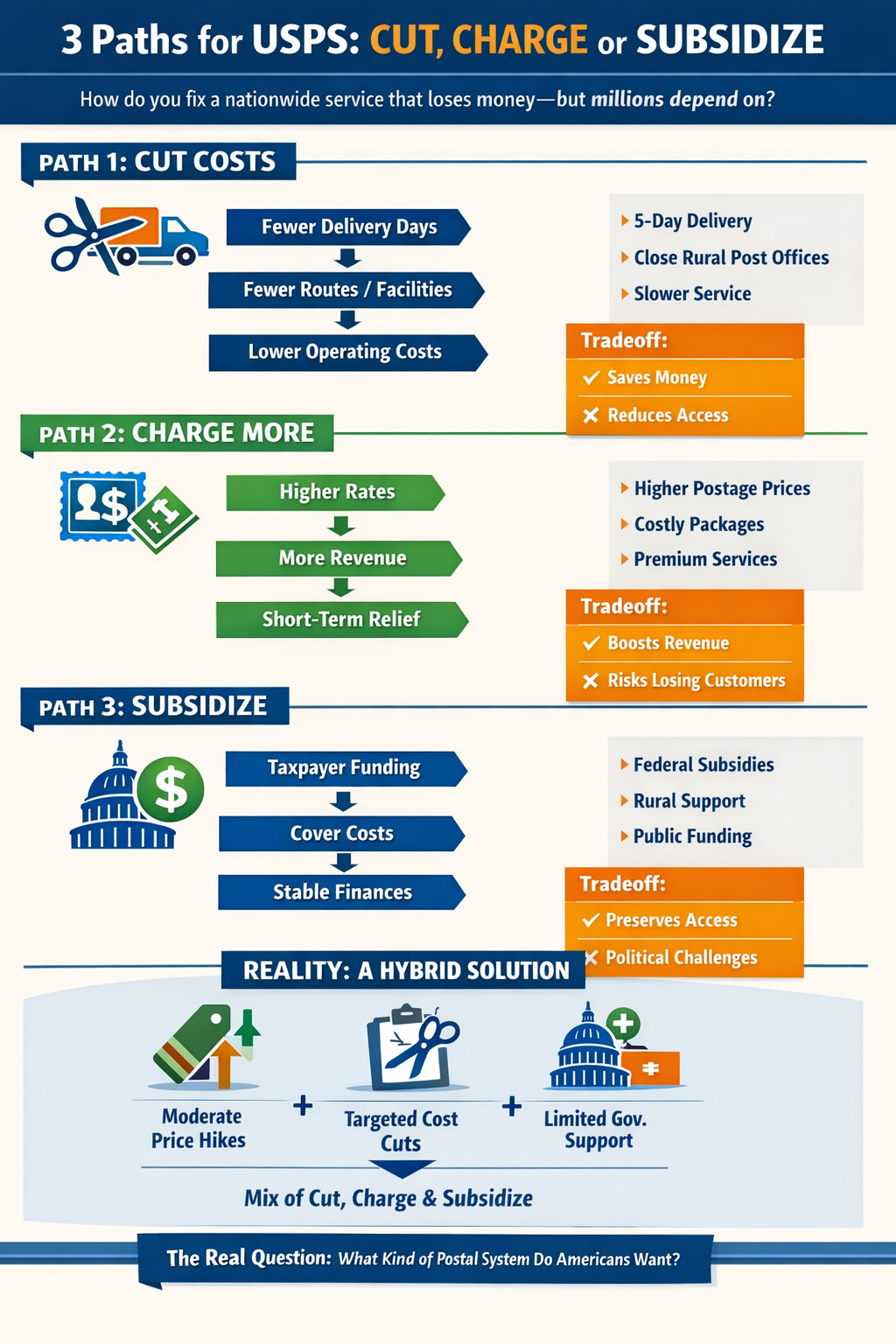
There’s no single solution to the Postal Service’s financial problems. Experts—including analysts at the Brookings Institution—say meaningful reform will likely require a mix of policy changes, pricing adjustments, and a clearer definition of USPS as either a business, a public service—or both.
Here are the leading ideas under debate:
1. Direct Government Support
One of the most straightforward fixes: treat USPS like public infrastructure.
Options include:
Annual taxpayer subsidies
Covering the cost of rural delivery
Federal assumption of certain legacy costs
Pros: Stabilizes finances quickly
Cons: Politically controversial; raises questions about independence
2. Reduce Service Levels
Cutting costs by scaling back operations is frequently proposed.
Examples:
Moving from 6-day to 5-day delivery
Slower delivery standards
Closing or consolidating post offices
Pros: Immediate cost savings
Cons: Reduced access, especially in rural communities
3. Raise Prices
Increasing postage rates could boost revenue.
But there are limits:
Higher prices may drive further declines in mail volume
Small businesses and consumers bear the cost
Pros: Generates revenue without cutting service
Cons: Risks accelerating long-term decline
4. Expand Revenue Streams
Some proposals focus on growing USPS beyond traditional mail.
Ideas include:
Postal banking (basic financial services)
Expanded logistics and package services
Government service hubs (licenses, forms, etc.)
Pros: Diversifies income
Cons: Requires investment and regulatory approval
5. Increase Operational Flexibility
Reforms could give USPS more freedom to act like a business.
Potential changes:
Greater pricing autonomy
Easier facility closures or consolidations
Streamlined labor and procurement rules
Pros: Improves efficiency
Cons: May conflict with public service obligations
6. Redefine the Mission
At the core of the debate is a bigger question:
What is the Postal Service supposed to be?
Policymakers could:
Fully embrace it as a public utility (with subsidies)
Push it toward a profit-driven model
Or adopt a hybrid approach with clearer tradeoffs
The Reality: No Easy Fix
Most experts agree that no single reform will solve the problem.
Instead, the likely path forward involves:
Some level of government support
Modest service or pricing changes
Long-term adaptation to a digital economy
Bottom Line
Fixing USPS isn’t just about balancing the books—it’s about deciding how much Americans value:
Universal delivery
Affordable access
A nationwide communications network
And ultimately, who should pay for it.