


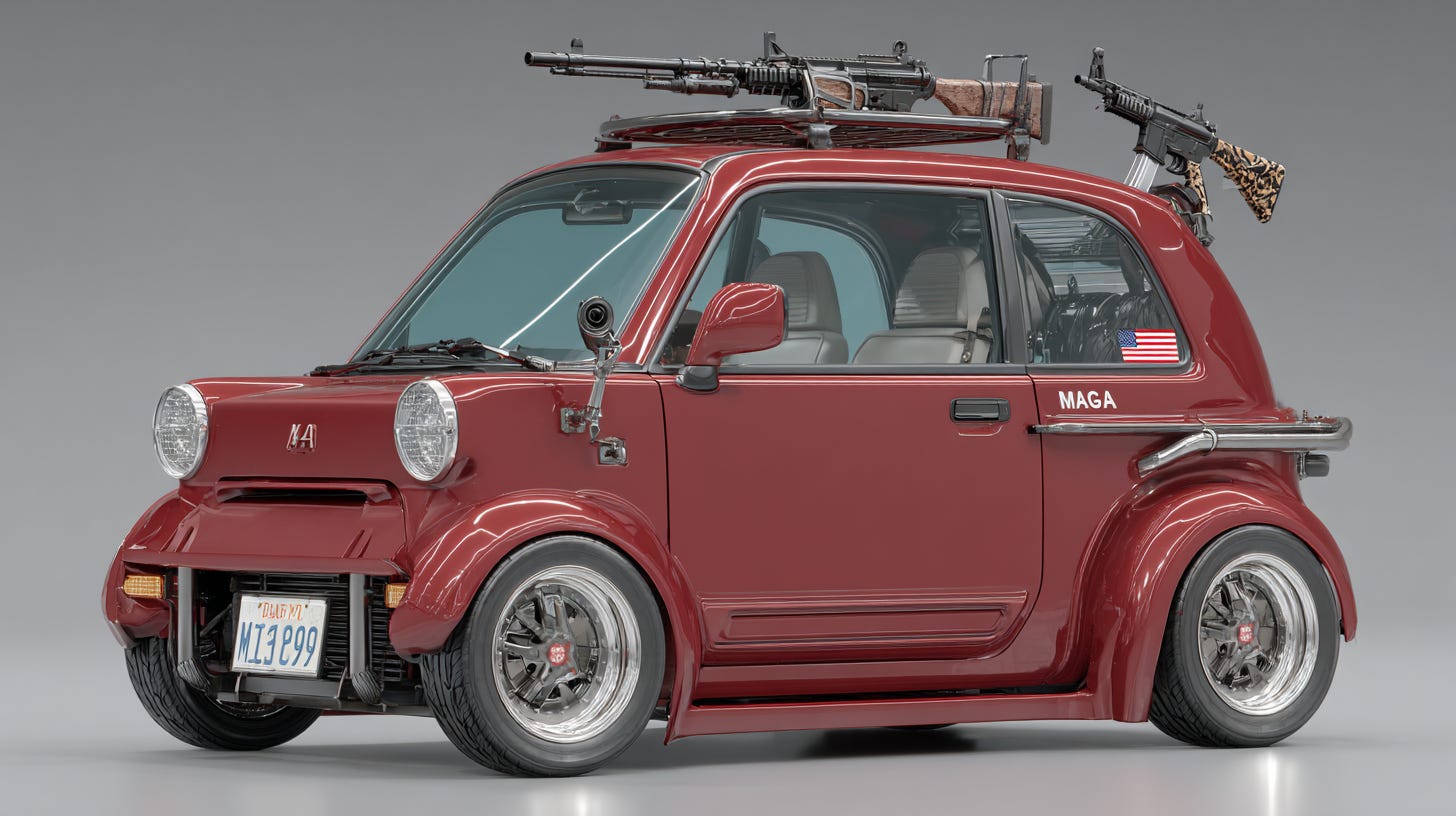
• Trump promotes ‘kei-style’ microcars as fuel rules loosen
• EV incentives end and federal targets roll back
• Analysts warn U.S. could fall far behind global electrification curve
Following the ins and outs of the Trump White House can get confusing but at least it’s never dull. Trump is now pitching tiny Japanese cars, seemingly contradicting his rollback of EV incentives and mileage rules.
“I have just approved TINY CARS to be built in America. Manufacturers have long wanted to do this, just like they are so successfully built in other countries,” Trump posted on Truth Social a few days ago. “They can be propelled by gasoline, electric, or hybrid.
“These cars of the very near future are inexpensive, safe, fuel efficient and, quite simply, AMAZING!!! START BUILDING THEM NOW!” Trump gushed.
Trump, you may recall, is newly returned from a visit to Japan, where he saw the tiny cars. They’re called “kei-style” and are are common in Japan and elsewhere in Asia and are sold at a lower cost and are tailored to narrower roadways.
President Trump’s enthusiasm for kei cars comes as his administration is dismantling many of the policies that pushed the auto industry toward electric vehicles and higher fuel efficiency, reverting to the gas-fueled gargantua that were at last beginning to fade.
So what is the Trumpian policy — smaller, cheaper cars or a weakening of the regulations and incentives that would encourage such cars in America?
Kei-car idea surfaces amid regulatory retreat
For at least as long as Trump’s fascination with tiny cars continues, he has directed the Department of Transportation to explore requiring similar small cars in the United States. That would require extensive changes to federal safety standards that currently prevent most kei-like designs from being sold here.
In Japan, kei cars thrive because of tax preferences, low insurance costs and consumer familiarity with urban congestion. But things are different in the U.S. — greater distances for one thing, and millions of huge trucks and SUVs competing for space for another. (And no, it’s not true that Americans are larger than the Japanese. The average American male is 5’9” and the average Japanese male is 5’7”).
There’s also the little matter of regulation. Federal Motor Vehicle Safety Standards require crashworthiness levels that kei cars typically can’t meet without extensive redesign. Of course, Trump might be able to abolish those rules.
But public opinion — consumer preference, in other words — may not be totally in tune with President Trump, at least on this issue. After all, for decades, Americans have gravitated toward larger vehicles — SUVs, pickups and crossovers — which now account for more than three-quarters of new-vehicle sales. Several automakers that experimented with microcars, including Smart and Fiat, saw sales collapse after brief spurts of novelty.
If you think Trump will bring tiny kei cars to the US, you might be as dumb as he is - Elektrek
Still, Trump framed the idea as a way to bring down vehicle prices, arguing that “really small, really cute” cars could help consumers squeezed by high monthly payments (now approaching $1,000 per month in many cases) and steep insurance costs. Industry analysts generally describe the notion as aspirational at best, noting that retooling U.S. factories or creating new regulatory categories for microcars would take years.
EV incentives expire and fuel targets fall
The microcar uproar emerged at the same moment the administration completed its rollback of federal electric-vehicle tax credits and fuel-economy rules. Under legislation signed in July, the long-standing $7,500 credit for new EVs expired on September 30, along with the smaller credit for used EVs. Analysts say the loss of those subsidies is already affecting automaker plans and consumer demand, especially in price-sensitive segments.
At the regulatory level, the administration last week proposed slashing the Corporate Average Fuel Economy (CAFE) targets for 2031 from roughly 50 miles per gallon to about 34.5 mpg. The plan would also eliminate mechanisms that allowed EVs and hybrids to generate compliance credits for manufacturers. Together, the changes signal a major shift away from policies designed to cut emissions and push the industry toward electrification.
Administration officials argue that the earlier standards forced automakers to produce cars that were too expensive for many buyers. They project that the rollback will save consumers an average of about $1,000 per new vehicle, which might not sound all that grand to someone paying $50,000 for a new car that doesn’t provide increased fuel economy. Environmental groups counter that the weakened rules will increase gasoline consumption and slow efforts to reduce climate-warming emissions from the transportation sector, the nation’s largest source of greenhouse gases.
Analysts expect slower EV adoption curve
Independent forecasts already show the impact of weaker policy support. Research groups that once projected EVs reaching close to half of U.S. new-vehicle sales by 2030 are revising those numbers downward. Some international energy bodies now estimate U.S. EV share could hover near 20 percent by the end of the decade if no new incentives or mandates are introduced — far below earlier expectations.
At the same time, early sales data for late 2025 show softness in EV demand, with several major automakers reporting year-over-year declines even as hybrids gain traction. Industry economists say the next two to three years will be critical in determining whether cost reductions and expanded charging infrastructure can offset the loss of federal support.
For now, Trump’s tiny-car enthusiasm appears more symbolic than structural. But combined with the broader policy retreat from electrification, it raises a deeper question for automakers and consumers alike: What exactly does the future of the American automobile look like when the government is no longer steering strongly toward an electric one?
None of this apparently bothers Trump, who seemingly can’t stop talking about tiny cars.
“They have a very small car. It’s sort of like the Beetle used to be with the Volkswagen,” Trump said Wednesday. “They’re very small, they’re really cute. And I said, ‘How would that do in this country?’ And everyone seems to think good, but you’re not allowed to build them.”
If you drive past a Trump rally, you’ll see a lot of pickup trucks and SUVs, many with big off-road tires and more than a few with a gun rack in the back window.
Where would you put that gun rack in a kei-style car?