

A new KFF Health Tracking Poll finds that public worry about prescription drug affordability has reached its highest level since the organization began tracking the question in 2018 — a finding that offers a complicated backdrop for the Trump administration’s flagship drug pricing initiative, TrumpRx.gov, which most Americans expect will not lower their costs.
Fifty-nine percent of Americans say they are at least somewhat worried about being able to afford prescription drugs for themselves and their families, with about one in five saying they are “very worried.”
Both figures are the largest KFF has recorded. At the same time, 59% of the public say it is “not too likely” or “not at all likely” that the Trump administration’s policies will lower drug costs for people like them.
A politically divided verdict
Awareness of TrumpRx, which launched February 5 and allows consumers to search for discounts on brand-name drugs, remains limited. Among Americans who take prescription drugs, just 35% say they have heard at least “some” about it, and only 7% say they have visited the site to compare prices.
Usage is somewhat higher among people who take or have taken GLP-1 medications — drugs like Ozempic and Wegovy that are among TrumpRx’s featured offerings — with 16% of that group reporting they have used the site.
Skepticism about the program’s impact runs along predictable partisan lines, though the breadth of doubt among non-Republicans stands out. Large majorities of Republicans (79%) and self-identified MAGA supporters (88%) expect the administration’s policies to lower their drug costs. But only 35% of independents and 11% of Democrats share that optimism.
The poll was conducted February 24 through March 2, capturing sentiment roughly three weeks after the site’s launch.
Bipartisan demand for regulation
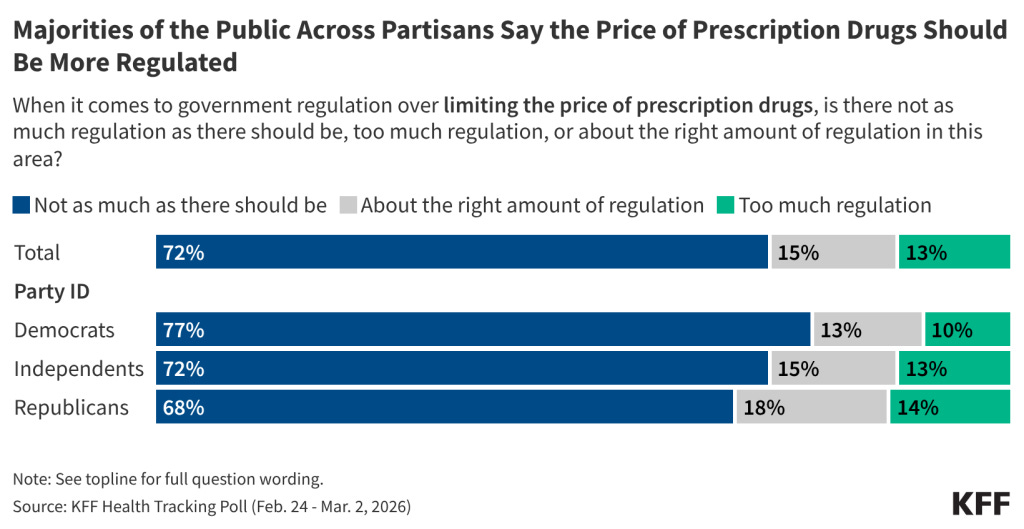
Where the poll finds unusual cross-party consensus is on the question of government intervention. Seven in 10 Americans — 72% — say there is not as much government regulation as there should be to limit drug prices, five times the share who say there is too much. At least two-thirds of Republicans (68%), independents (72%), and Democrats (77%) favor more government action on prices — a rare alignment in a polarized environment.
Those findings suggest that while the public broadly wants Washington to act, majorities outside the Republican base remain unconvinced that the current administration’s approach is working.
Consumers already shopping around
The poll also reveals that many Americans have already been navigating the fragmented drug discount landscape on their own. Among prescription drug users, 42% say they have used a discount card or coupon in the past year, and 39% say they have compared prices online to find the lowest price. Fewer — 15% — have purchased a drug from an online pharmacy without using insurance, and only 8% have bought directly from a manufacturer’s website.
That behavior predates TrumpRx; prior to its launch, discounts were available through third-party platforms like GoodRx, Amazon Pharmacy and directly through drug manufacturers. Health policy experts have noted the site largely aggregates tools that already existed. Independent analysts have also flagged that a number of the brand-name drugs listed on TrumpRx have cheaper generic equivalents available elsewhere, and that for most insured Americans, co-pays through their existing coverage are likely to be lower than TrumpRx’s cash prices.
A political liability heading into midterms
The poll carries an implicit warning for Republicans heading into November’s midterm elections.
Voters say they trust the Democratic Party over the Republican Party to better address prescription drug costs by a ten-point margin — 38% to 28%.
A quarter say they trust neither party on the issue. Among the critical independent voter bloc, Democrats hold a 31%-to-18% advantage on drug costs, though 41% of independents say they trust neither party to handle it.
Democrats hold a similar edge on health costs broadly, underscoring the durability of an issue that has repeatedly cut against Republicans at the ballot box.
The KFF Health Tracking Poll was conducted February 24–March 2, 2026, among a nationally representative sample of 1,343 U.S. adults online and by telephone, in English and Spanish. The margin of sampling error is plus or minus three percentage points for the full sample.