

The “free market” is constantly invoked by businesses and regulators as a priceless American birthright, almost as often as we’re told that a “level playing field” is important for one reason or another.
Of course, those uttering these hallowed phrases nearly always want the exact opposite. Take car dealers. They want you to buy the cars they want to sell you, without interference from governments, manufacturers and those pesky consumer and safety advocates.
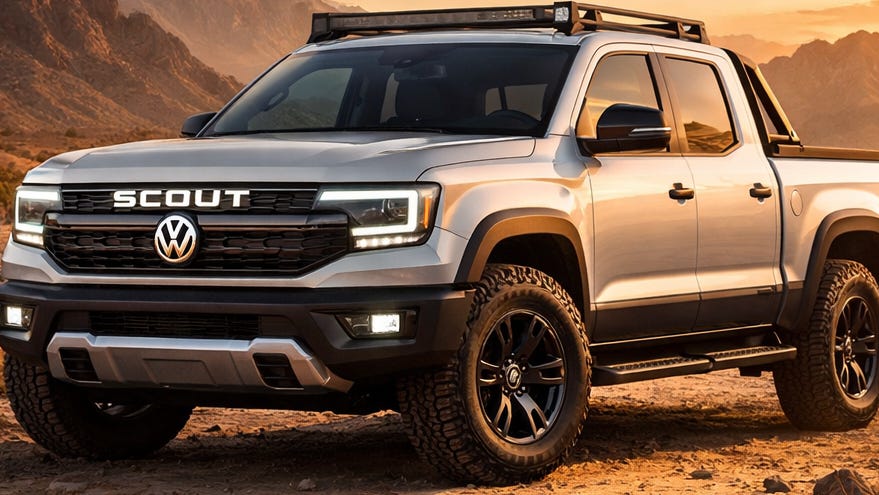
The latest example: a lawsuit filed this week by Volkswagen dealers seeking to block direct sales of VW’s new Scout electric truck. Two Volkswagen dealerships filed a proposed class-action lawsuit in federal court March 3 accusing Volkswagen of trying to sidestep its franchise dealer network by launching its new Scout Motors brand as a direct-to-consumer operation.
The dealers argue that Volkswagen is illegally bypassing its franchise agreements by planning to sell Scout vehicles online and through company-owned retail locations rather than through traditional dealerships.
But consumer advocates say the case underscores a deeper issue: state franchise laws and dealer lobbying power give auto dealers enormous influence over how cars are sold in the United States — and sometimes what cars are available at all.
A new electric truck — and a new sales model
Volkswagen revived the historic Scout nameplate to build rugged electric SUVs and pickup trucks designed to compete with the likes of Rivian’s R1T and Ford’s F-150 Lightning.
The first models — the Scout Terra pickup and Scout Traveler SUV — are expected to reach customers around 2027.
Unlike Volkswagen’s existing vehicles, the Scout lineup is designed to be sold directly to consumers, with buyers placing orders online and taking delivery through company-owned retail centers.
The model is similar to the approach used by EV makers like Tesla, Rivian and Lucid, which sell vehicles without franchised dealers.
Volkswagen says the structure allows the company to create a modern buying experience with transparent pricing and simplified ordering.
Dealers say it cuts them out entirely.
Dealers say Volkswagen is “cutting them out”
The lawsuit claims Volkswagen created separate corporate entities — including Scout Motors Sales LLC — specifically to evade franchise agreements requiring Volkswagen vehicles to be sold through franchised dealers.
The dealers argue the arrangement violates contracts and undermines investments they have made in Volkswagen dealerships across the country.
They are asking the court to:
block direct-to-consumer Scout sales
award damages
allow the case to proceed as a nationwide class action involving Volkswagen dealers.
If the case succeeds, it could force Volkswagen to sell Scout vehicles through its existing dealership network.
The power of franchise laws
At the center of the dispute are state franchise laws, which in many states prohibit automakers from selling vehicles directly to consumers if they have franchised dealers.
These laws were originally enacted decades ago to prevent manufacturers from competing with their own dealers or unfairly terminating franchises. But critics say they now serve primarily to protect dealership profits and restrict competition.
In practice, franchise laws give dealer groups significant leverage over automakers and policymakers.
As a result, even companies that want to experiment with new sales models often face legal and political obstacles.
Tesla and EV startups changed the equation
Companies such as Tesla avoided the franchise restrictions because they never created dealer networks in the first place. Instead, they opened company-owned stores and sold vehicles directly online.
But traditional automakers face a different situation because they already have dealer networks protected by franchise agreements.
Volkswagen’s Scout strategy attempts to work around that limitation by launching the vehicles under a separate brand and corporate structure.
The lawsuit suggests dealers intend to fight that effort aggressively.
Dealers also fight new competitors
The dispute highlights a broader pattern in the auto industry: dealer groups often oppose changes that could expand competition in the marketplace.
In recent years, dealer associations have also lobbied heavily to block or restrict Chinese electric vehicles from entering the U.S. market, arguing they pose unfair competition and security risks.
Some of those efforts overlap with calls for tariffs or import restrictions on Chinese automakers such as BYD and other EV manufacturers.
Critics say the combined effect can be to limit consumer choice.
If VW wins the Scout case, it could gradually expand direct-to-consumer car buying — something many consumers say they prefer because it eliminates negotiation, hidden fees and high-pressure sales tactics.
Dealerships, however, remain a powerful political force. Dealer groups are among the most influential lobbying organizations in many state legislatures, where franchise laws are written and enforced.
Industries that are primarily regulated by the states — insurance is the outstanding example — are nearly always more expensive and less consumer-friendly simply because state governments operate with much less transparency than those who face the harsher spotlight directed at Congress and federal agencies.
The rapid die-off of the newspaper industry contributes to this, as coverage of state legislatures is often at the top of the list for cutbacks. It’s expensive to maintain a state capitol bureau and readers are largely apathetic.
Tight-fisted publishers may hesitate to cut local sports coverage or reduce advice columns but are generally happy to trim state government coverage.
Consumers have the power to take back control of their lives but, critics say, are currently too busy doom-scrolling and binge-watching to pay attention.