

A drug never meant for humans — now everywhere
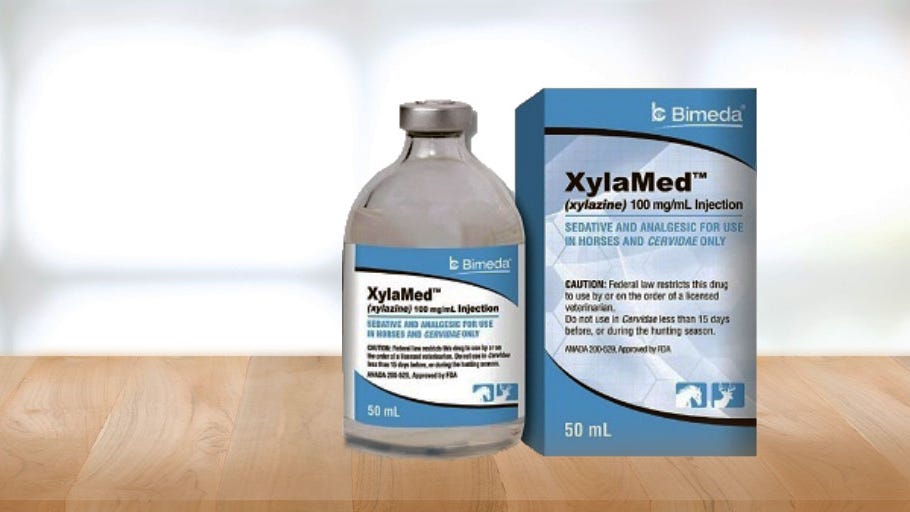
Xylazine, a powerful animal tranquilizer, has rapidly embedded itself in the U.S. illicit drug supply, creating what health officials describe as a new phase of the overdose crisis.
The drug is a non-opioid sedative that slows breathing, heart rate, and brain function — and is not approved for human use.
Yet it is now routinely found mixed with fentanyl, heroin, and even cocaine — often without users’ knowledge — increasing the risk of fatal overdoses and long-term injury.
The White House has already classified fentanyl mixed with xylazine as an “emerging drug threat,” underscoring how quickly the issue has escalated.
Why “tranq” is changing the overdose equation
It doesn’t respond to Narcan
Xylazine is not an opioid, meaning naloxone cannot reverse its effects. While Narcan can still treat the fentanyl portion of an overdose, patients may remain sedated and at risk of respiratory failure.
It causes devastating wounds
Doctors are increasingly reporting deep, necrotic skin ulcers linked directly to xylazine exposure — injuries that can develop even without injection and often require prolonged care.
It reflects a polysubstance era
The rise of xylazine signals a broader shift: today’s drug supply is a mix of multiple substances, making overdoses more unpredictable and harder to treat.
Cheap, potent — and spreading fast
Part of xylazine’s rapid spread comes down to economics, according to the Drug Enforcement Administration (DEA).
It can cost as little as $6–$20 per kilogram on global markets
It extends the effects of fentanyl, making drugs seem stronger
It is not federally controlled, creating a regulatory gap
That combination has made it attractive to traffickers — and difficult for regulators to contain.
States push for federal crackdown
In response to the surge, state attorneys general led by California’s Rob Bonta are urging Congress to take action, warning that xylazine abuse is spreading rapidly across the country.
His office is backing federal legislation — often referred to as the Combating Illicit Xylazine Act — that would:
Classify xylazine as a controlled substance
Improve tracking and enforcement
Close what officials see as a dangerous regulatory loophole
The push reflects growing concern among state officials that policy has not kept pace with the drug supply.
Affordability Watch: the hidden cost of “tranq”
Beyond the human toll, xylazine is quietly driving a new layer of healthcare costs — often borne by hospitals, taxpayers, and already-strained public systems.
1) Long-term wound care
Xylazine-related injuries are not typical injection-site infections. They are:
Slow-healing or non-healing wounds
Prone to infection, sepsis, and repeat hospitalization
Often requiring weeks or months of treatment
These cases can involve:
Repeated ER visits
Surgical debridement
Specialized wound care clinics
In severe cases, patients may require amputation or extended inpatient care, dramatically increasing costs.
2) Longer, more complex hospital stays
Because xylazine overdoses involve multiple substances:
Patients may need ventilation and intensive monitoring
There is no direct antidote, so care is supportive and prolonged
Withdrawal can be medically complex, requiring additional treatment
That translates into longer hospital stays and higher per-case costs compared with opioid-only overdoses.
3) Strain on safety-net providers
Hospitals in heavily affected regions report:
Increased demand for ER services and inpatient beds
Growing need for specialized wound care programs
Rising uncompensated care costs
A case documented in New Jersey described a patient with such severe xylazine wounds that routine dressing changes required sedation — an example of the intensity of care required, according to Hopkins Bloomberg Public Health Magazine.
4) Public cost, private burden
As with much of the overdose crisis, the financial burden falls unevenly:
Public hospitals and Medicaid absorb much of the cost
Local governments fund emergency response and harm reduction
Patients often face long-term disability and lost income
In short, xylazine is not just a public health issue — it is an emerging affordability crisis inside the healthcare system.
What this means
The overdose crisis is evolving faster than policy
Xylazine highlights how quickly new substances can outpace regulation.
Consumers — especially vulnerable ones — face unknown risks
Users increasingly have no way of knowing what’s in the drug supply.
Healthcare costs are quietly rising
The most severe impacts may show up not in headlines, but in ER budgets, Medicaid spending, and local hospital strain.
The bottom line
Xylazine represents a dangerous shift:
It’s cheap, unregulated, and widely available
It makes overdoses harder to reverse and more complex to treat
And it is adding a costly new dimension to an already expensive crisis
As states like California push for federal action, the question is whether policymakers can move fast enough to catch a drug that has already spread nationwide.
Photo via NY State Office of Addiction Services and Support
If you want next steps, I can add:
A data box (overdose trends, state spread)
A map graphic concept showing xylazine penetration
Or a “What the research says” sidebar pulling in recent studies
xxxxCalifornia Attorney General Bonta today, as part of a coalition of 41 attorneys general, sent another letter to Congress in support of the Combating Illicit Xylazine Act. This federal legislation seeks to place new regulations on xylazine, which is a non-opioid veterinary tranquilizer used for large animals like horses and deer, and is not approved for use in humans. In recent years, the tranquilizer has increasingly been found combined with illicit fentanyl by the Drug Enforcement Agency (DEA) with reports that 23% of the illicit fentanyl powder and 7% of the illicit fentanyl pills tested by the agency contain xylazine.
“To turn the tide on the fentanyl crisis, we have to deploy every resource available and demand accountability from those fueling it,” said Attorney General Bonta. “Xylazine’s growing presence in the illicit drug supply is intensifying the danger communities face in California and nationwide. We are once again calling on Congress to step up, close this gap in federal law, and classify xylazine as a controlled substance. States are standing together because the consequences of delay are measured in lives lost each day to fentanyl-related overdoses.”
Xylazine often causes fatal overdose and because it’s not an opioid, it does not respond to Naloxone (NARCAN). Its prevalence stems in part from the fact that it is cheap and legal. The Combating Illicit Xylazine Act seeks to change that by classifying xylazine as a Schedule III drug, restricting its legal use outside of certain approved purposes. The Act also provides critical tools that will enable the DEA to track its manufacturing, prevent diversion, and mandate analysis and reporting on the illicit use of xylazine.
Right now, the lack of restrictions on illicit xylazine makes it easy for criminal syndicates to transport it and for dealers to sell it. As long as it remains legal, it will remain an easy-to-acquire and dangerous drug. This letter acts as part of the multifaceted approach to the fentanyl crisis that utilizes ongoing enforcement, litigation, and effective public policy strategies for prevention. It includes holding the opioid industry accountable by obtaining judgments and using that money to fund treatment and interventions for drug addiction — especially for vulnerable youth — as well as providing outreach and awareness initiatives, increasing the availability of Naloxone (NARCAN), and supporting job creation programs for those recovering from substance use disorder.
In sending this letter, Attorney General Bonta joins the attorneys general of American Samoa, Arkansas, Arizona, Colorado, Connecticut, Delaware, District of Columbia, Georgia, Hawaii, Illinois, Indiana, Kansas, Kentucky, Louisiana, Maine, Michigan, Minnesota, Mississippi, Nevada, New Hampshire, New Jersey, New York, New Mexico, North Carolina, North Dakota, Ohio, Oklahoma, Oregon, Pennsylvania, Rhode Island, South Carolina, South Dakota, Tennessee, U.S. Virgin Islands, Utah, Vermont, Virginia, Washington, West Virginia, and Wyoming.
Here is a copy of the letter.
# # #