Trump rolls back gas-mileage rules, promising cheaper cars but higher fuel use
Cheaper at the dealership, more expensive at the pump? That's the promise.
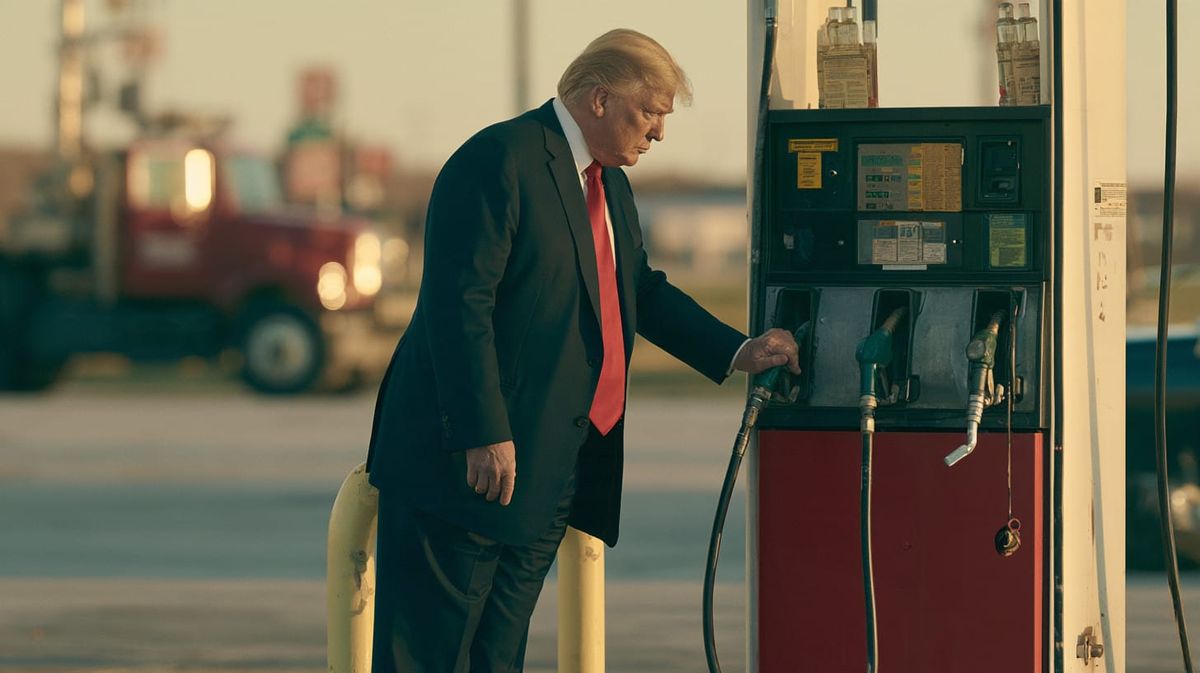
- The Trump administration has sharply reduced federal fuel-economy requirements, cutting the projected 2031 fleet average from 50.4 mpg under the previous rules to 34.9 mpg.
- The administration says the rollback will cut the average price of a new vehicle by about $1,300 and save Americans $138 billion over five years. Automakers welcomed the change.
- Consumer and environmental groups counter that less-efficient vehicles will require drivers to buy more gasoline for years after leaving the dealership. NHTSA's own earlier analysis estimated the proposed rollback would add roughly $1,400 in lifetime fuel costs for the average driver.
The Trump administration is promising Americans cheaper new cars by dramatically weakening federal gas-mileage requirements — but consumers may eventually give some or all of those savings back at the gas pump.
The Transportation Department on Monday finalized new Corporate Average Fuel Economy (CAFE) standards covering passenger cars and light trucks through the 2031 model year.
Under the new rules, automakers' fleets are projected to average about 34.9 miles per gallon in 2031, compared with 50.4 mpg under standards adopted during the Biden administration.
President Donald Trump and Transportation Secretary Sean Duffy have branded the policy “Freedom Means Affordable Cars.”
The administration estimates that requiring automakers to install less fuel-saving technology will reduce the average cost of a new vehicle by approximately $1,300, reduce automakers' technology costs by $60.6 billion through 2031 and save Americans $138 billion over five years.
General Motors alone could see its technology costs fall by an estimated $20.4 billion through 2031, according to Transportation Department calculations.
But there's another side to the affordability equation.
Cars that use more gasoline cost more to operate.
And unlike the purchase price, which consumers pay once, fuel bills continue for as long as they own the vehicle.
From 50.4 mpg to 34.9 mpg
The difference between the two policies is substantial.
The Biden-era standards were projected to produce an industrywide fleet average of approximately 50.4 mpg by model year 2031.
The Trump administration's replacement rules project 34.9 mpg. But Consumer Reports said that 65-68 miles per gallon is a more realistic target if the goal is truly to maximize savings for consumers.
The formulas don't mean every new car would have been required to get 50.4 mpg under the old rules, nor do they mean every vehicle will now get 34.9 mpg.
CAFE standards apply to a manufacturer's overall fleet and are calculated using regulatory formulas that don't correspond directly to the mileage displayed on a new-car window sticker.
Automakers can sell pickups, SUVs and other relatively inefficient vehicles as long as their overall fleets comply with the applicable requirements.
The practical effect of weaker standards is to reduce the pressure on manufacturers to make their fleets more efficient.
The administration says the savings start at the dealership
The administration's case rests heavily on new-car affordability.
Average new-vehicle prices have risen sharply over the past decade, putting new cars beyond the reach of many households.
Duffy argues that previous requirements forced manufacturers to spend heavily on electric vehicles and fuel-saving technologies that consumers didn't necessarily want.
The administration says relaxing those requirements will allow manufacturers to produce more of the gasoline-powered cars and trucks consumers actually choose to buy.
It also argues that cheaper vehicles will improve safety because more households will be able to replace older cars with newer models containing modern crash-protection technology.
NHTSA estimates the affordability effect could prevent more than 300,000 serious injuries and save 1,900 lives by accelerating replacement of older vehicles. Those are government projections rather than observed outcomes.
“Newer cars are safer cars,” NHTSA Administrator Jonathan Morrison said in announcing the rule.
The auto industry largely agrees with the administration's direction.
John Bozzella, president of the Alliance for Automotive Innovation, said the previous standards effectively required an EV transition that was out of step with consumer demand and called the new rule an appropriate correction.
But the purchase price isn't the whole cost of owning a car
Consumer advocates say focusing on the sticker price leaves out one of the largest continuing expenses associated with owning a gasoline vehicle.
Fuel.
The Natural Resources Defense Council says NHTSA's analysis when the rollback was proposed estimated that the average driver would spend approximately $1,400 more on fuel over the vehicle's lifetime under the weaker standards.
That figure is particularly relevant because the administration says the rule will reduce average vehicle prices by approximately $1,300.
Those estimates aren't directly interchangeable — actual savings and fuel costs will vary by vehicle, mileage, gasoline prices and how long someone owns a car.
But they illustrate the basic tradeoff:
The consumer could save money when buying the car and spend more money operating it.
And today's gasoline prices make that calculation particularly important.
The national average gasoline price was around $4.47 a gallon Monday, according to AAA data cited by CBS, up sharply amid disruption to global oil supplies.
Nobody knows what gasoline will cost over the 10 or 15 years a new vehicle may remain on the road.
That's precisely why fuel economy has traditionally been viewed as a form of insurance against future oil-price shocks.
Consumer Reports: Efficiency hasn't caused the price explosion
Consumer Reports has challenged the assumption that tougher fuel-economy standards are a principal reason vehicles have become so expensive.
Its analysis of model years 2003 through 2021 found that average fuel economy improved approximately 30%, producing roughly $7,000 in lifetime fuel savings for the average vehicle, without finding that efficiency improvements drove the overall increase in vehicle prices.
Instead, Consumer Reports has pointed to the industry's shift toward larger and more expensive SUVs and trucks as an important reason average transaction prices increased.
That distinction matters.
If adding fuel-saving technology were primarily responsible for expensive vehicles, weakening efficiency standards could provide substantial relief.
But if prices rose largely because manufacturers shifted toward larger, more profitable vehicles loaded with additional equipment and features, reducing fuel-efficiency requirements might provide consumers with considerably less relief than advertised.
Consumer Reports has also found that hybrids can produce substantial savings.
In comments submitted to NHTSA during an earlier rulemaking, CR examined 10 popular hybrids and estimated that they generated about $5 in lifetime fuel savings for every $1 in additional purchase cost. All 10 provided savings during the first year when financed, according to the organization's analysis.
A 34.9-mpg fleet will burn considerably more gasoline
There is little dispute over one consequence of the new policy.
Americans will consume more gasoline than they would under the previous standards.
Even the Transportation Department's analysis says the new rules will increase fuel consumption and carbon-dioxide emissions relative to the standards they're replacing.
That has consequences beyond an individual driver's fuel bill.
Greater gasoline consumption increases U.S. oil demand, potentially making prices more sensitive to global supply disruptions.
It also increases pollution.
Critics point out that fuel-economy standards originated not primarily as climate policy but as energy-security policy.
Congress created the CAFE program in 1975 following the Arab oil embargo and the gasoline shortages and price shocks of the early 1970s.
Its original purpose was straightforward: make American vehicles travel farther on a gallon so the country wouldn't need as much oil.
No, there wasn't literally an EV mandate
The administration repeatedly describes the previous standards as an “EV mandate.”
That's political shorthand rather than a literal requirement.
The federal government did not require consumers to buy electric cars, nor did the previous CAFE rule require an individual manufacturer to make every vehicle electric.
Instead, increasingly stringent fleetwide efficiency and emissions standards made EVs, hybrids and other fuel-saving technologies increasingly valuable to automakers attempting to meet their overall targets.
The Trump administration argues that this amounted to a backdoor EV mandate because manufacturers couldn't realistically meet the previous standards without substantially increasing electrified-vehicle production.
The auto industry largely shares that interpretation.
Critics counter that manufacturers had multiple technologies available, including conventional hybrids, improved engines, transmissions, aerodynamics and weight reduction.
Another big change: Automakers can't buy credits from competitors
The final rule also eliminates inter-manufacturer trading of fuel-economy credits beginning with model year 2028.
Previously, a manufacturer exceeding its fuel-economy requirements could generate credits and sell them to another manufacturer struggling to comply.
That system became particularly valuable to electric-vehicle manufacturers, whose efficient fleets generated credits purchased by companies selling larger numbers of gasoline-powered trucks and SUVs.
The administration says eliminating trading will stop traditional manufacturers from effectively subsidizing EV companies and encourage each automaker to spread efficiency improvements throughout its own fleet.
The change could have significant consequences for companies whose business models benefited from selling regulatory credits.
The strange SUV loophole is changing too
There's one part of the new rule that may actually encourage smaller vehicles.
For years, federal rules have classified many crossovers as light trucks, which face less demanding fuel-economy standards than passenger cars.
That created a peculiar incentive for automakers to modify vehicles so they qualified as trucks.
The Trump administration says it will revise those classifications beginning in model year 2030.
DOT expects the change to flip today's approximately 70% light-truck/30% passenger-car classification mix to roughly 30% trucks and 70% passenger cars.
The agency argues that could encourage manufacturers to offer more hatchbacks, wagons and smaller vehicles instead of designing crossovers specifically to qualify for more lenient truck standards.
That's potentially significant for affordability because smaller vehicles generally cost less to manufacture and buy.
The legal fight probably isn't over
Environmental groups are already signaling court challenges.
NRDC argues that NHTSA has a statutory obligation to establish fuel-economy standards at the “maximum feasible” level and contends the new requirements fall below that threshold.
The administration takes precisely the opposite position, arguing the previous rules exceeded NHTSA's legal authority by effectively incorporating EV technology into standards despite statutory restrictions on how alternative-fuel vehicles can be considered.
That means courts may eventually decide not merely whether the new policy is sensible, but what Congress actually authorized NHTSA to do.
The uncertainty itself creates problems for automakers.
Vehicle platforms and factories are planned years in advance. Rules that swing sharply every four or eight years make long-term investment decisions considerably harder.
The international question
There's another consequence that may not show up immediately at American dealerships.
The rest of the world isn't necessarily following the United States toward less-efficient vehicles.
China has become an enormous producer of electric vehicles and batteries. European and other markets continue pushing toward electrification and greater efficiency.
Economist Sue Helper of Case Western Reserve University argues that allowing U.S. manufacturers to concentrate on highly profitable gasoline-powered trucks and SUVs may help them in the short run while weakening their competitiveness in markets moving rapidly toward EVs and more efficient vehicles.
That creates an uncomfortable possibility.
A regulation intended to protect American automakers from costly technological change could eventually leave them less prepared for it.
What this means for consumers
For car buyers, the new rule creates a tradeoff that can't be captured by the sticker price alone.
The administration says weaker requirements will reduce the average new-car price by about $1,300.
Its critics point to government estimates suggesting the average driver could spend roughly $1,400 more on gasoline over the vehicle's lifetime.
Neither number tells an individual buyer exactly what will happen.
Someone who drives 5,000 miles a year will care less about fuel economy than someone commuting 20,000 miles.
A pickup buyer towing a trailer has different needs from someone commuting alone.
And gasoline at $2.50 produces a very different ownership calculation from gasoline at $4.50.
The important number, therefore, isn't simply:
What does the car cost?
It's:
What will the car cost me to own?
That includes the purchase price, financing, insurance, maintenance — and every gallon of gasoline the vehicle consumes during the years it sits in the driveway.
The Trump administration is betting that reducing the first number will matter more to consumers.
Critics are betting that the second will.
Affordability Watch: Sticker price vs. lifetime cost
When comparing two vehicles, consumers can make the calculation themselves.
Look at:
- Purchase price
- APR and loan term
- EPA-rated fuel economy
- Annual miles driven
- Local gasoline price
- Insurance
- Maintenance
- Expected ownership period
A vehicle that's $1,500 cheaper but consumes an extra $500 of gasoline every year isn't necessarily the bargain it appears to be.
Conversely, paying thousands more for efficiency may not make financial sense for someone who drives very little.
The useful measure is total cost of ownership, not the number printed on the windshield.